

Land-based climate solutions are essential to achieving global warming targets, but they pose challenges for food production and ecosystems.
Researchers suggest integrating bioenergy with forest protection and agricultural emission reductions to minimise land pressure.
Without such measures, the economic cost of climate action and competition for land could escalate, especially in developing nations.
The world may find it significantly more expensive to limit global warming if it relies almost entirely on cutting emissions from the energy sector while neglecting the role of agriculture, forests and other land-based measures. In fact, without contributions from the land sector, limiting global warming to 1.5 degrees Celsius (°C) would become unattainable within this century, according to a new study published on November 11, 2026 in the jounal Nature Sustainability.
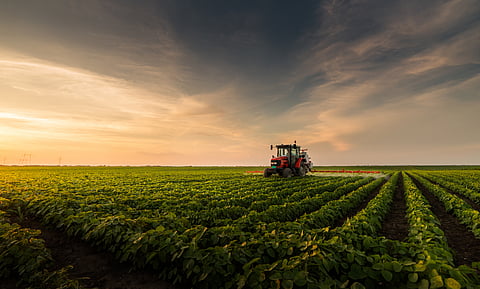
But the push to use land to fight climate change could itself create new land-use challenges. One increasingly used approach is bioenergy, particularly crops grown specifically for energy production, which require land. Expanding this approach, however, risks increasing pressure on land needed for food production and natural ecosystems.
The study, conducted by researchers at the Potsdam Institute for Climate Impact Research (PIK), examines how land-based measures can contribute to climate mitigation without placing excessive pressure on land.
For a pathway that limits peak warming to 1.7°C above pre-industrial levels – the lower end of the 1.7–1.8°C peak warming range in the United Nations Environment Programme's (UNEP) lowest-possible 1.5°C overshoot scenario – the researchers estimate that the area required for biomass cultivation could be limited to 66 million hectares by 2050 if countries combine bioenergy use with ecosystem protection and restoration, alongside cuts in agricultural emissions.
By comparison, if countries rely on bioenergy alone for land-based climate mitigation, the land requirement would rise to 267 million hectares, or four times as much.
To put this into perspective, 66 million hectares is roughly the size of France, while 267 million hectares is close to the total area of Argentina.
The researchers examined three broad sets of interventions in the land sector: limiting emissions from land-use change by protecting forests and other natural ecosystems; reducing agricultural emissions of methane and nitrous oxide, which are released from sources such as livestock, rice cultivation and fertiliser use; and expanding the use of biomass for energy.
In other words, countries would not have to depend as heavily on energy crops if they also reduced agricultural emissions and protected natural carbon sinks.
The study found that excluding agriculture, forestry and other land use from climate mitigation would significantly increase the economic cost of achieving the same climate target. For a pathway that limits peak warming to below 1.7°C, the modelled loss in consumption rises from 1.3 per cent to 3.5 per cent when land-based mitigation measures are excluded.
These losses are measured against a baseline in which current climate policies continue.
"Using a model that integrates the economy, the energy system, land use and climate, the research team calculated various future scenarios by varying the mitigation measures in the land sector. One key finding is that without a significant contribution from land-based greenhouse gas reductions, the target of limiting global heating to 1.5°C by 2100 – following a temporary overshoot – can no longer be achieved," according to a statement by PIK.
But even the lower land requirement raises questions about competing demands for agricultural land. Diverting land to grow energy crops could mean that food production would have to become more intensive on the remaining farmland to maintain supplies.
The study's projections partly depend on future improvements in crop yields. If these improvements do not materialise, competition for land could intensify and push up food prices. The authors also caution that their model does not capture all the ways in which higher energy costs could feed into food prices, including through transport, processing and marketing.
The challenge also has a geographical dimension.
The implications of land-based climate mitigation will also depend on where these measures are implemented.
The research points out that if countries face similar or uniform prices for greenhouse gas emissions, a relatively large share of land-based mitigation could take place in developing countries, potentially having a significant impact on food prices in these countries.
This raises concerns about equity, particularly because a larger proportion of the population in poorer countries depends on agriculture for their livelihoods and is likely to be more vulnerable to rising food costs.
Alexander Popp, head of the Land Use Transition Lab at PIK and a co-author of the study, points out that this geographical distribution would be problematic.
"...the potential for land-based climate protection lies largely in the Global South, where food shortages, water scarcity and biodiversity loss are already particularly pressing issues," he says.
The risks, however, extend beyond food production. Large-scale cultivation of energy crops and afforestation require substantial land and other inputs, and could affect biodiversity and natural ecosystems. The study notes that irrigated bioenergy plantations could also intensify water stress in regions already facing water scarcity.
The researchers also warn that without comprehensive land protection policies, the expansion of bioenergy could lead to land-use change emissions large enough to undermine its climate benefits.