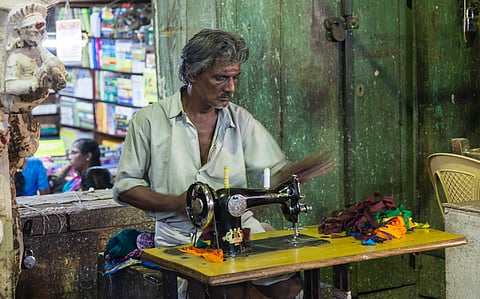


Nearly nine of 10 garment workers surveyed in India feel that extreme heat inside factories was making them sick, according to a new report that links rising temperatures to a growing workplace health and labour rights emergency.
As many as 87 per cent of workers reported suffering from headaches, dizziness and muscle cramps during the summer months, while 78.3 per cent said the heat on their workstations is so intense that their workstations felt like “working in a furnace.”
The findings were part of a new report, Breaking Point: Heat and the Garment Floor by HeatWatch and the Tata Institute of Social Sciences (TISS), which looked at how extreme heat is endangering the lives, health, and livelihoods of India’s garment workers, most of whom are women.
Drawing on surveys of 115 garment workers, 47 in-depth interviews and case studies across 15 garment and textile units in Tamil Nadu, Delhi-NCR, and Gujarat, the report described employees operating near machines that reach temperatures of up to an appalling 99 degrees Celsius.
It documented widespread heat-related illnesses among workers. Overall, 68.7 per cent said the heat had affected their ability to work and 78 per cent skipped breaks to meet production targets, showing nearly double stress levels compared to others.
To quantify the scale of the crisis, the researchers developed a composite Heat Stress Index (HSI) by converting survey and interview responses into standardised risk scores across six domains: physiological strain, workload, clothing, sanitation, environment and hydration.
The findings place the average HSI at 58.9, pushing the majority of workers into the ‘high stress’ category. A quarter of the workforce scored above 70, indicating a critical state. Under established benchmarks such as the Belding-Hatch Index, scores between 40 and 60 are classified as ‘severe heat strain’ — a direct threat to health — meaning many workers are already experiencing heat exposure beyond the body’s natural cooling capacity.
When assessed against ISO 7243 standards for Wet Bulb Globe Temperature (WBGT), factory conditions frequently exceeded the 28°C threshold for moderate work and the 25°C limit for heavy work, signalling that current metabolic demands are physically unsustainable.
At least 36.5 per cent workers reported, that although water is available on the factory floor, it can run out or is not clean. Furthermore, due to lack of access to toilets, workers often said they try to consume less water even during the summer months.
“What was most concerning was the widespread acceptance of unbearable workplace temperatures. We see people working near machines operating at 90°C and women lying on the factory bathroom floors to get a few minutes of respite from the heat. Heat among indoor workers cannot be ignored any longer,” said Vasundhara Jhobta, Project Associate at HeatWatch.
However, factory-level safeguards to address heat stress remained severely inadequate. Nearly 60 per cent of the surveyed factories did not have any medical clinic or doctor on site. Only six of the 15 units had an on-site clinic and medical officer, and even among these, one in five did not have a full-time doctor. Instead, most factories said they relied on informally training workers to respond to medical emergencies.
Infrastructure gaps further compounded the risks. Eleven out of 15 factories — 73.3 per cent — had roofs made of metal or asbestos, materials known to trap and intensify heat.
A detailed ground-level account by Down To Earth in 2024 had underscored how unbearable heat inside “hellfire” factories plays out in workers’ daily lives. Visits to textile and boiler plants found temperatures near furnaces often soaring well above 40°C with high humidity, forcing workers to spend long hours in suffocating conditions with minimal ventilation or cooling, wiping sweat constantly and taking only short breaks outside before returning to stifling interiors.
The burden of heat stress was not evenly distributed. Women recorded a significantly higher average HSI score of 61.5 compared to 18.6 for men, underscoring the disproportionate physiological and occupational strain they face in garment factories.
Overall, the findings pointed to alarming physical consequences, especially for women workers, highlighting how rising heat interacts with long working hours, factory abuse, and gendered power dynamics on the production floor. Nearly 96.8 per cent of women workers reported burning sensations during urination — a likely sign of dehydration — and 92.6 per cent said their menstrual cycles were disrupted.
“When we ask for fans, or even to use the toilet more often, we are criticised,” the report quoted Jothi, a garment worker from Tirupur, as saying.
“Most management and owners are men, so there is no one to recognise heat stress as a real labour issue for women. Only when women trainers or organisers genuinely ask us do we feel safe enough to speak. For many of us in manufacturing, our heat problems are treated as unimportant because they are not seen as affecting business, but they affect our health and dignity every day,” she said.
According to the International Labour Organization (ILO) India could lose the equivalent of 35 million full-time jobs and face a 4.5 per cent decline in GDP by 2030 due to heat stress if urgent action was not taken.
The textile and garment sector — one of the country’s largest employers — was particularly exposed. The industry employs around 45 million people and exported textiles and apparel worth roughly US$35 billion in FY 2023-24, the report noted.
With dense factory settings, long working hours and intense production pressures driven by global supply chains and fast fashion timelines, the sector was especially vulnerable to rising temperatures.
Arguing that protecting workers from heat stress was inseparable from business responsibility and long-term economic sustainability, the report recommended expanding the definition of what is a heatwave using a graded classification system and comprehensive temperature thresholds like WBGT (which also takes into account humidity along with temperature) or Universal Thermal Climate Index (UTCI) to address heat stress among indoor workers who work in high temperatures.
It also urged to recognise heat stress and heat morbidity as occupational diseases and including heat stress in the Employees’ State Insurance Act, 1948 and extend coverage under the Employees’ Compensation Act, 1923.
The report concludes that India’s climate policy architecture remains largely disconnected from the realities of the workplace. National frameworks such as the National Action Plan on Climate Change (NAPCC), India’s Nationally Determined Contributions (NDCs), State Action Plans on Climate Change (SAPCCs) and City Climate Action Plans (CCAPs) focussed primarily on sectoral priorities such as energy, agriculture and rural resilience. However, they lack detailed vulnerability assessments or enforceable safeguards to address extreme heat in indoor workplaces and informal urban labour settings.
At the same time, the Union Ministry of Labour and Employment, which is responsible for worker safety and conditions, remained largely absent from climate action planning. Without stronger coordination between climate and labour authorities, the report warned, millions of workers will continue to face escalating heat risks without formal recognition, protection or accountability, even as temperatures and economic stakes continued to rise.