
The Siang Upper Multipurpose Project, proposed as a response to China's Medog dam, risks escalating a strategic hydropower race in the ecologically fragile eastern Himalayas.
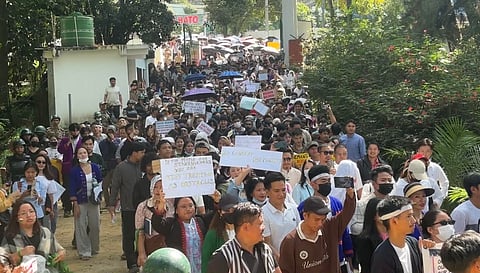
Local protests highlight the need for dialogue and scientific transparency.
A dam-for-a-dam strategy could endanger livelihoods and ecosystems while failing to secure meaningful water rights.
Dams on the Siang river were first proposed in the 1980s, while the Siang Upper Multipurpose Project (SUMP) has been on the drawing board since the 2000s. But its implementation has gained sudden urgency following China’s announcement in late 2024 that it would begin work on the 60 GW Medog dam upstream. This has sharply escalated strategic posturing on both sides of the river. India needs to demonstrate that it is responding to China’s upstream intervention, and the SUMP has become a means of strategic signalling.
Both countries are now positioning themselves across one of the most ecologically sensitive and seismically active regions of the eastern Himalayas. China enjoys a strategic advantage as the upper riparian state and an authoritarian regime, while India is downstream and a democracy. India cannot push through projects in Arunachal Pradesh as easily as China can in Tibet. But the protests demand dialogue and consultation, not confrontation. The government must engage with local communities and provide them with credible scientific information about the SUMP.
The argument that India must build a mega dam downstream simply because China is building one upstream carries little weight with local communities. It also traps India in a cycle of responding to every Chinese move, fuelling a strategic hydropower race. A dam-for-a-dam approach would endanger the ecology of the eastern Himalayas and the lives and livelihoods of communities that have depended on these rivers for generations.
If the Medog dam poses a potential water-security threat to downstream India, SUMP could create similar risks for downstream areas of Arunachal Pradesh, Assam and Bangladesh. We cannot afford a race to build competing water bombs in a fragile mountain region shaped by powerful earthquakes and constant geological change. Nor does the argument of first-user rights offer India much leverage.
Neither China nor India is a signatory to the UN Watercourses Convention, and the two countries have no bilateral treaty framework to resolve disputes over these transboundary rivers through arbitration. Even if such legal provisions existed, China’s record on respecting international law offers little assurance that it would comply. Building the SUMP would therefore do little to establish or enforce India’s claim to first-user rights. India should instead use diplomacy to bring China to the negotiating table and secure meaningful guarantees on shared transboundary waters.
It has an opportunity to demonstrate riparian leadership rather than get trapped in a dam-for-a-dam contest that could devastate the eastern Himalayas. Besides, neither project is likely to be completed in the near future. Both are technically complex undertakings. Meanwhile, renewable energy technologies are advancing rapidly, prompting countries to reassess their dependence on large and mega hydropower projects. The Siang and Medog projects must be viewed in this changing energy landscape.
This column is based on an interview with Sandipan Talukdar, and was first published in the November 16-30, 2026 print edition of Down To Earth
