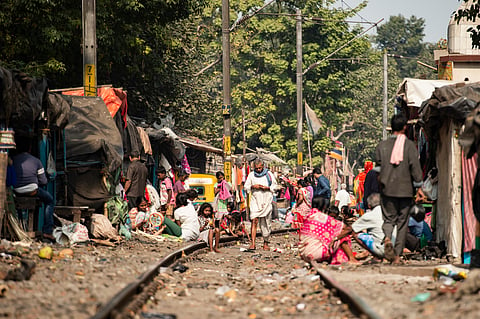


According to the latest update to the global Multidimensional Poverty Index, brought out by the United Nations Development Programme (UNDP) and the Oxford University, 51.5 million more people were added to this category of poor in 2025.
The Index came into existence in 2010 to measure poverty “beyond what people earn,” covering 108 countries accounting for 78 per cent of the global population.
The Index uses 10 indicators on health, education and standard of living that include nutrition and child mortality, schooling, and access to water and sanitation. One is defined as multidimensionally poor if s/he is deprived in one-third or more of the indicators.
This is the first time since the adoption of this measure of poverty that more people have been added. In 2025, there were 1.2 billion multidimensionally poor people in the world – every second one is a child and over four-fifths of them lived in rural areas.
The rise in the multidimensionally poor population is concerning as it indicates a lack of access to basic amenities that define wholesome human development. All the indicators used in this measure are critical to each other and failure in one can trigger a cascade of others not being met.
Alexander De Croo, UNDP Administrator, says, “The rise in poverty should be a wake-up call for the world. Behind these figures are 1.2 billion people facing hardships that reinforce one another: hunger, missed schooling and a lack of clean water or electricity. This is unacceptable.”
While the latest update is a grim milestone, countries have reduced multidimensional poverty in the last 15 years. Some 33 countries including six in sub-Saharan Africa have reduced this poverty level in less than 15 years. Sub-Saharan Africa has the highest level of multidimensional poverty in the world.
China reduced its poverty the fastest in the world – from 9.5 per cent in 2010 to 4.2 per cent in 2014.
India has also significantly reduced its multidimensional poverty levels, which the incumbent government has been celebrating as one of its key achievements.
In 2005-2006, India’s multidimensional poverty incidence was 55.1 per cent, which came down to 16.4 per cent in 2019-2021.
The prime reason for this increase in the multidimensionally poor population, according to UNDP and Oxford University, is the rise in population. In other words, although multidimensional poverty is being eradicated, its rate is not outpacing population growth.
“This is a sum of two elements. The first is net population growth of 15.8 million in the 95 non-updated countries. Holding poverty rates constant, simply changing the population figures from 2023 to 2024 adds 15.8 million poor people across the 95 countries,” says a note to the Index.
In terms of the indicators, the new Index reveals the level of deprivation in access to basic amenities. For instance, consider child mortality. The Index shows that 145 million multidimensionally poor people live in households that lost a child in the last five years.
Similarly, over a billion people still cook with solid fuels. In sub-Saharan Africa and South Asia, people experienced deprivation in every indicator at significant levels. South Asia (including India) has the world’s largest share of deprivation in nutrition, housing and years of the schooling.
India though has made progress in eradicating multidimensional poverty, going by the performance in the indicators shows huge basic development deficit. In 2024, India had over 238 million multidimensionally poor. Besides, another nearly 19 per cent of population was vulnerable to multidimensional poverty.
Of the three dimensions, the living standard (other two are health and education) contributes most to multidimensional poverty at nearly 40 percent. This dimension has indicators like cooking fuel, sanitation, drinking water, electricity, housing and asset. It means notwithstanding the progress, India’s deepening of basic development amenities lags behind significantly.
