
Subscribe
For over a century, discussions about Eurasia have been dominated by the language of competition. The last two decades have accelerated it further. Analysts compare the International North-South Transport Corridor (that connects India, Iran, the Caucasus, Russia and Northern Europe) with the Middle Corridor (which links East Asia to Europe through Central Asia and the Caucasus). Governments promote competing port projects. Policymakers debate sanctions, strategic influence, transit revenues and geopolitical alignments. Maps are drawn to illustrate which corridor might prevail and which route might attract the largest volume of trade. Yet these perspectives capture only part of a much larger transformation currently unfolding across the Eurasian continent.
One major flaw in the debate is the assumption that Eurasia can be understood through a single corridor. The second is the tendency to view individual routes as isolated projects, rather than recognising that many of them—whether by design, geography, economic necessity, or the passage of time—are evolving into interconnected and complementary elements of a much broader Eurasian connectivity architecture.
Consider the emerging Trans-Afghan routes that link Central Asia to South Asian markets. Gulf logistics hubs, Arabian Sea ports, Caspian crossings, Arctic shipping routes, energy interconnections and expanding digital infrastructure all contribute additional dimensions to the existing Middle Corridor and North-South Transport Corridor.
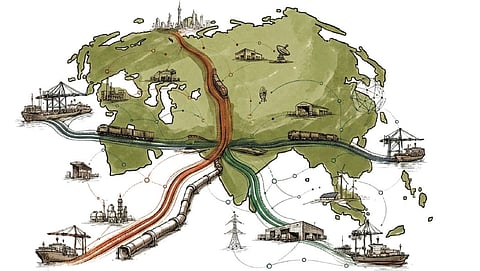
The result is not a corridor but an ecosystem—a network of networks. The distinction is crucial: corridors compete, while networks cooperate. Corridors can be disrupted; networks interact and adapt. Corridors accumulate risk, while networks amortise and distribute it.
The emerging Eurasian order is simultaneously physical, digital, economic and geopolitical. Recent geopolitical shocks reinforced this.
Disruptions affecting the Suez Canal, instability in the Red Sea, sanctions regimes, supply-chain disruptions and shifting geopolitical alignments have all highlighted the vulnerabilities associated with excessive dependence on individual routes and chokepoints. Consequently, durability and predictability has become as important as efficiency. Governments and businesses increasingly seek redundancy, diversification and flexibility. The objective is no longer simply to minimise transport costs. It is to ensure that trade can continue even when particular routes face disruption.
For much of modern history, strategic thinking focused on chokepoints: straits of Gibraltar, Hormuz, Malacca, Bab el-Mandeb and the Bosporus and the Suez Canal. These passages remain vital to global commerce. Yet the emerging geoeconomics of connectivity increasingly rewards the ability to build alternative routes and interconnected systems around them. As findings of Global Academy for Future Governance (GAFG), a think tank, suggest: the strategic question is gradually shifting from who controls a chokepoint to who can successfully connect networks around it. Resilience derives not from dependence on a single gateway but from participation in a wider architecture of complementary routes and connections.
This shift is producing what Anis H Bajrektarevic, chairperson and professor in international law and global political studies, Vienna, Austria, describes as “two parallel maps of Eurasia, providing a conceptual gateway to the Connectivity Doctrine”. The first is the political map, characterised by (open and frozen) conflicts, sanctions, rivalries, alliances and strategic competition. This map continues to dominate headlines and policy de-bates. It reflects the enduring realities of power politics and interstate competition. Alongside it, a second chart is emerging: The connectivity map. It consists of railways, ports, logistics hubs, fibreoptic cables, pipelines, industrial zones, energy systems, multimodal transport corridors and cross-generational dynamism. Unlike the political map, which emphasises division, the connectivity map is fundamentally concerned with linkage and integration.
Politics may divide but infrastructure connects—a resilience and peace project at the same time.
The emergence of a networked Eurasia may also redefine the role of middle powers and transit states, giving edge to those normally dis-advantaged—the landlocked ones. Countries such as Kazakhstan, Azerbaijan, Uzbekistan, Georgia, Türkiye and Morocco increasingly derive strategic significance not merely from their size, military capabilities or resource endowments but from their ability to connect regions, markets and infrastructures. In a networked world, influence is increasingly generated through connectivity rather than the power projection or control. The strategic value of these states lies less in serving as buffers between or a battlefield for competing powers and more in functioning as bridges between interconnected systems.
Similar conclusions have been reached in research published over the years by the International Institute for Middle East and Balkan Studies (IFIMES). Long before connectivity became a fashionable concept, IFIMES analyses consistently highlighted the relationship between infrastructure, economic integration, regional stability and geopolitical cooperation. The central insight remains highly relevant today: transport corridors are not merely channels for moving goods; they are instruments for building interdependence, resilience and long-term development.
Nowhere is this transformation more visible than in Central Asia. For much of modern geopolitical literature, Central Asia was portrayed as a strategic “heartland” to be controlled. Contemporary developments suggest a different interpretation: For Central Asia to reemerge as a crossroads.
For most of the pre-modern history, the region functioned as the meeting point of major civilisations and economic systems. China, South Asia, West Asia, Russia and Europe all interacted, for good or bad, through Central Asian networks. Its significance derived not from domination over surrounding territories but from its ability to connect them. And now, their history is returning.
New railway projects, logistics hubs, energy corridors and trade routes are repositioning Central Asia as one of the principal nodes within Eurasia’s emerging connectivity architecture. Rather than serving as the endpoint of competing geopolitical projects, it is increasingly becoming a platform where multiple networks intersect.
As Vladimir Norov, vice-chairperson of IFIMES Advisory Board and former Secretary-General of Shanghai Cooperation Organisation, a 10-member bloc, often says, sustainable prosperity across Eurasia depends less on geopolitical rivalry than on the expansion of practical mechanisms of cooperation. Transport corridors, energy systems, trade networks, educational exchanges and technological partnerships all contribute to building trust and shared development across regions. The same logic applies to Afghanistan, viewed only through the prism of security challenges and political instability. While these issues remain significant, they should not obscure a fundamental geographic reality: Afghanistan occupies a natural junction between Central Asia, South Asia, Iran and the northern approaches to the Indian Ocean. For centuries, trade routes crossed Afghan territory.
Contemporary proposals for Trans-Afghan connectivity seek to revive aspects of this historical role by linking Central Asian economies with South Asian markets and maritime gateways (of Persian Gulf and western Indian ocean). Such projects face undeniable challenges, such as reconnecting spaces, fragmented for (too) long. But the implications will inevitably extend well beyond Eurasia itself.
Similar dynamics are increasingly visible in North Africa. Moro cco’s Atlantic logistics strategy, the continued expansion of Tanger Med, proposals for a fixed link across the Strait of Gibraltar and Algeria’s long-discussed Trans-Saharan Railway linking the Mediterranean with Niger and Nigeria all point towards the same conclusion. The emerging Eurasian network may ultimately find one of its most significant extensions in Africa, creating new Afro-Eurasian linkages that connect the Mediterranean, Atlantic, Indian Ocean and Eurasian spaces into a broader framework of interaction.
The trajectory is clear: The future of Eurasia is not shaped by a single power controlling a single dominant corridor. Nor will it be determined by a simple competition between the Middle Corridor and the International North-South Transport Corridor; between Arctic routes and southern maritime pathways; or between rail and sea transport. These are wrong dilemmas. The more consequential is whether Eurasia can successfully transform a collection of projects into a functioning network. It surely necessitates collaborative works of big and small—a Kantian, not a Hobbesian environment.
Recognising the significance of these transformations, GAFG is launching the Global Maritime Governance Forum whose inaugural session will convene in Gibraltar, on Spain’s south coast, in September 2026. It is founded on the understanding that the future of global commerce will increasingly depend on the multidimensional and cross-sectoral interaction. One of the Forum’s central themes will be the emergence of a network of networks. Bringing together policymakers, industry leaders, academics and practitioners, GMGF seeks to examine not merely individual corridors, but the wider connectivity ecosystems that are reshaping Eurasia, Africa, and the international system as a whole. After all, strategic relevance in the 21st century will belong less to those who control individual passages and more to those who successfully connect systems.
(Alice Ferrari is a senior researcher working with the Global Academy for Future Governance)
This article was originally published in the August 1-15, 2026 print edition of Down To Earth
