
Subscribe
.jpeg)

Bihar’s Renewable Energy Policy 2025 targets 340 MW of off-grid capacity by 2030
The policy prioritises decentralised solar for livelihoods, including cold storage, dryers and EV charging
Together with Jharkhand and Odisha, eastern India plans over 600 MW of off-grid and mini-grid installations
Execution, finance and district-level capacity will determine whether policies translate into lasting income gains
Bihar has positioned itself as a leader among eastern Indian states in promoting decentralised renewable energy and off-grid solar solutions, unveiling an ambitious target of 340 MW of off-grid renewable energy by 2030. The policy places significant emphasis on solar-powered livelihood applications that promise to transform rural economies across the region.
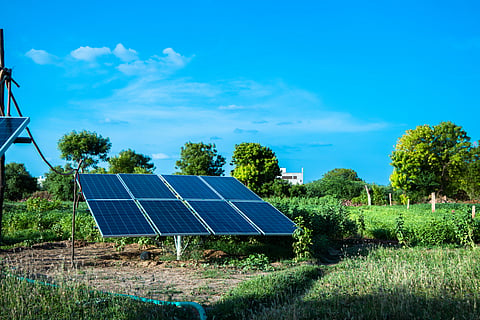
The state’s newly unveiled Bihar Renewable Energy Policy 2025 sets out a comprehensive roadmap for off-grid installations, targeting 110 megawatts (MW) through decentralised renewable energy livelihood applications, 50 MW via mini and micro grids, and 180 MW from standalone solar pumps over the next five years. This represents one of the most aggressive off-grid deployment strategies in eastern India, signalling Bihar’s intent to address energy poverty while simultaneously creating income-generating opportunities in rural areas.
Combined with initiatives in neighbouring states, the region presents a formidable clean energy transition. Jharkhand’s State Solar Policy 2022 targets 280 MW of off-grid solar by 2027, with 110 MW allocated to mini and micro grids, 50 MW for solar livelihood applications, and 120 MW for solar pumps. While the overall capacity is comparable to Bihar’s, Jharkhand’s timeline is more compressed, aiming to achieve these targets two years earlier.
Odisha, through its Vision 2036 and 2047 document, takes a longer-term approach with broader energy goals, though it provides less granular detail on specific off-grid and decentralised renewable energy targets compared with its neighbouring states. Together, the three states aim to install over 600 MW of off-grid and mini-grid capacity by 2030.
Bihar’s policy stands out for its structured approach to decentralised renewable energy livelihood applications, explicitly defining them as solar-powered solutions for income generation, including solar dryers, cold storage facilities, electric vehicle charging stations and solar charkhas. The state has committed to opening Bihar Akshay Urja Kendras in every district — dedicated centres that will serve as one-stop hubs for information, skill development and service support for renewable energy applications. These centres will be staffed by technical resources from empanelled developers and original equipment manufacturers, ensuring sustained post-installation support.
Jharkhand’s approach emphasises model solar villages, with a target of complete solarisation of 1,000 villages by 2027, where both consumptive and productive loads, including healthcare, education, agriculture and livelihood enterprises, are solarised. The state’s policy integrates solar deployment with existing community structures, working through village-level committees comprising gram panchayat members, self-help groups and youth organisations. Subsidies of up to 60 per cent for systems below 3 kilowatts and 40 per cent for systems between 3 and 10 kilowatts are offered for off-grid mini-grids, solar home systems and livelihood applications.
The policy frameworks across eastern states demonstrate institutional commitment beyond mere project deployment. Bihar allocates a minimum of five per cent of its annual renewable energy budget specifically for research and development, including pilot projects and commercialisation support. The establishment of a dedicated research centre under the Bihar Renewable Energy Development Agency, potentially evolving into an independent Bihar Energy Research and Management Institute, reflects this long-term vision.
Both Bihar and Jharkhand recognise the critical role of financial access in scaling decentralised renewable energy applications. Bihar’s policy creates the Bihar Renewable Energy Development Fund with multiple revenue streams, including application fees, penalties on obligated entities and contributions from renewable energy developers. Jharkhand proposes leveraging its Green Fund, established under the Jharkhand Green Energy Cess Act 2021, alongside partnerships with National Bank for Agriculture and Rural Development (NABARD), regional rural banks and microfinance institutions to extend credit for village-level enterprises.
For off-grid and decentralised renewable energy ambitions to deliver real livelihood gains in eastern India, policy intent must now give way to execution. States need to move quickly on three fronts that have long stalled progress. Implementation guidelines for mini-grids, productive-use applications and solar pumps remain delayed; without clear technical norms and financing pathways, projects continue to remain on paper. Equally critical is finance. State green energy funds, priority-sector lending through NABARD and regional rural banks, and targeted viability gap support for community systems must shift from announcements to active instruments that reduce risk for early movers.
The third gap lies at the district level, where policies ultimately succeed or fail. Skill-building programmes, a reliable pool of empanelled vendors, and functional district-level Akshay Urja Kendras are essential to anchor deployment and after-sales support. States that treat off-grid solar as part of a wider livelihood ecosystem, linking power supply to skills, credit, market access and ongoing handholding, are far more likely to see durable income gains rather than short-lived pilots.
Bihar, Jharkhand and Odisha have already laid out broad visions and enabling policies. What remains missing is operational depth. The next phase calls for translating intent into institutions, replacing one-size-fits-all subsidies with differentiated support, making working capital and market linkages integral to programme design, and tracking success through livelihood outcomes rather than installation numbers. None of this is technically difficult. It hinges on political resolve, smarter use of budgets, and the discipline to follow through.
