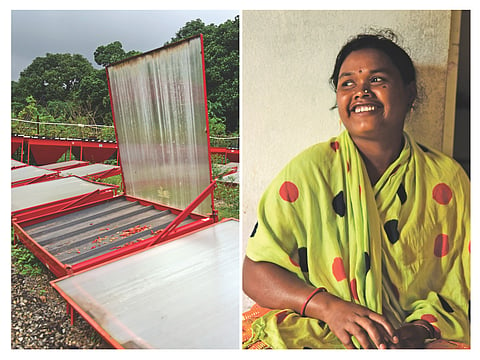


For farmers in Bairagiput village in Odisha’s Koraput district, access to water for cultivation has long depended on the monsoon or on diesel and electric motors. For women running food-processing enterprises in Kalahandi, unreliable electricity can can delay food preparation and delivery. Across these communities, decentralised renewable energy (DRE) is being used to work around gaps in conventional power supply.
In Bairagiput village in Nandapur block of Koraput district, Amara Lakei, 35, has been farming for around 15 years while also working as an Accredited Social Health Activist (ASHA). She grows ginger, cauliflower, chilli, millets, paddy and cabbage.
Electricity availability for irrigation has been a challenge. In 2024, a Professional Assistance for Development Action (PRADAN) and HDFC-supported intervention provided a solar motor, sprinkler and pipes. During summer, a solar fence also protects crops from animals, Lakei told Down To Earth (DTE) in July.
For Madan Burud, 35, who cultivates two acres and has been engaged in farming for around 20 years, diesel has been another part of the irrigation equation. Farming is an ancestral occupation for his family, and he previously used a diesel motor.
Burud said he got a solar-powered motor about 3-4 months ago. A traditional motor requires one litre of diesel and lasts about an hour, while irrigation is undertaken every other day. In the absence of rain, irrigation is carried out around twice or thrice a week for at least 5 hours a day.
Burud’s household earned approximately Rs 70,000 in the 2026 season, compared to Rs 40,000 from ginger the previous year.
26-year-old Gopinath Sisha’s fuel expenditure for cultivation was usually around Rs 20,000, and he said his bean sales in 2023 were Rs 1 lakh, which has now gone up to Rs 1.5 lakh with an increase in production. Similarly, he could sell ginger at a higher rate of Rs 180 per kg.
Sisha has been farming for around 10 years and grows beans, cabbage, tomato, brinjal, chilli, coriander and potato. His solar-powered motor was installed in 2023.
Alongside irrigation, renewable energy is also being used by women’s SHGs in Nandapur for agricultural processing, particularly ginger. In Kurji village, an SHG has incorporated solar energy into its operations to dry agricultural produce, primarily ginger.
Ulash Khinbudi, the 27-year-old community resource person in the village, said ginger production was previously high, but there were limited means of processing it, resulting in post-harvest losses. “Ginger production was too much before, and there were no means of processing it, causing post-harvest loss,” Khinbudi said.
Following technological assistance provided by Professional Assistance for Development Action (PRADAN), the SHG began using the technology for processing and value addition, she said.
The technology combines conventional processing equipment with solar drying, including electric cutters, fan-based dryers and solar dryers.
Khinbudi said the price realised for ginger has increased following processing. Small ginger, which previously sold for Rs 8–10 a kg, now fetches around Rs 40 a kg. Big ginger sells for around Rs 140 a kg, compared with Rs 20–30 previously.
“Rates were not remunerative before. They could manage to sell small ginger at Rs 8-10 a kg before, but now they get Rs 40. As for a kg of big ginger, it’s Rs 140 from Rs 20-30 before,” she said, adding that reliable power remained a concern. At present, about 40 women are part of the SHG, working in shifts.
A similar solar dryer intervention is in Kirajholla village, among others in the same block and district. This SHG is capable of processing raw ginger or turmeric up to 1 tonne per day, said Rashmi Ranjan Sahoo, a field coordinator of PRADAN based in Nandapur.
PRADAN has worked with women’s SHGs in Odisha within the broader Mission Shakti and rural livelihoods ecosystem. According to its 2008–09 annual report, PRADAN was selected as a resource organisation under the Mission Shakti project in Rayagada district, where it worked with SHGs across 11 blocks to strengthen groups, develop federations and identify livelihood activities. In Koraput, PRADAN partnered with a technology provider in 2018 to install 7 drying units for seven SHGs across three villages, according to its field coordinators in Nandapur.
The intervention initially focused on ginger and was intended to enable processing and value addition while reducing post-harvest losses. Each SHG comprised around 10 to 12 women.
According to PRADAN’s on-ground coordinators in Nandapur, each unit had two 1.5 kilowatt electric cutters, 10 fan-based dryers and 16 solar dryers. According to a 2026 study by the World Resources Institute (WRI) India, the units could process 50 kg batches of ginger, with solar drying taking around 3-4 hours. The study of productive use of renewable energy across nine states, notes that energy gaps in rural and remote areas constrain agricultural productivity and incomes. The study identifies decentralised renewable energy as a means of supporting rural livelihoods, microenterprises and infrastructure across agrifood value chains.
For another household in Bairagiput, electricity has been a persistent constraint. Power interruptions of two to three hours a day have been recorded, with the problem continuing for around 20 years.
An electric pole is far from the agricultural field, making installation of an electric motor difficult. Diesel is also difficult to obtain, as to procure it, one has to go to Nandapur or Sehliguda which is not feasible most of the time.
The irrigation system includes a 5 horsepower solar motor, 80 pipes, including 40 in the pipeline, and 40 sprinklers. It uses monsoon rainwater, seepage and water from the hills. The intervention extends across agricultural clusters in the area. Kalandi has a cabbage cluster, while Dharangaba has solar fencing and a 5 horsepower government motor. Around 20 people are recorded as benefiting from the intervention. There are a total of 4 motors. The second motor is associated with approximately 30 acres, while the third and fourth motors are associated with around 20 acres each. The intervention covers two villages, Sahoo said.
The energy challenge is not limited to agricultural fields. In Thuamul Rampur block of Kalahandi district, a women’s self-help group (SHG) uses solar power and battery storage for its food-processing operations, by SELCO Foundation, a not-for-profit organisation that uses DRE as a catalyst to alleviate poverty and improve public services in underserved communities.
Jai Durga SHG, a 10-member women’s collective, supplies supplementary nutrition to Anganwadi centres across eight gram panchayats in the block under the Integrated Child Development Services (ICDS).
Sourajini Singh, 65, a former president of the SHG, said the group’s electricity bill reduced after solar panels and battery storage were incorporated into its operations. The group received four 200 Ah batteries, one 3.5 kilowatt inverter, four 595 watt solar panels and a rice puff extruder or puffed rice roaster about two years ago.
The equipment has also reduced the need to travel to Bhawanipatna for processed ingredients.
“We no longer have to travel 40-45 kilometres to Bhawanipatna to get ready-made puffed rice and chana (gram), peanut, wheat, sugar and gram flour roasted,” Singh told DTE. “It not only saves our transportation cost but also enables us to consume efficiently.”
Singh, who was president of Jai Durga SHG until May 2026, said the group’s electricity costs have also changed as its operations have expanded. With only one bulb, the monthly electricity bill was around Rs 200–300, she said. It is now around Rs 650–800 because of packing and sealing machines, which are not powered by solar.
But the larger concern is the reliability of electricity. “More importantly, reliable and round-the-clock power is a big deal here as power outages for 2-6 hours are usual, extending up to 10-15 days during monsoon,” Singh said.
The SHG is required to send supplementary nutrition to Anganwadi centres on the first day of every month. Disrupted electricity, Singh said, can delay deliveries. The group supplies puffed rice, roasted chana and its flour, and dates to Anganwadi centres across the eight gram panchayats. The intervention is supported by the Odisha government’s Mission Shakti initiative, under which women’s groups are supported for financial inclusion, social empowerment and livelihoods.