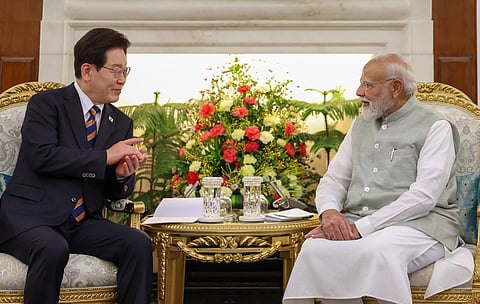


India and South Korea have signed 16 MoUs across e-mobility, green energy and advanced manufacturing
Both countries aim to double bilateral trade to $54bn by 2030, targeting nearly 18% annual growth
Agreements come amid global inflation risks, energy insecurity and supply chain disruptions
India says first tranche of a trade deal with the US is “almost finalised”
Partnership focuses on future sectors such as semiconductors, batteries and clean energy
India and South Korea are deepening economic ties at a time of rising inflation risks, energy insecurity and supply chain disruptions driven by global conflicts, signing 16 memorandums of understanding (MoU) across electric mobility, green energy and advanced manufacturing. The two countries are aiming to double bilateral trade to $54 billion by 2030, targeting nearly 18 per cent annual growth.
The agreements, signed on April 20, 2026, during a visit of South Korean President Lee Jae Myung and talks with Prime Minister Narendra Modi, come as inflationary pressures, driven by volatile energy markets and geopolitical tensions, force countries to reconfigure trade, technology partnerships and industrial strategies.
At the same time, Union Commerce and Industry Minister Piyush Goyal said India has “almost finalised” the first tranche of a bilateral trade agreement with the United States, signalling a parallel push to secure market access and diversify trade ties.
Speaking at the India-Korea Business Forum, South Korean President Lee Jae Myung described India as a “key pillar” of the global economy and urged businesses to expand trade and investment.
He highlighted opportunities to deepen cooperation as both sides work to upgrade the Comprehensive Economic Partnership Agreement (CEPA), with particular focus on high-technology sectors such as artificial intelligence and shipbuilding.
Goyal said the two countries have set up an India-Korea Industrial Cooperation Committee, with four working groups covering trade, industry, strategic resources and clean energy, to accelerate engagement. He said trade needs to grow from the current $27 billion to $54 billion by 2030, requiring sustained annual growth of around 18 per cent.
The minister added that both sides would fast-track the CEPA upgrade by addressing non-tariff barriers, simplifying rules of origin, expanding market access and improving ease of doing business.
Priority sectors identified include semiconductors, electronics, e-mobility, green energy, shipbuilding and digital trade. Companies in both countries are expected to collaborate on co-production, co-design and co-innovation for global markets.
Goyal also said Prime Minister Narendra Modi and President Lee had discussed establishing a Korea-specific industrial township in India, with plug-and-play infrastructure aimed at boosting investment and supporting Korean firms targeting domestic and export markets.
The MoUs span priority sectors including semiconductors, electronics, green energy, e-mobility, shipbuilding and digital trade. These areas are central to both countries’ long-term competitiveness and energy transition goals.
A key outcome was cooperation under Article 6.2 of the Paris Agreement, enabling carbon market collaboration through the trading of emission reductions. Both countries also reiterated their net-zero targets (India by 2070 and South Korea by 2050) and their commitments under their updated Nationally Determined Contributions.
The partnership also envisions a Korea-specific industrial township in India, aimed at attracting investments with plug-and-play infrastructure and linking Korean firms to both domestic and export markets.
The MoUs are seen as significant in several ways. First, they signal efforts to diversify supply chains in an increasingly fragmented global economy. Ongoing tensions, including the US-China rivalry, the Russia-Ukraine war and conflict involving the US, Israel and Iran, have exposed vulnerabilities in concentrated production networks.
By expanding cooperation in sectors such as semiconductors, electronics and clean energy, India and South Korea are positioning themselves as complementary partners in building more resilient and geographically diversified supply chains.
Second, the agreements reflect a shift towards partnerships between countries with aligned strategic interests. As trade increasingly intersects with national security, particularly in critical technologies, both sides appear to be prioritising more “trusted” economic relationships.
Third, the focus on clean energy, battery technologies, e-mobility and digital trade highlights a race to secure leadership in future industries. Early cooperation in these sectors could shape competitiveness over the coming decades while reducing dependence on dominant players such as China.
Fourth, the MoUs gain importance amid uncertainty in global trade rules and rising protectionism. With tariff regimes shifting, particularly in the United States, and multilateral systems under strain, bilateral arrangements such as CEPA are becoming more central to trade policy.
Fifth, the agreements align with India’s broader strategy of diversifying its economic partnerships. Even as it advances trade talks with the US, New Delhi is strengthening ties with other major economies to reduce dependence on any single partner and improve negotiating leverage and cushions against external shocks.
Finally, the partnership reflects mutual economic interests. For India, South Korean investment brings technology, capital and manufacturing expertise. For South Korea, India offers scale, market access and a growing role in global demand. In a volatile global environment, this mutual dependence becomes a stabilising factor.
By locking in cooperation in clean energy, battery technologies, e-mobility and digital trade, both countries are positioning themselves in sectors expected to define global competitiveness over the next two decades.
The agreements also align with India’s multi-alignment strategy, as they deepen ties with key partners like South Korea while advancing trade negotiations with the US, thereby enhancing negotiating leverage and reducing overdependence on any single market.
For India, Korean investments bring capital, advanced technology and manufacturing expertise. For South Korea, India offers scale, demand and a growing role in global supply chains.
Experts say the partnership is also driven by energy security concerns. Aarti Khosla, director at Climate Trends, noted that dependence on crude flows through the Strait of Hormuz makes cooperation in renewables, green hydrogen and electrification critical to reducing fossil fuel reliance.
According to Jagjeet Sareen, partner at Dalberg Advisors, deeper collaboration in semiconductors, batteries and nuclear energy could accelerate India’s clean-tech manufacturing ambitions and strengthen global supply chains.
In a world marked by inflationary pressures, protectionism and fragmented supply chains, the India–South Korea partnership is emerging as a strategic pillar of Asia’s clean energy and technology architecture, combining India’s scale with Korea’s technological depth. As both countries align trade, climate and industrial strategies, their collaboration could play a stabilising role in an increasingly volatile global economic landscape, they said.
India and South Korea established diplomatic relations in 1973, and economic ties strengthened after India’s economic liberalisation in the 1990s. South Korean firms expanded investments in sectors such as automobiles, electronics and heavy industry, becoming an integral part of India’s manufacturing ecosystem.
The two countries signed CEPA in 2009 to reduce tariffs and promote trade in goods and services. While the agreement boosted trade, both sides are now seeking to upgrade it to address issues such as non-tariff barriers, market access and trade imbalances.
Today, South Korea is among India’s key investors, with companies such as Samsung, Hyundai, LG and POSCO operating across sectors. However, officials on both sides say trade remains below potential, prompting renewed efforts to deepen cooperation.
India is also advancing trade negotiations with the United States. Separately, Goyal told reporters that the first tranche of India’s bilateral trade agreement with the US is “almost finalised,” with both sides working to secure preferential market access for Indian goods.
An Indian delegation led by chief negotiator Darpan Jain has begun a fresh round of talks in Washington after earlier negotiations were deferred in February. Officials say discussions now extend beyond trade to include technology, defence and broader strategic coordination, reflecting closer alignment between economic and geopolitical priorities.
Despite these complexities, India says it remains confident of concluding a deal on favourable terms, while simultaneously strengthening partnerships with countries such as South Korea to build resilient supply chains and expand cooperation in emerging sectors.