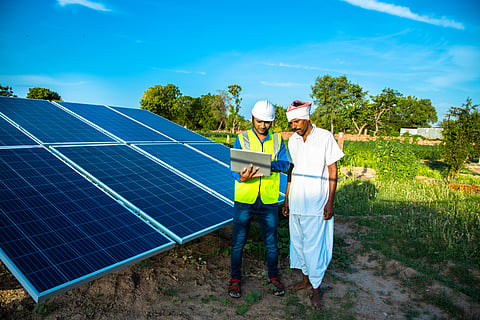


India’s flagship solar energy scheme, the Pradhan Mantri Kisan Urja Suraksha evam Utthaan Mahabhiyan (PM-KUSUM) saw the end of its first phase in March 2026
The scheme's uneven progress highlights institutional and financial challenges, urging readiness assessments, payment security, and tailored agrivoltaic models to benefit farmers and address groundwater management concerns.
Energy experts emphasise the need for PM-KUSUM 2.0 to prioritise farmers, financing and agrivoltaics.
India’s flagship solar energy scheme, the Pradhan Mantri Kisan Urja Suraksha evam Utthaan Mahabhiyan (PM-KUSUM) installed nearly 90 per cent of its targeted stand-alone solar pumps by the end of its first phase in March 2026. However, the scheme achieved only about a quarter of its target for decentralised solar power plants. As the government prepares for PM-KUSUM 2.0, Delhi-based think tank Centre for Science and Environment (CSE) has called for project readiness assessments, stronger financing and payment mechanisms, and a greater focus on benefits to farmers.
PM-KUSUM launched in 2019, aims to promote solar energy solutions in agriculture through stand-alone solar pumps, decentralised grid-connected solar power plants and the solarisation of existing agricultural pumps and feeders.
Speaking at a webinar, “Redesigning PM-KUSUM 2.0”, on Tuesday, October 27, Binit Das, programme manager for renewable energy at CSE, said implementation of the scheme’s first phase had progressed unevenly across the three primary components.
Component A, which supports decentralised grid-connected solar power plants, has installed around 2,400 megawatts (MW) against a target of 10,000 MW. However, Component B, which supports stand-alone solar pumps, has installed about 119,000 pumps, nearly 90 per cent of its sanctioned target.
Meanwhile, progress under Component C, which supports the solarisation of existing grid-connected agricultural pumps and feeders, has varied across states and implementation models.
The difference in progress highlights the need to address the institutional and financial challenges associated with decentralised power generation and feeder-level solarisation, Das said. These projects require coordination among state agencies, electricity distribution companies (DISCOMs), regulators, developers, lenders and landowners. State-wise implementation has also varied considerably, with some states recording little or no progress under particular components.
“PM-KUSUM 2.0 should address the complete delivery chain — from site selection and project preparation to financing, grid readiness, maintenance and farmer outcomes,” said Das. Capacity should be allocated only when the conditions for implementation are in place, he added.
During the session, CSE called for project readiness assessments before capacity is allocated. These assessments should establish land access, grid capacity, statutory clearances, procurement plans and financing arrangements to reduce delays during implementation.
There is also a need to improve project economics and payment security. Tariffs and procurement decisions should account for the full costs of land, structures, grid connectivity, financing, operations and maintenance and insurance.
Payment delays by DISCOMs can increase borrowing costs and weaken developers’ ability to service debt. CSE therefore recommended clear billing and payment timelines, credible payment-security arrangements and procedures to resolve overdue invoices.
The government is preparing the next phase of PM-KUSUM and has indicated that it will include a dedicated agrivoltaics component. Agrivoltaics combines solar power generation with crop cultivation on the same land. Public reporting has also referred to a proposed financial requirement of up to Rs 51,000 crore, including existing liabilities. However, the final outlay, eligibility conditions and implementation guidelines remain subject to formal government approval.
The new framework should also ensure that agrivoltaic projects reflect crop requirements, local agro-climatic conditions and farming practices. Delivery models must also accommodate different farm sizes and local circumstances, while financing and eligibility criteria should account for barriers faced by smallholders and tenant farmers.
The organisation cautioned that solar irrigation must be linked to water management measures, as lower pumping costs could encourage greater groundwater extraction in the absence of safeguards.
The webinar’s panellists included Hemanga Deka, scientific officer, Assam Energy Development Agency, Priyami Dutta, policy advisor, International Institute for Sustainable Development, and Himanshu Tyagi, senior research analyst, energy program, World Resources Institute (WRI) India.
During the session, Dutta said the success of the revamped scheme should be assessed by its impact on farmers rather than solar capacity alone. “The measure of success of PM-KUSUM 2.0 will not be limited to how much solar capacity we installed on agricultural land, but how much tangible benefits we will be able to create for farmers who depend on their land,” she said.