
As intense heatwaves grip India — with the India Meteorological Department forecasting severe heatwave conditions across northwest and central India — power outages have become routine. India’s peak power demand hit a record 256.1 GW in April — then surpassed it within weeks, reaching 257.37 GW in May. The power ministry now projects 270 GW this summer. With El Niño conditions likely this year, this is not an anomaly; it is the new baseline. It is also, increasingly, a fiscal emergency: India’s energy subsidies already stand at Rs 4.3 lakh crore (US$ 51 billion), or 2.3 per cent of GDP, with fossil fuels receiving three times the public support directed at clean energy.
These demand shocks are arriving on top of a geopolitical rupture. The 2026 West Asian crisis disrupted nearly 40 per cent of India’s crude supply and 90 per cent of its LPG imports — a vulnerability that already costs the exchequer Rs 71,718 crore annually, before any price shock is factored in. Nowhere do these pressures converge more acutely than in agriculture, where irrigation demand peaks precisely when the grid is most strained, and where diesel and LPG — exactly the inputs the crisis disrupted — remain what millions of farmers depend on. This reached Rs 2,40,992 crore (US $ 28 billion) in FY 25 and contributed to nearly 58 per cent of all energy subsidies.
Agriculture has long absorbed the lion’s share of direct electricity tariff subsidies nationwide — studies put its share at 75 per cent — with the annual bill reaching Rs 91,000 crore, almost entirely financing fossil-fuel-based power that drives the pumps of the world’s largest groundwater consumer, accounting for 37 per cent of global agricultural groundwater use. As one farmer from Mandla district in Madhya Pradesh put it, “We no longer decide when to irrigate, electricity does.”
That vulnerability has a solution — but it must reach the farm. India’s solar capacity has grown from barely 3 GW a decade ago to over 130 GW today, with a record 44.61 GW added in FY 2025-26. Solar contributed over 21 per cent of generation during April’s record demand event. The Union Cabinet has committed to 60 per cent non-fossil electricity capacity, a target already more than halfway met, five years ahead of schedule. Yet India’s fields still run largely on diesel, subsidised grid power, and imported LPG — precisely the inputs both crises exposed. Agricultural solarisation offers a way out that is not merely cleaner, but fiscally rational: replacing recurring subsidy dependence with one-time capital investment. The gap between India’s solar ambition and its agricultural reality is where energy security is actually won or lost.
Agriculture remains one of the largest consumers of electricity in India, primarily for groundwater irrigation. For millions of farmers, reliable and affordable energy is not an amenity — it is the determinant of whether crops and ultimately the farmers themselves survive. India has made genuine strides in grid connectivity and irrigation infrastructure, yet the structural vulnerabilities persist. Approximately 9 million diesel pumps and 21 million electric pumps form the backbone of agricultural water access — a system built on subsidies and fossil fuel dependence.
Groundwater irrigation alone accounts for roughly 8 to 11 per cent of national emissions. The fiscal and ecological costs of inaction are no longer abstract.
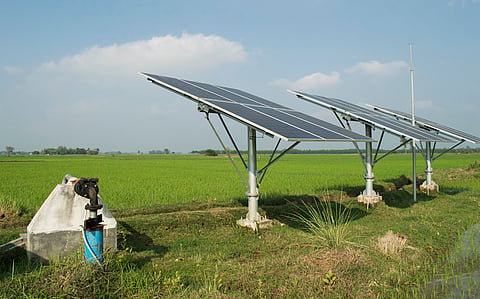
Recognising the urgency of this energy-irrigation nexus, the Government of India has prioritised solar-based solutions through the Pradhan Mantri Kisan Urja Suraksha evam Utthaan Mahabhiyan — PM-KUSUM, one of the world’s largest solar irrigation programs, reaching over 2 million farmers across India. The scheme deploys standalone solar irrigation pumps, solarises agricultural feeders, and — critically enables farmers to sell surplus power back to the grid, creating new income streams while displacing diesel.
Solar irrigation pumps offer predictable daytime power is a luxury in regions where grid supply is erratic — enabling farmers to plan irrigation rather than react to power cuts. They reduce operating costs, improve affordability, and open a path away from diesel for smallholders who have no viable alternative.
The policy debate is too often dominated by a single anxiety: near-zero pumping costs will encourage over-extraction, accelerating aquifer depletion. The risk is real. But it is model-specific, not technology-specific. The architecture of incentives, not the technology itself, determines whether solar irrigation becomes a conservation tool or an extraction accelerant. This is the central design lesson that should inform every iteration of solar irrigation policy.
Evidence from the International Water Management Institute’s evaluation of Gujarat’s Surya Shakti Kisan Yojana shows that farmers can earn up to Rs 21,900 annually from surplus power sales — demonstrating that where grid connectivity exists, solar irrigation can be designed to reward efficiency, not just output. Integrating institutional mechanisms such as Water User Groups, alongside appropriate incentives, can help moderate extraction and align energy access with long-term aquifer health.
The most instructive experiences come not from projections but from the field. In Mandla district of Madhya Pradesh, IWMI has supported the formation of Water User Groups to manage shared irrigation resources, linking them with the State Rural Livelihoods Mission to enable access to government-subsidised loans for solar irrigation systems. Solar pump pilots operated by women-led groups have expanded irrigation access across multiple holdings, cut diesel dependence, and stabilised water availability in ways that seasonal or erratic grid power never could. A solar-powered rice mill introduced within the same framework has strengthened local value chains — enabling on-site processing and improving farmgate returns. The pump need not remain a single-use irrigation tool.
There is a further opportunity that Indian policy has not yet fully seized. The emissions reductions from solar irrigation are measurable, reportable, and verifiable — precisely the attributes that qualify for international carbon finance under Article 6 of the Paris Agreement. Aggregating smallholders through Farmer-Producer Organisations into carbon credit markets could unlock an additional revenue stream that simultaneously eases upfront financing and advances India’s new NDC commitments — making the scheme self-reinforcing rather than a permanent call on the exchequer.
India has already demonstrated that solar irrigation can simultaneously transform rural livelihoods, moderate groundwater extraction, and decarbonise agriculture — when the design is right. The evidence from Gujarat and Madhya Pradesh is not anecdotal. It is a blueprint.
PM-KUSUM is a serious policy instrument. What it requires now is institutional depth — Water User Groups embedded in credit systems, FPO-mediated carbon markets, agri-processing infrastructure financed through the Agriculture Infrastructure Fund. The 2026 West Asian crisis was a reminder that systemic shocks are not exceptional events — they are the operating environment. India’s energy transition will be judged not by installed gigawatts alone, but by whether the farmer in Mandla or the smallholder in Gujarat experiences it as a change in her life. The pump is the entry point. The question is what we build around it.
The authors work with the International Water Management Institute. Opinions are personal.
Views expressed are the authors’ own and don’t necessarily reflect those of Down To Earth
