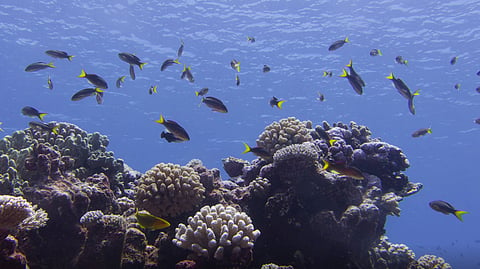


Nearly all shallow-water coral reef ecosystems face a critical risk of collapse by 2075, with 96% assessed reefs classified as 'Critically Endangered' according to the IUCN's global assessment.
Climate change-induced heat stress, overfishing and pollution are driving this decline.
Targeted conservation efforts and ambitious climate action could still reverse the trend.
The first global coral reef assessment under the International Union for Conservation of Nature (IUCN) Red List of Ecosystem says that nearly all shallow-water coral reef ecosystems assessed by IUCN face extremely high risk of collapse by 2075, with 96 per cent being classified as “Critically Endangered”. The assessment covers reefs in more than 80 countries and territories, and was released on October 22, 2026, at 17th meeting of the Conference of the Parties (COP17) to the Convention on Biological Diversity (CBD) in Yerevan, Armenia.
“The analysis covers all coral reef ecosystems in warm, shallow waters, spanning 127 tropical and subtropical ecoregions, and encompassing 188,362 km2 of coral reefs globally. Alarmingly, it shows that the world's largest and most biodiverse coral reef ecosystems – including those within the Great Barrier Reef in Australia, the Coral Triangle in the western Pacific Ocean and Southeast Asia, the Mesoamerican Barrier Reef System and the Red Sea coral reefs – are all Critically Endangered, the highest level of threat,” says the IUCN statement.
A coral reef ecosystem collapses when it loses is defining characteristics of functionality. Hard corals are living building blocks of the ocean floor and almost disappear when stress becomes extreme due to high temperatures. This space is taken over by algae, rubble and sponges. This transformation impoverishes the formerly thriving complex ecosystem, failing to support diverse marine life. It also negatively impacts the entire food web because animals such as tiny invertebrates, clams, sea cucumbers, reef fish, sea turtles, as well as large predators such as sharks, all depend on it.
The IUCN assessment says the figures are still conservative and the actual numbers could be higher. “The share of Critically Endangered coral reef ecosystems would be higher still, encompassing all assessed coral reefs, were it not for four out of the 127 ecoregions that remain Data Deficient, and the Western Galápagos Islands, already classified as Collapsed since the 1982-83 El Niño event,” it says.
The assessment observes that in East Asia, where coral cover has shown notable historical resilience relative to other global ocean basins, 20 per cent of coral reef ecosystems would be “Critically Endangered” based solely on observed changes over the past 50 years—well below the universal “Critically Endangered” status when future climate projections are included. The situation is comparable in the Northern Red Sea, where reefs have developed unusually strong thermal tolerance and would be classified as “Vulnerable” rather than “Critically Endangered”, based only on recent trends, it says.
Heat stress from human-induced climate change has emerged to be the single most dominant and consistent threat driving the coral reefs towards global decline. The statement says that ocean warming and marine heatwaves are to be attributed to mass bleaching events that result in widespread coral mortality with increasing frequency. IPCC’s “middle-of-the-road” scenario, used in the assessment, projects 2.7°C of atmospheric warming by the end of the century, resulting in continued warming of ocean surface temperatures, it says.

Across several regions, including East Asia, the Western Indian Ocean, the Caribbean and Brazil, overexploitation of key fish groups, such as parrotfish and grouper populations, is a major threat. These herbivore and predator species help control competitive algae and balance the marine food web. But depleted fish populations are disrupting the ecological balance of reef systems and undermining their ability to recover from heat stress, threatening 63 per cent of coral reef ecosystems. Coastal development, pollution, excessive tourism, industrial development, aquaculture, more frequent storms, freshwater flooding and crown-of-thorns starfish outbreaks are also significant threats driving reef degradation and ecological imbalances, the statement adds.
“Coral reefs are one of the clearest vital signs of the ocean’s health. They support a quarter of all marine species and serve as an early warning system for the state of the seas. Their decline is depriving countless species of the food, shelter and breeding grounds they depend on, while threatening the safety and livelihoods of coastal communities and undermining key economic sectors such as fisheries, aquaculture and coastal tourism,” the IUCN statement quotes Grethel Aguilar, IUCN Director General.
“It is not too late to give coral reefs a chance to recover, but it requires decisive action to tackle climate change and halt further ocean warming. We know what is needed: ambitious emissions reductions, stronger protection and restoration efforts, and sustained investment in resilient coastal ecosystems and the communities that depend on them,” Aguilar says.
The statement adds that despite serious pressure, coral reef ecosystems in most parts of the world are not yet lost. “Based solely on observed changes over the past 50 years and excluding future climate projections, 24 per cent would be Critically Endangered rather than 96 per cent. This gap highlights a crucial opportunity: ambitious climate action combined with targeted conservation measures can still make a difference,” it says.
“The risk of coral reef collapse is escalating, but this must be a wake-up call rather than a cause for despair. Coral reefs have shown a remarkable ability to bounce back from devastating bleaching events,” says Mishal Gudka, scientific lead of the global IUCN Red List of Coral Reef Ecosystems assessment, underlining that the assessment reveals the urgent needs to cut down on greenhouse gas emissions.