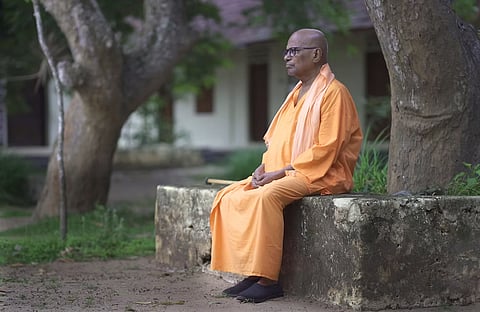


The passing of Muni Narayana Prasad on Saturday, April 25, at the age of 87, marks the loss of one of India’s most original philosophical voices on sustainability. He did not speak the language of climate targets or carbon markets. He did not frame his arguments in the vocabulary of policy or activism. Yet, few thinkers in recent decades have engaged as deeply with the crisis that now defines our time.
For him, the ecological question was not technical. It was civilisational.
At a time when sustainability is widely discussed in fragmented terms, energy, water, biodiversity, climate, he insisted on seeing the whole. The crisis, he argued, lies not only in how we manage resources but in how we understand existence itself. A civilisation that sees itself as separate from nature will inevitably destroy the conditions that sustain it.
Muni Narayana Prasad stands as one of the most rigorous inheritors of the legacy of Narayana Guru, the philosopher-reformer who challenged caste hierarchy and articulated a vision of equality grounded in spiritual unity. But Prasad did not merely interpret Guru. He extended that vision into the terrain of modern development, asking what it means to live ethically in a world shaped by consumption, extraction and speed.
Born in 1939 in Kerala, he trained as a civil engineer and briefly worked within the state system. That early exposure to infrastructure and planning gave him an insider’s understanding of how development operates. His decision in the late 1960s to leave that path and join the Narayana Gurukula marked a decisive shift.
The Gurukula, founded in 1923 by Nataraja Guru in the Nilgiris near Ooty, is unlike most institutions. It is not a monastery and not a university. It is a space of open inquiry where philosophy is lived rather than taught as doctrine. Drawing from the teachings of Narayana Guru, it created a platform where seekers from different backgrounds could engage with questions of existence, society and knowledge without the constraints of orthodoxy or academic compartmentalisation.
Muni Narayana Prasad would go on to lead this institution and shape its intellectual direction for decades. Through it, he reached readers and students across India and abroad, without ever seeking visibility in the conventional sense.
His body of work is vast, more than 130 books in Malayalam and English. He wrote on the Upanishads, the Bhagavad Gita and also engaged deeply with the Quran and the Bible. This engagement across traditions was not an attempt at superficial harmony. It was a serious philosophical effort to identify a shared ethical foundation that affirms the interconnectedness of life.
This idea of interconnectedness lies at the heart of his ecological vision.
Existence, he argued, is one. The divisions we create between human beings and nature are conceptual and misleading. Once this division is accepted, nature becomes available for exploitation. Rivers become water resources, forests become timber stock, coasts become real estate. What follows is not just environmental damage but a deeper erosion of meaning.
Long before climate change entered everyday discourse, he warned that a civilisation driven by endless consumption would destabilise both ecological systems and human well-being. Development, when detached from ethical restraint, becomes a process of extraction, from land, water and labour, and eventually from human consciousness itself.
Kerala, often held up as a model of social development, provided him with a living illustration of this contradiction. High literacy and health indicators coexist with growing ecological stress. Rivers swell during intense monsoon events yet lose their ecological vitality. Coasts are eroding even as economic activity expands. Public discourse is vibrant but increasingly fragmented.
He approached these not as isolated problems but as expressions of a deeper imbalance.
Take the case of rivers. Muni Narayana Prasad did not view them merely as hydrological systems to be regulated. He saw them as living presences within a shared ecological field. Their degradation, whether through pollution, damming or over-extraction, reflected a breakdown in the relationship between society and nature.
This insight has become even more relevant today. Across peninsular India, including the Cauvery basin, rivers carry more water during extreme rainfall events but show declining ecological health. The paradox of abundance without vitality points to the limits of purely technical management.
Similarly, the recurring floods in Kerala cannot be understood only through the lens of rainfall intensity. They are linked to patterns of land use, quarrying, deforestation and unregulated construction. Groundwater depletion in regions that receive heavy rainfall indicates a failure to understand water as part of an interconnected cycle. Coastal erosion, intensified by infrastructure projects and sand mining, reveals the fragility of ecosystems under sustained pressure.
In each of these cases, responses have largely been technical. Better forecasting, stronger infrastructure, tighter regulation. These are necessary but insufficient. They do not address the underlying logic that drives ecological degradation.
Muni Narayana Prasad’s work invites a more difficult question. Why do societies continue to act in ways that undermine their own ecological foundations.
His answer was uncompromising. The crisis lies in perception.
When nature is reduced to a resource, human beings too are reduced to economic units. The same logic that allows the extraction of sand from rivers enables the exploitation of labour and the erosion of community life. Ecology and justice, in this sense, are inseparable.
His critique of consumerism is central to this argument. A society organised around desire will inevitably exhaust both natural resources and inner stability. This is not only an environmental issue but a civilisational one.
At the Narayana Gurukula, he attempted to live out an alternative. The Gurukula functioned with minimal consumption and emphasised simplicity, restraint and attentiveness to the environment. This was not presented as a retreat from the world but as a demonstration of what sustainable living could look like when rooted in ethical awareness.
He was also critical of the commodification of knowledge. In a world where education is increasingly shaped by market demands, his work insisted on keeping inquiry open, accessible and connected to life. His writings across religious traditions were part of this effort to democratise understanding.
The Tamil-Malayalam writer B Jeyamohan once observed that “Muni Narayana Prasad stood in a rare space where thought itself became a form of meditation, continuous, disciplined and anchored in lived reality.”
Writer N E Sudheer offered a similar insight, noting that “for Muni Narayana Prasad, philosophy was not argument alone but a way of aligning life with truth, where understanding must transform how one lives.”
These reflections capture the essence of his work. He did not treat philosophy as abstraction but as a method of seeing and living.
Two broader observations often made by those who engaged closely with him underline his continuing relevance. He brought Narayana Guru’s vision into the present not as memory but as method, a way of understanding society, nature and the self as one continuum. And at a time when sustainability is reduced to policy language, he reminded us that without ethical transformation, no ecological solution can endure.
His critique also anticipates many strands of contemporary ecological thought. The limits of growth, the need to rethink well-being beyond consumption, and the importance of balance between human activity and natural systems are all themes that find resonance in his work. Yet, unlike many modern critiques, his approach does not reject science or technology. Instead, it calls for their reorientation.
Science, in his view, must be guided by ethical insight rather than market imperatives. Development must be measured not only by economic output but by its impact on ecological integrity and social well-being.
For readers outside Kerala, his significance lies in this ability to bridge traditions and contemporary challenges. He represents a strand of Indian thought that integrates ecology, society and consciousness. At a time when environmental debates are fragmented across disciplines, his work insists on seeing the whole.
He did not lead movements or organise protests. His intervention was quieter, through writing, teaching and lived example. But its implications are far-reaching.
He leaves behind not just a body of work but a set of urgent questions. Can development be reimagined beyond extraction. Can societies move from consumption to restraint. Can ecological balance be restored without rethinking the ethical foundations of modern life.
Muni Narayana Prasad did not offer easy answers. What he offered instead was a way of seeing, one that recognises the interconnectedness of all life and the responsibilities that follow from that recognition.
In an age defined by climate crisis and ecological uncertainty, that way of seeing may well be his most enduring legacy.