

As global climate talks push market-based land restoration, India is rethinking its grasslands once dismissed as “wastelands”.
Scientists now recognise them as vital ecosystems, yet new carbon and biodiversity credit schemes risk repeating old plantation logic.
With soil carbon hard to measure and commons poorly protected in law, the real test is whether pastoral communities retain control over their rangelands.
The 17th Conference of Parties to the United Nations Framework Convention on Climate Change (UNCCD COP17) has just closed in Ulaanbaatar, in the United Nations International Year of Rangelands and Pastoralists. Much of the summit was about money. The convention estimates that land restoration needs about $355 billion a year through 2030, compared with roughly $77 billion flowing now. To close that gap, the talks leaned on markets, including nature and biodiversity credits, and launched a rangelands finance initiative worth about $1.2 billion. Rangelands cover more than half the world’s land surface and support around 500 million pastoralists, so the direction of this finance matters.
India is part of the shift, and it arrives at a turning point at home. For decades the state read treeless land as empty and filed India’s grasslands, savannas, and scrub under the label of ‘wasteland’. That reading is finally breaking down. Scientists have shown these open ecosystems are not degraded forests but functioning systems in their own right, and official language is starting to catch up. The correction is welcome. The worry is how it is being routed. Recognition is arriving with a price tag attached, through carbon and biodiversity credits. So, it is worth asking one narrow question. As India stops calling grasslands wastelands, is the market-based fix repeating the plantation logic it is meant to replace?
Start with what is actually happening and what is not. In February 2024, the environment ministry notified a tree-plantation methodology under the Green Credit Programme that allows plantation on degraded land, including open forests, scrub, wasteland, and catchment areas under state control. Green credits are tradable, and ecologists have warned that the definition of degraded land is loose enough to put trees on grasslands that were never forests. Separately, grassland carbon finance is now being promoted directly: a June 2026 analysis by TERI calls grasslands a hidden carbon bank and argues that restoration can become a pathway for carbon finance. A biochar carbon-removal project already operates on the Banni grasslands in Kutch. India’s formal carbon market, though, has no approved grassland or rangeland soil-carbon methodology yet. So, this is a frontier arriving, not a market already running, and it would be wrong to claim otherwise. The point is that the design is being set now, before the projects scale.
Grassland carbon is genuinely hard to price. Most of it sits below ground, where it is expensive to measure and slow to verify. Dryland soil carbon is also old and, once disturbed, hard to rebuild: one study in Nature Communications found that dryland soils hold organic carbon with a mean age of around 2,100 years. Crediting schemes struggle with additionality too, meaning payment for carbon that would have accumulated anyway. The clearest warning comes from Australia, where a 2024 study in Carbon Management found that soil carbon credits issued to grazing farms implied sequestration rates far above those in the scientific literature, and that the measured gains were largely driven by above-average rainfall rather than by anything the projects did. On Indian grasslands the ecological risk is sharper still. Chasing measurable carbon can push land managers toward soil disturbance or tree planting, and both can destroy the perennial grass bud banks that let these systems regenerate after the monsoon. A credit designed to store carbon can end up harming the ecosystem that held it.
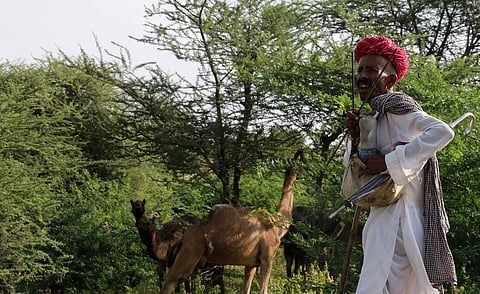
The deeper issue is not measurement but power: who decides and who benefits. Rangelands are commons, and pastoral mobility is the management system, not a sign of its absence. A carbon or biodiversity project that fixes boundaries, excludes grazing, or assigns the land to whoever can fund the credits can cut across that system. The cautionary evidence so far comes from elsewhere and should be read as a warning rather than as Indian fact. In northern Kenya, a large rangeland carbon project that sold millions of credits to global buyers was challenged over consent, and in early 2025 a Kenyan court found two of its conservancies had been set up unconstitutionally, after which the registry suspended the project. Maasai communities in Tanzania are resisting soil-carbon schemes on grazing land for similar reasons. None of this has happened in India. The concern is that the design that produced it is now being proposed here.
India has its own version of the gap, and it is legal. Grassland commons often fall between categories, neither clearly forest nor cleanly revenue land, which makes it hard for pastoralists to claim community forest resource rights over them under the Forest Rights Act. India’s carbon market rules, notified in 2023, do not refer to the gram sabha consent that the act entails. The 2023 amendment to the forest law also removed mandatory gram sabha consent for diverting forest land. So a credit or plantation project on a commons can, in principle, proceed without the people who depend on it having a say.
Banni shows these pressures meeting on one landscape. At COP17, the environment minister named Banni and described pastoralists as custodians rather than beneficiaries. On the ground, the National Green Tribunal upheld the Maldharis' community forest resource title over Banni in 2021. A biochar project now runs there, converting invasive Prosopis juliflora into carbon credits bought by firms including Google and Microsoft. Clearing that invasive species is defensible on its own terms, and the point is not that this project is a villain. It is that the same grassland is now valued as carbon, eyed for a cheetah population, and held under a community title all at once. Whose valuation prevails, and who signs off, is unsettled.
None of this argues for leaving grasslands unpriced and unprotected. It argues for valuing them without pricing away the people and the ecology that make them work. Three steps would help. Recognised community forest resource areas and mapped open ecosystems should be excluded from the degraded land eligible for green credits and plantation. Gram sabha consent should be a documented precondition for any credit or plantation project on a commons, not an afterthought. And a model already exists: in January 2025, Himachal Pradesh notified 1,637 pastoral routes and halting sites and directed forest staff not to plant trees on them. That is recognition with legal teeth.
India enters the Year of Rangelands with the right words. The test is whether the instruments follow them. If the fix simply re-prices grasslands as carbon and hands them to whoever can afford the credits, it will have renamed the wasteland, not retired it.
Views expressed are the authors’ own and don’t necessarily reflect those of Down To Earth