

India’s environmental indicators paint a deeply worrying picture, according to the latest annual statistical report released by Delhi-based think tank Centre for Science and Environment (CSE) and Down To Earth magazine to mark the upcoming World Environment Day.
State of India’s Environment 2026: In Figures, released by CSE director general Sunita Narain on June 4, 2026, used official government data to track trends across climate, extreme weather, public health, forests, biodiversity, water, air pollution, waste and the performance of Indian states on key development indicators.
“We must hold on to numbers,” Narain wrote in the foreword. “You get what you measure; more importantly, what gets measured is what, subsequently, gets done. Data, therefore, is central to driving actions.”
The country diverted around 97,000 hectares of forestland for non-forest use between 2020-21 and 2024-25, with forest diversion rising in 26 states, the report detailed. Human-wildlife conflict also showed a worrying increase. Elephant attacks on humans rose in 10 states during this period, while tigers killed 40 people in the first six months of 2025 alone.
As many as 15 states and UTs fell below the halfway-mark in in the analysis. Waste management has emerged as the biggest challenge for most.
“Goa, the top-ranked state, has excelled due to its high share of new renewable sources in power generation,” said Kiran Pandey, programme director, environmental resources, CSE and one of the authors of the report. “However, the state faces challenges like forest cover change, sewage treatment and management of polluted river stretches.”
Richard Mahapatra, managing editor of Down To Earth and report co-author, pointed out that even top-ranked states seem to be struggling. Punjab, which demonstrates a strong agricultural economy, lagged in ‘agriculture inputs’ due to its high dependence on chemical fertilisers and weak show on organic farming, he said.
The e-report was released June 4, 2026 ahead of World Environment Day (June 5) by CSE director-general Sunita Narain in a virtual presentation. “In today’s uncertain world, numbers are the crutch that will help us stay grounded. They will help us understand trends: What is shaping our world and our future; what is changing; what is improving, and what is not,” she said.
“Barring one, all indicators for assessment have used official government data sources,” Mahapatra said, explaining the methodology behind the data selection.
In the 'agriculture and land' theme, Punjab, Haryana, Sikkim, Tripura and Jharkhand were top rankers, while Mizoram, Nagaland, Odisha, Telangana and Goa were the lowest.
Indicators for this assessment included agricultural economy, agriculture input, farmer welfare and sustainable land use.
Twenty-seven states have remained below the halfway mark in this category and “farmer welfare is where most of the states have performed poorly,” said Pandey.
In the 'public health' theme, Goa, Himachal Pradesh, Manipur, Kerala and Sikkim emerged as best performers. Madhya Pradesh, Bihar, Uttar Pradesh, Assam and Chhattisgarh were at the bottom of the rankings.
Among Union territories, Delhi topped the ranking that was done on the basis of four metrics: Cost of health, environmental risk, health outcome and health infrastructure. Dadra and Nagar Haveli and Daman and Diu were the lowest scorers.
Goa is the only state in India where all registered deaths are medically certified with a known cause of death, according to a joint press release by DTE and CSE. However, the state faces a shortfall in government hospital beds per 1,000 population, it noted.
While 16 states and UTs have fallen below the halfway mark in this category, ‘environmental risk’ (disability adjusted life years due to air pollution) has emerged as the key cause for concern in most of them.
On 'public infrastructure and human development, Goa, Nagaland, Tripura, Himachal Pradesh and Tamil Nadu were the top performers, while Jharkhand, Bihar, Uttar Pradesh, Odisha and Arunachal Pradesh were the worst.
Dadra and Nagar Haveli and Daman and Diu topped the ranking among UTs and Lakshadweep was at the bottom.
Public infrastructure, gender, education and unemployment, and povery and inequality were the four indicators for this analysis.
Thirty-two of the 36 states and UTs were assessed to be below the halfway mark, with public infrastructure (roadways, power and housing) the common problem area.
The findings indicate that overall national progress toward achieving the Sustainable Development Goals (SDG) is likely to be slower, particularly in critical areas such as health outcomes, infrastructure development, social equity, and environmental sustainability, said Mahapatra.
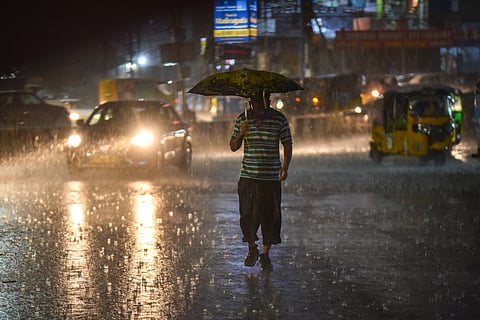
Extreme weather events were recorded across all states and Union territories in 2025. India experienced extreme weather on 99 per cent of the days of the year, according to CSE’s analysis. These events killed 4,421 people and damaged 17.41 million hectares of cropped area.
The report also flags mounting water stress. Fifteen states and Union territories have over-exploited groundwater, with Punjab, Rajasthan and Haryana extracting more groundwater than is recharged. Major river deltas in India are also sinking at alarming rates due to excessive groundwater extraction.
Public health indicators, too, show signs of strain. Nearly 13 per cent of Indians reported suffering from some kind of disease, with young girls and women reporting higher illness than men in both rural and urban areas. The report notes that the share of people reporting illness has doubled in three decades.
Air pollution remains one of India’s biggest health burdens. India’s share of global air pollution-related deaths rose from 23.76 per cent to 25.34 per cent between 2014 and 2023. Deaths attributable to ambient PM2.5 increased by 61 per cent over the past decade.
Richard Mahapatra, managing editor of Down To Earth and one of the report’s writers, said the findings were “discouraging”, especially because none of India’s five most populous states feature at the top of the state rankings.
Narain said the report offers “an opportunity to fix what is broken”, adding that data must guide planning on water scarcity, pollution, air quality and public transport.
