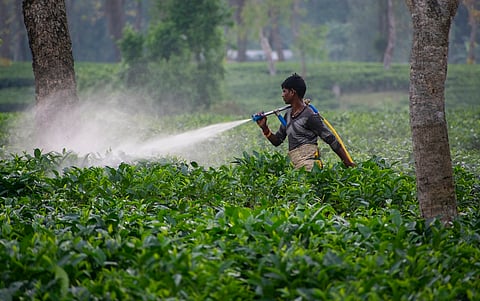


The Union Ministry of Agriculture and Farmers Welfare on January 7 released a fresh draft of The Pesticide Management Bill, 2025, aimed at regulating everything from manufacture, import to sale and use of pesticides.
The proposed law seeks to replace the Insecticides Act of 1968 and the Insecticides Rules framed more than five decades ago, marking yet another attempt — after several earlier efforts — to overhaul India’s pesticide regulatory framework.
However, the 2025 draft introduces limited substantive changes when compared to the Pesticides Management Bill circulated in 2020. Many of the concerns raised by experts and civil society groups over the earlier version, particularly around regulatory clarity, enforcement powers and accountability, remain largely unaddressed.
While the number of clauses in the bill has been reduced from 65 to 55, critics argued that the language of the revised draft was weaker. Key demands, including greater regulatory and prohibition powers for state governments, provisions for price regulation, and clear redressal and liability mechanisms, continue to be missing from the proposed legislation.
The draft bill 2025 says it aims to “strive to minimise risk to human beings, animals, living organisms other than pests, and the environment”, instead of a stronger language of “minimise risk”, as suggested and demanded by organisations like Pesticide Action Network (PAN) India in the 2020 version of the draft.
The bill, the Union government said, was a “farmer-centric legislation”, that incorporates provisions such as transparency and traceability to ensure better services to farmers, thereby “promoting ease of living”.
In 2025, Union Agriculture Minister Shivraj Singh Chouhan heard complaints from farmers, in a month-long campaign, regarding sale of spurious pesticides and fake seeds, and had called for strict action.
However, even in the revised bill, state governments have not been provided with regulatory powers to act on prohibition of pesticides. Under the bill, the state governments can issue a notification to prohibit the distribution, sale or use of a pesticide or a specified batch in such area for a period not exceeding one year.
This notification will then be reviewed by a ‘Registration Committee’, formed by the Union government and consisting of a chairperson nominated by it, along with by members from Drugs Controller General of India, Indian Council of Agricultural Research, Union Ministry of Environment, Forest and Climate Change, Department of Chemicals and Petro Chemicals, Union Ministry of Chemicals and Fertilizers, a representative of any national public institution of repute conducting research in toxicology, and a Plant Protection Advisor.
There is also a provision of constitution of a Central Pesticides Board, which will recommend pesticides to the central government for inclusion in the act from time to time, making criteria for good manufacturing practices including processes for pesticide manufacturers, best practices for pest control operators, and the procedure for the recall of pesticides, and criteria for the disposal of pesticides and packages in an environmentally sound manner. It will also frame model protocols to deal with occurrences of poisoning including the specification of standard operating procedures for medical facilities.
“Functions of the board are as same as proposed in 2020, but they are not as provisions of the law,” said Narasimha Reddy Donthi, a public policy expert and consultant at the Pesticide Action Network India.
He added that state governments have no role in punitive measures, and the effectiveness of such measures may not be felt by companies or offenders.
Meanwhile, there is no mention of a ‘criminal liability’ provision, which fixes liability and awards appropriate punishment for both manufacturers, distributors and marketers in cases where pesticides have been used for other than crop protection purposes such as poisoning of lakes, and other water bodies and suicides.
There has been an inordinate delay in enacting the Pesticides Management Bill to replace the Insecticides Act of 1968. The Bill is meant to ensure more effective regulation of the sector, minimise risks to human beings, animals, living organisms other than pests and the environment, with an endeavour to promote pesticides that are biological and based on traditional knowledge.
The first such bill was introduced in 2008, followed by in February 2018, which was introduced in Rajya Sabha as a revised bill in 2020. It was then sent to a parliamentary standing committee.
The government has invited comments and suggestions on the draft bill and its provision from all stakeholders and the general public by February 2, 2026.