
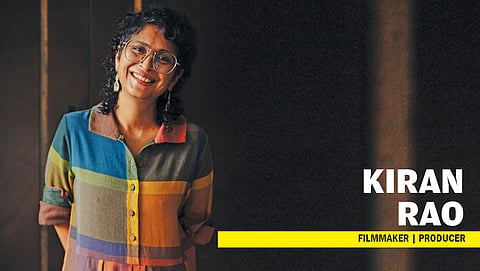
“Practising sustainability is not always convenient”

Filmmaker and producer Kiran Rao has mastered the art of mainstreaming social commentary, as seen in her early films like Dhobi Ghat and more recently in Laapataa Ladies and Humans in the Loop. In 2016, Rao co-founded Paani Foundation, a non-profit focused on helping Maharashtra’s drought-stricken farmers become climate-resilient. In an interview with Preetha Banerjee, Rao shares how her journey has deepened her understanding of nature and how it has influenced her creative work:
What first sparked your awareness of environmental and social issues, and how has that awareness evolved over the years?
My awareness has developed slowly and organically over the years. As a child, I always felt most alive when I was outdoors—around trees, rain, rivers—especially during our family holidays in the Himalayas. I did not have the language to express it then, but as I grew older, I learnt how deeply we are nurtured by and connected to nature. Later, as I began travelling through rural India, especially after we started Paani Foundation, I saw how everything is interconnected. Trees, water and the care we give to our natural resources are directly tied to our survival, family security, and even our happiness.
Through our work on mitigating drought and improving farmer livelihoods, I saw firsthand how climate change is not an abstract idea. It is tangible—visible in the lives of farmers, in parched wells and in the loss of forests. That experience deepened my understanding. I realised that environmental consciousness is not just a personal feeling; it is a social and collective responsibility.
Practising sustainability is not easy. What challenges do you face while making these choices?
I try to live simply. I am very aware of my water usage and we try to reuse as much as possible at home. Composting, saying no to single-use plastics and eating local, seasonal food—these may seem like small actions but they add up. I also try to choose sustainable fashion and support local designers and artists. During film production and the events we host at Paani Foundation, we try to be mindful—by avoiding waste and being responsible with travel and use of materials. Beyond all that, it is really about sensibility. You start by asking yourself: What kind of world am I reflecting? What values am I reinforcing? These questions result mindful actions.
The hard part is that it is not always convenient; it is not easy to recycle or always choose cleaner alternatives. Part of it is cost and access, another part is habit. I believe that those of us who have access to better choices should make them. We have grown accustomed to convenience and unlearning that takes effort. But it is not impossible. I still have a long way to go before I can say I am proud of my carbon footprint, but I try my best every day.
Has your environmental awareness influenced the kind of projects you choose or the way you approach your work in film, theatre or writing?
Yes, it has, perhaps not in obvious ways, but in how I see the world. I am drawn to stories that are rooted in people, places, relationships that feel lived-in. I find myself gravitating towards authenticity, towards characters that exist in relation to their environment. In fact, the next film project I am developing is deeply rooted in ecological consciousness and the interconnectedness of all life. Storytelling has immense power. It can normalise care, empathy, balance. That is something I try to hold on to, whether it is a big film or a smaller creative project.
You have co-founded Paani Foundation. What has the journey been like and what does it mean to you?
It has been one of the most profound and joyful journeys of my life. When we started Paani Foundation, we were clear that this was not about charity but about enabling people to take charge of their own future. The initial idea was simple: motivate and mobilise communities, teach the science of watershed management and unite people around a shared goal. We aimed to make the process joyful by hosting a competition called the Water Cup, that takes the drudgery and crisis away from drought. We did not anticipate how transformative the process would be. Village residents who had not spoken to each other in years began working side by side. Women emerged as incredible leaders. The land transformed, but so did the people.
I have learnt more from our own communities than from any classroom. People have shown what collective action and hope can achieve. For me, Paani Foundation is a reminder that environmental transformation is about change in human behaviour; it is about social unity, collabo-ration and resilience.
You have often used art as a medium to explore pressing social issues. What kind of stories do you think we need more of today?
Stories shape how we see the world—what we value, what we stand for, and how we understand our place in the larger ecosystem. I have always believed that environmental consciousness is not separate from human consciousness. The way we treat the earth mirrors the way we treat each other—with care or with indifference. For example, that is what drew me to Humans in the Loop, a film directed by Aranya Sahay, which I recently came on board as an executive producer for. It is about an adivasi woman working as a data labeller to train an AI (artificial intelligence) model. On the surface, it may seem like a job completely detached from nature. But beneath that, it is a story about disconnection—how technology can erase indigenous knowledge systems and cultural contexts, how progress can marginalise those closest to the land, and how we risk losing our roots, both cultural and ecological, in the name of advancement.
That is the kind of storytelling we need more of today. They do not need to be heavy or didactic “issue films”—they can be human narratives that show how interconnected our worlds really are. We also try to do with the short films we make at Paani Foundation. These are stories that remind us that we are not outside nature; we are part of it.
This article is from the January 1-15, 2026 special edition, "Anxiety in a warming world", featuring exclusive interviews with Dia Mirza, Kalki Koechlin, Kiran Rao, Nila Madhab Panda, Sajana Sajeevan, Tsewang Chuskit, Manish Mehrotra and others, as well as columns by scientists, activists and journalists