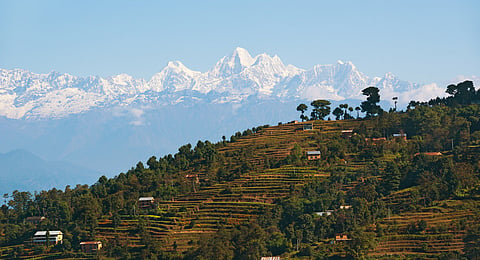


The article argues that the rapidly warming Himalaya, where glaciers are collapsing and hazards are intensifying, must be treated as a humanitarian crisis rather than a niche environmental issue.
Using Nepal’s deadly 2026 disaster as a warning, it calls for early-warning systems, risk-sensitive development, community-led planning and fair climate finance based on vulnerability, not national income.
The Himalaya is warming at roughly twice the global average. Its glaciers are retreating, permafrost is becoming increasingly unstable, and thousands of glacial lakes are changing in size and behaviour. But the risks facing Himalayan communities go beyond glacial lake outburst floods (GLOFs). Glacier collapses, ice-rock avalanches, landslides, debris flows and sudden floods can combine to produce disasters with little warning.
Nepal’s catastrophe of August 26, 2026, is a devastating reminder. A massive ice-rock and glacier collapse in the Langtang-Lirung region triggered a destructive surge through the Bhotekoshi-Trishuli river system, sweeping away settlements, bridges, roads and critical infrastructure. By early September, Nepal’s disaster authorities had confirmed more than 1,300 deaths, with nearly 5,000 people still missing; dozens more were killed or unaccounted for across the border in China’s Tibet Autonomous Region. It is now Nepal’s deadliest disaster since the 2015 earthquake. The government’s preliminary assessment puts reconstruction costs at $4-5 billion, alongside an initial estimate of over Rs 400 billion in overall losses. Preliminary assessments point to a glacier collapse rather than a conventional glacial lake outburst flood as the trigger.
This distinction matters. The lesson from Nepal is not simply that we need to monitor more glacial lakes. It is that the entire Himalayan risk landscape is changing.
The Himalaya is among the world’s youngest and most geologically active mountain systems. The continuing collision of the Indian and Eurasian plates makes it inherently prone to earthquakes, landslides and slope failures. Climate change is adding another layer of instability by accelerating glacier retreat and contributing to permafrost degradation. When these natural processes interact with roads, hydropower projects, settlements and other infrastructure in vulnerable valleys, a hazard can quickly become a humanitarian catastrophe.
The scale of the August disaster means relief cannot end with rescue and debris clearance. The immediate priorities are clear: restore safe drinking water and sanitation; reconnect isolated communities by repairing roads and bridges; provide emergency shelter and essential supplies; and ensure that cash and other assistance reaches bereaved, displaced and vulnerable families without bureaucratic delays.
But temporary shelter cannot be the endpoint. Displaced families need a credible recovery and resettlement plan that does not simply move them from one hazardous location to another. Reconstruction must include livelihoods, health, education, social protection and psychosocial support.
Most importantly, rebuilding should reduce vulnerability rather than reproduce it.
Nepal has experienced a succession of serious glacial and mountain hazards in recent years.
In August 2024, a cascading glacial lake outburst flood devastated much of Thame village in the Everest region. An upstream glacial lake overtopped and contributed to the failure of a downstream lake, sending hundreds of thousands of cubic metres of water and debris towards the village.
In May 2025, glacial lakes above Tilgaun in Humla burst suddenly, damaging bridges and water infrastructure and displacing families. Two months later, in July, a sudden glacial flood swept away the Nepal-China Friendship Bridge at Rasuwagadhi and disrupted a vital cross-border trade route.
These events should not be treated as isolated accidents. They demonstrate the growing exposure of Himalayan communities to a combination of GLOFs, glacier collapses, landslides and flash floods.
A 2020 ICIMOD-UNDP inventory identified 47 potentially dangerous glacial lakes in the Koshi, Gandaki and Karnali basins across Nepal, Tibet and India-25 in China, 21 in Nepal and one in India. These lakes require close monitoring because their failure could generate dangerous floods downstream.
But the August 2026 disaster reminds us that monitoring lakes alone is not enough.
The Himalaya needs a comprehensive mountain-hazard early-warning architecture.
This should combine satellite monitoring with ground-based sensors, seismic and acoustic monitoring, river gauges, drones and other technologies capable of detecting rapidly developing glacier, landslide and flood events. High-risk glacial lakes and unstable slopes should be regularly assessed, while communities downstream must have functioning sirens, mobile alerts, evacuation routes and safe shelters.
Technology, however, is only half the solution.
An early warning that reaches a government office but not a remote household has failed. Communities must know what an alert means, where to go and how quickly to move. Regular drills, local volunteers and community-based disaster preparedness are therefore as important as sophisticated monitoring equipment.
The experience of Blatten in Switzerland demonstrates what early warning can achieve. In 2025, years of monitoring an unstable glacier and surrounding slopes enabled authorities to evacuate residents before a massive collapse. The village was devastated, but the advance evacuation prevented a mass-casualty disaster.
The Himalaya needs the same principle: anticipate, warn, evacuate and reduce risk before disaster strikes.
And because Himalayan hazards cross borders, India, Nepal, Bhutan and China must strengthen systems for sharing risk information. A flood does not stop at a boundary line, and neither should hazard data.
Across the Himalaya, including Nepal and India, road-cutting, hydropower development and settlement in floodplains or unstable slopes can increase exposure and vulnerability.
The answer is not to stop development. Himalayan communities need roads, electricity, communications, schools, hospitals and livelihoods. But development must recognise the ecological and geological limits of mountain environments.
Environmental assessments should therefore move beyond individual projects. What matters is the cumulative impact of dams, roads, tunnels, hydropower stations, transmission lines and settlements across an entire river basin.
Reforestation of degraded slopes, restoration of natural drainage channels, protection of river corridors and strict controls on construction in high-risk areas must become part of development planning.
Local and Indigenous communities must also be treated as partners. Their generations of knowledge about rivers, slopes, glaciers and changing weather patterns can complement scientific monitoring. They should not be consulted only after projects have been designed or disasters have occurred.
Perhaps the most important lesson from Nepal is political rather than technical.
Nepal has begun calling for climate justice and compensation from major greenhouse-gas emitters, arguing that a country contributing very little to global emissions should not bear the escalating costs of a warming world alone.
This is not an argument against humanitarian solidarity. It is an argument for a fairer international system in which countries and communities facing climate-induced loss and damage receive the resources necessary to recover and build resilience.
ActionAid has consistently argued for this principle in international climate negotiations. Its climate justice benchmarks have called for wealthy, high-emitting countries to provide adequate finance to communities on the frontline of the climate crisis, including through the Loss and Damage Fund, and for this support to be provided as grants rather than loans so that vulnerable countries are not pushed deeper into debt.
At COP30 in Belem, the Fund for Responding to Loss and Damage issued its first call for funding, backed by just $250 million in grant support-a fraction of what climate-vulnerable countries need. That funding window was, rightly, designed to prioritise smaller and least-developed nations such as Nepal, whose contribution to global emissions is negligible but whose exposure to glacial floods, landslides and monsoon extremes is acute.
But the same logic that justifies support for Nepal should not exclude India. India is among the most climate-vulnerable countries in the world, with a fragile Himalayan north and more than 11,000 kilometres of coastline exposed to cyclones and sea-level rise. Because of its size and middle-income status, India is often assumed to be able to absorb these costs domestically, and current Loss and Damage funding windows are structured in ways that leave it little realistic access to global finance. Yet many of India’s own Himalayan and coastal states-Assam, Bihar, West Bengal, Uttarakhand, Sikkim-face the same glacial and flood risks devastating Nepal, and India’s disaster response is financed almost entirely out of its own budget. A fair and coherent climate justice framework must recognise that both smaller nations like Nepal and larger, highly exposed countries like India deserve access to international Loss and Damage funds when disasters of this scale strike; vulnerability, not the size of a country's economy, should determine eligibility for support.
The issue, therefore, is not charity. It is responsibility, equity and justice.
Nepal’s tragedy should become part of a wider Himalayan demand for climate finance-reaching India, Nepal, Bhutan and other exposed nations alike-that supports early warning, risk reduction, resilient infrastructure, ecosystem restoration, livelihood recovery and safe relocation where necessary.
The Himalaya cannot be rebuilt village by village after every disaster.
The real challenge is to change how we understand both development and humanitarian action in mountain regions.
Relief must restore dignity and livelihoods, not simply provide temporary shelter. Reconstruction must reduce risk rather than reproduce vulnerability. Infrastructure planning must treat mountains as living, shifting and interconnected systems rather than as backdrops for dams and highways. Early-warning systems must reach the last household, not just the most accessible valley. And climate finance must reach every community living on the frontline of the crisis, whether in a small mountain nation or a large, exposed one.
The August 2026 catastrophe should become a turning point.
The Himalaya is not merely a spectacular landscape. It is a living ecological system, the source of water for hundreds of millions of people and home to some of Asia’s most vulnerable communities.
Protecting Himalayan ecology is therefore not an environmental luxury. It is a humanitarian imperative.
And if the world is serious about climate justice, those who have contributed most to warming the planet must help pay the cost of keeping its most vulnerable communities-large and small-safe.
Views expressed are the author’s own and don’t necessarily reflect those of Down To Earth
