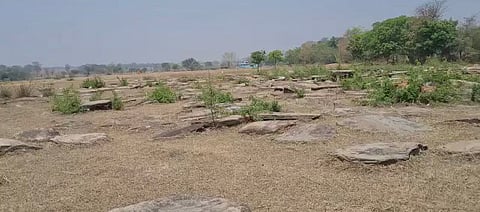


The megaliths of Jharkhand, the sociological and archaeological relics of India’s Adivasis, are yet to receive any concrete recognition which can protect them from complete destruction as a result of mining and developmental projects according to the researcher who has played a critical role in bringing them to public attention.
Hazaribagh-based researcher and author Subhashis Das has spent three decades of his life documenting these ancient structures. The ground reality though, he told this reporter, is very different.
He points to the famous megalithic site of Chokahatu, which lies in Bundu in Ranchi district. It is yet to be declared a UNESCO World Heritage Site.
According to Das, he wants Chokahatu to get UNSECO status. In one of his works, he had mentioned Chokahatu as far back as 2009. The book is called Sacred Stones in Indian Civilization. Das also shared that about a decade ago, he started an online campaign to make Chokahatu a World Heritage Site for its continued uninterrupted usage by the Munda tribe.
The reason for preferring Chokahatu is clear. “The other famous site, Pakri Barwadih, which lies in Hazaribagh district and was used to view equinoxes, is on the brink of obliteration and cannot be declared a heritage site. And it is not only Pakri Barwadih which is in danger, as coal mining has taken its toll on many megaliths of Jharkhand,” Das said.
Indeed, when this reporter visited Chokahatu in 2021, it was in a sorry state with cattle having a free run at the place.
In a story reported for the Pulitzer Center by this reporter, mining in the Pakri Barwadih open-cast coal mine, which is spread over more than 3,000 hectares, started in 2016. The mine owned by the National Thermal Power Corporation, with a production capacity of 15 million tonnes a year, is located within five kilometres of the megalith site. It is no wonder then that the site is in danger, as Das noted. In 2017-2018 as reported by Down To Earth, people’s protests against coal mining had happened in the area.
On his part, Das got a bit emotional while talking about his favourite megaliths of Jharkhand. “I was almost in tears when I found that the stones had disappeared when I took some of my friends to see the Katia Murwey site discovered about 12 years back near Hazaribagh. They came over from England especially to see it.”
The author has penned several books on megaliths. For an upcoming book on these structures, which will come out within a few months, he has already completed the third edit till the time of reporting this story. He promised that this book, his fifth and last one, would be a wholesome history on megaliths.

For discovering the megaliths of Jharkhand, Das has also been featured in the Jharkhand board’s Class 6 history book. His 2018 book, The Archaeoastronomy of a Few Megalithic Sites of Jharkhand, was a bestseller. In one of his books titled Lost Heritage of Jharkhand Including Megaliths, which was published with three other booklets of Outlook Traveller Getaways, he showed that megaliths can be popular tourist sites.
Outside Jharkhand, Deosa in Rajasthan near Jaipur once had a wonderful megalithic complex, but today it does not exist. “In this upcoming book, I have featured Rajasthan and even the Asota megaliths of Pakistan. India has megaliths, right from Kashmir to Kanyakumari,” said Das.
As megaliths were never part of the mainstream Indian consciousness, many people still have no idea about them. Das informed that the National Thermal Power Corporation had planned to come up with a megalithic park but does not feel it would be of much help anyways. “I now repent as to why I popularised Chokahatu and Pakri Barwadih. I made a mistake and should have only restricted them to my books.” In his Facebook posts, Das writes a lot about his megalithic discoveries. He pointed out that prior to him, nobody discussed the megaliths of Jharkhand.
In January this year, Jharkhand chief minister Hemant Soren went to Davos, Switzerland for the World Economic Forum. After that, he visited Engalnd for highlighting the state’s megaliths on the basis of Stonehenge. But Das lamented that till now not a single megalithic site in India has been declared a UNESCO World Heritage Site.
“Now, of course, it is being talked about as megaliths have come to the forefront. It is possible that Hirebenakal can be declared a heritage site, and also maybe Mudumal in Telangana. But I focus mainly on Jharkhand. However, megaliths are there in southern India, right from Vidarbha (Maharashtra) downwards.”
Many megaliths have been eaten up as a result of land acquisition and coal mining in Jharkhand, a mining-heavy state formed in 2000. In 2021, this reporter visited the Chano megalith on Das’ insistence only to find that it has disappeared completely. It was one of the best archaeo-astronomical megalithic sites. “I had discovered it almost 25 years back,” Das added. Of course, that land is gair majrua (government land generally uncultivated and used for public purposes), and as it belongs to nobody in records, it is always encroached upon by locals.”
In the iconic Bangla novel Aranyak, writer Bibhutibhushan Bandyopadhyay mentions the burial places of the tribes of North Bihar (Bhagalpur and Purnea). He also mentions Tarbaro, the buffalo king and others myths of the forest. Today, while South Korea and England have famous megaliths which are famous tourist attractions, Jharkhand’s megaliths still remain largely unknown.
In January this year, a Jharkhand delegation headed by Soren met Historic England, the United Kingdom’s public body responsible for heritage protection. The aim is to explore long-term collaboration on the conservation of Jharkhand’s megaliths.
Jharkhand is a mineral-rich state and holds vast reserves of coal. The state has 114 coal mines, of which 27 are underground, 77 open-cast and 10 mixed, as per a report, Coal Transition Jharkhand by the National Foundation for India. In Pakri Barwadih, about 25 km from Hazaribagh, 41,976 people and 1636.18 hectares of land are affected, according to Land Conflict Watch.
As India still largely depends on coal for energy outputs, it is mined extensively in states like Jharkhand, Odisha and Chhattisgarh. So, it is no wonder that megaliths hardly get the attention they deserve in a land ravaged by mines. Jharkhand was exclusively created from Bihar after bifurcation to promote Indigenous or tribal communities and their culture and heritage. Even today, the Mundas of Jharkhand practice a living megalithic tradition. In many places they erect stones slabs to mark burials and land rights. This can be traced also to the Pathalgadi movement of Jharkhand which took the country by storm around 2019.