
Subscribe

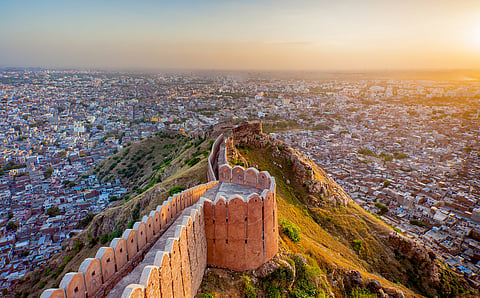
The Aravalli hills are not merely a geological formation; they are an ecological system that has quietly shaped water, climate and human settlement across northwestern India for millennia. Stretching across nearly 670 kilometres from Gujarat through Rajasthan to Haryana and Delhi-National Capital Region (Delhi-NCR), the Aravallis are among the oldest surviving mountain systems on the planet, formed over three billion years ago. Long before modern states, laws, or economies existed, these ancient hills shaped the ecological destiny of northwestern India. They moderated climate, slowed the eastward march of the Thar Desert, enabled groundwater recharge across semi-arid regions, and supported complex human and ecological settlements. Today, however, the Aravallis are increasingly discussed not as a living ecological system but as an administrative category: something to be narrowly defined, selectively protected and strategically exploited.
The ongoing controversy around mining, legal definitions and environmental regulation in the Aravalli region is therefore not a routine policy dispute. It is a moment that reveals how the Indian state understands environmental responsibility in an era of economic urgency. At stake is not merely the fate of a mountain range, but the credibility of India’s environmental governance and its ability to reconcile development with ecological restraint.
In November 2025, the Supreme Court accepted a “uniform definition” of the Aravalli hills based primarily on a 100-metre elevation threshold, following recommendations from the Forest Survey of India, the Geological Survey of India and the Central Empowered Committee. Under this definition, only landforms rising at least 100 metres above the surrounding terrain would qualify as Aravalli hills, and a “range” would be recognised if such hills occurred within 500 metres of one another. The intent, as articulated, was to resolve long-standing ambiguities that had complicated the enforcement of mining restrictions across states.
Yet this attempt at clarity exposes a fundamental conceptual error. The Aravallis are not young, steep mountain ranges whose ecological value can be inferred from height alone. They are ancient, eroded and fragmented formations, where ecological function resides in continuity rather than prominence. Their importance lies in networks of low ridges, shallow slopes, rocky outcrops and seasonal drainage systems that together regulate wind flow, water infiltration and habitat connectivity.
Forest Survey of India data, reported by the Indian Express, reveals that out of more than 12,000 mapped hill features across the Aravalli landscape, fewer than 1,100 meet the 100-metre criterion. In effect, over 90 per cent of the terrain historically recognised by geologists, ecologists and local communities alike, as part of the Aravallis risks falling outside formal legal protection. These “excluded” features are not ecologically insignificant. They function as windbreaks that reduce dust transport from the Thar Desert, as micro-catchments that enable groundwater recharge in water-scarce districts, and as corridors that connect fragmented wildlife habitats across Rajasthan and Haryana.
By privileging elevation over function, the law substitutes a visible metric for an invisible reality. Ecological systems do not operate according to neat numerical thresholds. They depend on relationships, flows and cumulative effects. A policy framework that fails to recognise these risks, protecting fragments while sacrificing the whole.
Following widespread concern over the implications of the new definition, the Union Ministry of Environment, Forest and Climate Change announced a ban on new mining leases in the Aravallis, presenting it as evidence that environmental protection remains intact. Yet this announcement, upon closer scrutiny, represents continuity rather than change. Restrictions on fresh mining leases in the Aravalli region have existed for decades, shaped by Supreme Court interventions dating back to the early 2000s. What has changed is not the prohibition itself, but the boundary within which protection operates.
The government has repeatedly asserted that protected forests, wildlife sanctuaries, eco-sensitive zones and recorded forest lands remain inviolate, and that only a negligible fraction of land could become eligible for mining under the revised definition. However, official records and legislative disclosures complicate this reassurance. Mining activity already spans thousands of square kilometres across Rajasthan’s Aravalli belt, with figures cited in government documents often exceeding public claims. The region’s history of illegal and semi-legal mining, particularly in districts such as Alwar, Bharatpur and parts of Gurugram, demonstrates how easily regulatory intent is undermined by weak enforcement, fragmented jurisdiction and entrenched economic interests.
More importantly, mining is only one dimension of the threat. Once landforms fall outside the legally recognised Aravallis, they become vulnerable to a range of activities, real estate development, road construction, stone crushing, and industrial expansion that individually appear minor but collectively hollow out the landscape. Environmental degradation in the Aravallis has rarely occurred through a single dramatic clearance. It has unfolded gradually, through incremental permissions that are administratively defensible in isolation but devastating in their cumulative impact.
Any serious discussion of the Aravallis must acknowledge the economic realities of the region. Mining of marble, granite, dolomite and other minerals supports livelihoods and contributes to state revenues, particularly in Rajasthan. For many communities, extractive activity has been one of the few available sources of employment. To deny this would be intellectually dishonest. But development, if it is to be sustainable, must also reckon with costs that do not appear on revenue statements.
The degradation of the Aravallis has direct and measurable consequences. The removal of ridges accelerates desertification and worsens air pollution in cities such as Delhi-NCR, already among the most polluted urban regions in the world. Groundwater recharge declines in districts where aquifers are officially classified as over-exploited. Soil erosion increases, reservoirs silt up, and local microclimates destabilise. Wildlife corridors fracture, intensifying human-animal conflict and undermining long-term biodiversity resilience.
Globally, environmental governance is increasingly informed by the recognition of ecosystem services — the understanding that landscapes provide public goods such as clean air, water security and climate regulation, whose value far exceeds short-term extractive gains. India’s environmental jurisprudence has often gestured towards this wisdom. Yet current policy choices suggest a reluctance to fully internalise these lessons, favouring administrative convenience and immediate economic returns over long-term resilience.
Equally troubling is the democratic dimension. Tribal communities and pastoral groups who have lived in the Aravalli region for generations understand these hills not as geomorphological abstractions but as lived landscapes: sources of water, fodder, medicine and cultural identity. Recent protests reflect a fear that decisions shaping their future are being made through technocratic processes that neither recognise traditional ecological knowledge nor ensure meaningful participation. Environmental governance divorced from social legitimacy risks becoming both fragile and unjust.
The Aravalli debate is ultimately not just about metres, maps or mining leases. It is about whether India can govern its ecological inheritance with honesty, humility, foresight and restraint. The Environment Ministry’s assurances and reiteration of mining bans may offer temporary reassurance, but protection that depends on executive intent rather than robust, ecologically grounded definitions remains inherently fragile.
India’s Constitution, judicial precedent and civilisational ethos all recognise nature not merely as a resource, but as a trust held for future generations. Other nations have begun to translate this understanding into law, recognising rivers, forests and ecosystems as rights-bearing entities. India, with its long tradition of environmental thought and jurisprudence, should not settle for minimalist protection framed by administrative expediency.
The Aravallis have endured for billions of years, shaping water systems, climate patterns and human settlement across the subcontinent. Their survival now depends not on geological resilience but on political judgement. History will not remember how efficiently a hill was defined. It will remember whether a society, faced with a clear ecological warning, chose stewardship over convenience and wisdom over short-sighted gain.
Amal Chandra is an author, policy analyst and columnist. He tweets @ens_socialis
Views expressed are the author’s own and don’t necessarily reflect those of Down To Earth
