
Subscribe

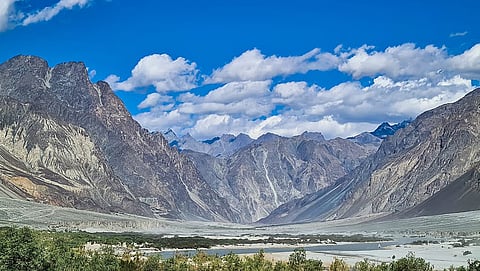
Turtuk is a village at the edge of India, in Ladakh’s Nubra Valley, where the Karakoram range casts long shadows over apricot orchards and stone-walled lanes. Until 1971, it was on the other side of the border. But borders mean little to the winds that have swept through this valley for a millennium. And sustainability means even less as a concept here. Here, it was never a choice. It was survival.
I came to Turtuk as a traveller interested in traditional design and sustainable living. I left with a quiet, urgent lesson for every architect, policymaker and researcher who cares about the future of India’s mountains.
In the oldest part of the village, called Yul, stands the Yabgo Dynasty Palace. No towering gates. No grand announcement. Just a weathered wooden entrance guarded by a carved eagle. The palace was not built to intimidate. It was built to endure.
Stepping inside felt less like entering a museum and more like walking into someone’s memory. The ground floor made up of spaces that spoke of life lived simply. The kitchen with its walls darkened by generations of smoke. The baithak, a sitting room, where families must have gathered on long winter nights, sharing tea and stories. And there was a small courtyard, modest but essential, tying the home together.
One will never fail to notice the windows. They are small and set deep into walls nearly a metre thick. At first glance, they seem inadequate. Then you understand the intention. They keep the freezing Himalayan wind at bay while allowing the precious winter sun to slip through and warm the rooms from within. This is passive solar design, perfected centuries before the term entered any architectural textbook. In an age when mountain towns are installing energy-guzzling electric heaters, often powered by diesel generators or coal-dependent grids, these quiet, intelligent walls offer a zero-energy alternative.
The walls are local stone. The timber is local wood. The carbon footprint of the palace’s construction is effectively zero. Not because anyone was trying to be “green,” but because there was simply no other way. This was very different from the new construction in Ladakh, of concrete hotels with electric heaters, glass facades that leak heat and bathrooms that guzzle water in a cold desert.
Upstairs, the main hall tells a different kind of story. On one wall, a sprawling painting traces the family tree of the Yabgo dynasty. It is of a lineage that ruled Baltistan for over a thousand years. Sepia-toned photographs of rulers in regal attire. Swords that once saw battle. Coins worn smooth by the hands that traded them. Traditional Balti jewellery that once adorned queens.
And in the corner of the hall sits Yabgo Mohammad Khan Kacho, the last king. A long staff rests in his hands. He is dressed simply. No crown. No throne. Just a quiet presence that fills the room. He is the last ruling descendant of a dynasty that once commanded vast territories. Today, his kingdom is a single village that became Indian soil only five decades ago.
He spoke softly, with a passion that came from the heart. He pointed to names on the family tree and faces in the photographs. He gestured toward the windows. The Karakoram range stretched across the horizon. Unchanged. Unmoved. The same peaks his ancestors looked upon a thousand years ago. The same light.
What remains when land and power are gone? In Turtuk, the answer is memory, grace and the courage to keep your doors open.
As I walked back down the narrow stone stairs, I realised something. The Yabgo Palace is a quiet critique of everything that is going wrong in India’s mountain regions today.
Consider the numbers. Since Ladakh became a Union Territory in 2019, over 1,670 kilometres of new roads have been built. Tourist arrivals nearly doubled from 279,937 in 2019 to 531,396 in 2022. Tourism now accounts for roughly 50 to 60 per cent of Ladakh’s GDP. But over 70 per cent of Ladakh’s food is now imported from the plains, trucked in over high passes at great carbon cost.
A single tourist uses 75 litres of water per day, compared to 21 litres for a resident. In Kargil town, the built-up area expanded more than ninefold between 1965 and 2020, from 0.25 square kilometres to 2.30 square kilometres. Much of this new construction is hotels with Western-style plumbing. Traditional Ladakhi dry toilets, which use almost no water, are being replaced by borewells that strain a scarce resource.
As of early 2023, over 12.74 lakh (1.274 million) vehicles used the Atal Tunnel in 2022 alone. The plastic waste, the vehicle emissions, the accelerated glacial retreat. These are not abstract problems. They are happening now.
The Yabgo Palace offers none of these problems. No heating emissions. No water waste. No imported materials. No plastic. It is not a relic. It is a working model. One that has sustained itself for a thousand years without once needing a government subsidy or a sustainability report.
The palace is not a museum. There are no glass facades, no recorded audio guides. It remains a private family home. And that is precisely what makes it culturally sustainable.
Academics call it “living heritage”, where preservation does not mean freezing a building in time, but allowing it to pass through generations, cared for and spoken aloud by those who experience it. The Faro Convention, adopted by the Council of Europe in 2005, positions cultural heritage as “as a fundamental human right linked to society and democracy, rather than just physical artifacts”. It is a lever for sustainable development and an improvement in people’s quality of life.
A palace locked behind glass is a relic. A palace where a family still tells its own stories is a living heritage. That is what Turtuk still has.
I am not saying Ladakh should close its roads and turn away visitors. That is neither possible nor desirable. Tourism provides livelihoods, connects remote communities to the wider world and creates economic incentives for preservation. A 2025 analysis in East Asia Forum concluded that unregulated tourism has damaged Ladakh’s fragile environment, requiring an immediate paradigm shift, not a shutdown. Turtuk offers some clues to what might shift look like.
Stay in homestays, not hotels. The Himalayan Homestay Policy supports over 900 homestays across Ladakh. These are not luxury accommodations. They are people’s homes. You eat what the family eats. You sleep where the family sleeps. Your money goes directly to local households and most homestays are run by women.
Eat local food. The apricots drying on Turtuk’s rooftops are not picturesque decoration. They are winter food security, preserved without refrigeration. The buckwheat bread and the sea buckthorn juice have a fraction of the carbon footprint of anything trucked in from the plains.
Walk. The narrow lanes of Turtuk were not designed for cars. Walk. It is slower. That is the point.
Listen more than you photograph. The last king tells a story. He receives guests. The difference matters.
A small, hopeful conclusion
The Yabgo Palace has seen better days. You can see it in the weathered walls, the faded photographs, the quiet humbleness of it all. But somehow, that only makes it more beautiful. It is not a monument to glory. It is a testament to endurance. Ecological, cultural and human.
I went looking for traditional design. I found a kingdom. Not in maps or borders, but in a pair of small, wise windows, a man and his staff and a way of living that asks nothing more than to be remembered and respected.
It is time we started paying attention. Before the roads close for winter, before the apricots stop drying on the rooftops and before the last king speaks his last story.
If you ever find yourself in Ladakh, make the journey to Turtuk. Walk up to the palace. Sit with the last king. Look out through those small, wise windows. And listen.
Sulagna Saha is Assistant Professor at National Institute of Fashion Technology (NIFT), Bhubaneswar, with a passion for driving innovation in fashion through sustainable practices
Views expressed are the author’s own and don’t necessarily reflect those of Down To Earth