

India’s Natural Gas (Supply Regulation) Order, 2026, as the government’s first formal response to the Gulf energy disruption, established an allocation framework to ration gas supplies. But it left a critical gap: food access of millions of migrant workers in Indian cities, many of whom depend on low-cost hotels, dhabas, and community eateries for daily meals.
With the collapse of shipping through the Strait of Hormuz — a route that carries roughly a fifth of the world’s petroleum trade and a major share of LNG shipments — since the attack by US-Israel and retaliatory attacks by Iran, India, which imports over 85 per cent of its crude oil and a growing share of its LNG through Gulf routes, on March 10 invoked provisions of the Essential Commodities Act to regulate the supply and distribution of natural gas and ensure priority sectors continue to receive fuel.
The order protects piped natural gas (PNG) for households, compressed natural gas (CNG) for vehicles, and natural gas used for LPG production at full supply while cutting allocations to several industrial and commercial sectors including refineries and power: restricted supply at 80 per cent of their past six-month average gas consumption, petrochemicals and fertiliser plants at 70 per cent, and industrial and commercial users at 65 per cent.
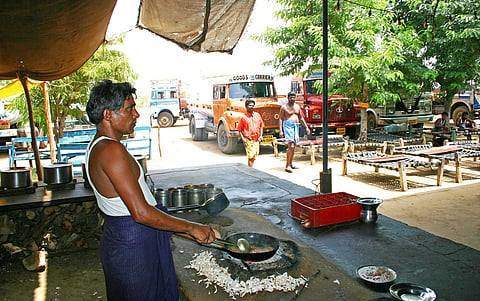
In the industrial and commercial category, however, the order groups together a wide range of gas users — including hotels, dhabas, roadside eateries, canteen-style restaurants and community kitchens — all of which now face a 35 per cent supply cut.
Many of India’s estimated 100 million migrant workers in cities eat their daily meals at these low-cost establishments within walking distance of their construction sites, factories, warehouses, and urban slum settlements, because they lack access to home kitchens. This reduction could directly affect food availability and prices. For them, the gas shortage will not be a mere price hike but a direct hit to their food security.
For street vendors who serve low-cost meals to migrant workers, the disruption has already begun to show on the ground. Many workers who cannot afford even small dhabas depend on roadside food stalls, which operate on small LPG cylinders or informal gas connections and require frequent refills.
“We have started seeing the impact already. With the present situation, many of the street vendors are facing problems and have shut down,” said Sandeep Verma, convenor of the Indian Hawkers Alliance.
According to Verma, vendors are unable to pass rising fuel costs on to their customers. “Those who still have limited supply cannot increase food prices like restaurants because the people who eat here simply can’t afford costly meals. We have received multiple calls since yesterday. This is a double hit — one on the livelihoods of vendors and second on the food security of migrant workers who depend on them,” he said.
Of the roughly 10,000 vendors associated with the alliance, Verma said around 1,000 have already closed down since the supply disruption began.
Experts said the situation threatens to recreate the conditions of one of India’s most painful modern memories of the exodus of millions of families during COVID-19 lockdown in March 2020 when, among other things, they were cut off from food access without advance notice or alternative provision.
Narasimha Reddy Donthi, public policy expert and visiting senior fellow at Impact and Policy Research Institute said that the government should quickly expand the definition of priority sectors, particularly to protect food access for migrant workers in cities.
“The government must immediately re-classify affordable food service establishments — defined by a price threshold per meal — as protected ‘food security infrastructure’ under the Essential Services category, with a minimum guaranteed gas supply of 85 per cent of normal consumption. This should be linked to a parallel activation of PDS-supported community kitchens in cities with significant migrant worker populations, modelled on the Amma Canteen and Indira Canteen schemes that several state governments have operated. The central government should fund the incremental cost, and state governments should be directed to activate these schemes within seven days,” he said.
In a letter to the prime minister’s office on March 11, Donthi urged Prime Minster Narendra Modi to treat the present situation as a national emergency and designate affordable and community food service establishments as protected critical infrastructure for migrant worker food security, with a defined minimum gas supply guarantee.
Meanwhile, migration experts said migrant workers are already facing multiple barriers to accessing basic services, including cooking fuel, especially after the KYC requirements for LPG connections.
“Particularly those without permanent addresses or local identity documentation had already been facing issues in accessing LPG connections,” said Umi Daniel, Director, migration and education, Aide et Action International.
He added that the emerging fuel shortage is beginning to trigger emergency responses at the local level. On March 11, the Bhubaneswar Municipal Corporation allowed the temporary use of coal and firewood for cooking, easing an earlier ban imposed for pollution control, amid concerns over LPG availability.
Daniel added that such measures reflect growing anxiety about fuel access and the potential knock-on effects on food supply for low-income urban populations.