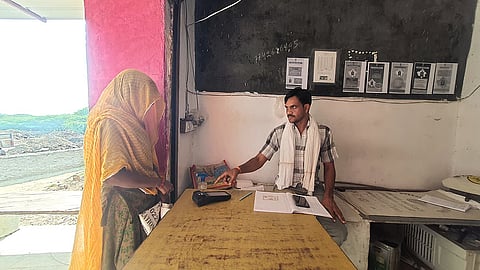


The Union government has proposed replacing the fixed 35kg monthly foodgrain quota for Antyodaya Anna Yojana households with a 7kg per-person entitlement.
The draft National Food Security amendment retains a 35kg cap per household, which experts say will continue to disadvantage families with more than five members.
Food rights experts say the proposal addresses only cereals and does not include pulses, edible oils or other nutrition support for India’s poorest households.
The amendment does not address wider concerns over outdated NFSA coverage, biometric failures and access barriers in the Public Distribution System.
For India’s poorest families, the amount of subsidised grain they receive may soon depend on how many people live in the household, under a new proposal from the Union government. The Centre has proposed moving from a fixed family quota to a per-person entitlement.
Under the current National Food Security Act (NFSA), 2013, households covered under the Antyodaya Anna Yojana (AAY) — the poorest of the poor — receive a flat 35 kilogrammes (kg) of food grains per family per month, regardless of how many people live in the household. The draft National Food Security (Amendment) Bill, 2026, by the Department of Food and Public Distribution, proposes to replace this with an entitlement of 7 kg per person per month, but with a capping of a maximum of 35 kg per household.
Enacted with the aim to protect people against food insecurity, hunger and malnutrition, NFSA legally entitles 75 per cent of rural and 50 per cent of urban population — two-thirds of the country’s total population (covering 813 million people) — to subsidised food grains.
The Act categorises beneficiaries into two groups: the poorest of the poor under the AAY, and the remaining under Priority Households (PHH).
Beneficiaries in the PHH category are entitled to 5 kg of food grains per person per month at prices of Rs 3, Rs 2 and Rs 1 per kg for rice, wheat, and coarse grains respectively. For AAY beneficiaries, the entitlement is 35 kg of food grains a month, irrespective of family size.
In the proposed draft, the government says the change is aimed at removing intra-category inequities and rationalising food grain allocation.
“The existing household-based entitlement under AAY, though intended as a protective measure for the most vulnerable families, results in significant inequities depending upon the size of the household. Smaller households receive a higher per-capita entitlement, whereas larger households receive a lower per-capita entitlement, which may fall below the entitlement available to priority households,” the draft amendment said.
The Indian Council of Medical Research (ICMR), in its revised guidelines, recommends 250 grams of cereals per adult per day. This works out to roughly 7.5 kg a month and the proposed entitlement in the draft amendment is close to that.
ICMR’s earlier norm was 400 grams per day, or about 14 kg a month per adult. This revision in its cereal recommendation was not made in isolation but came alongside a push for greater dietary diversity, which included eating less cereal, and more protein, pulses and fats. The assumption built into that advice is that people can substitute cereals with other foods.
But for AAY households, that assumption is difficult to hold. For these poorest of the poor households, activists say, 250 grams a day is not a realistic basis for policy. They cannot buy pulses, edible oils or protein-rich foods from the market and their ration allocation by the government, constitutes most of their diet.
It is a number that does not reflect what poor families actually eat, said Anuradha Talwar, who was the West Bengal Advisor to the Commissioners of the Supreme Court in the Right to Food cases.
“The revised ICMR guidelines are totally insufficient. No poor family can survive on just 250 grams of rice per person per day. The average consumption is 400-500 grams. It is very sad that this amendment is for AAY, because they are the poorest families who are not able to do market purchasing,” said Talwar who, through her work, was involved with framing of the legal food entitlement norms under NFSA.
The amendment, however, addresses only cereals. It makes no provision for pulses, edible oils or any other nutrient. “If they are saying they are going to reduce the carbohydrates, then what are people supposed to fill their stomachs with?” asked Talwar, adding that curtailing the allocation in the case of AAY households is pushing people into starvation again.
Right to food experts have long been demanding that pulses, oilseeds, and fats be included in the food allocation.
Dipa Sinha, a development economist who works on the right to food, said the government has missed the larger point. “These households require additional support. Pulses and edible oils should be added to the package,” she said.
While the shift to per-person entitlement corrects the anomaly for smaller households, the 35 kg household ceiling maintains the inequity for larger ones. A family of six would be entitled to 42 kg under the new per-person rate but will be capped at 35 kg, receiving less than 6 kg per person, barely above the 5 kg entitlement of priority households, who are not classified among the poorest of the poor.
The cap undermines the very logic of the shift, said Singh. “The limit of 35 kg per household when there are more than five members is problematic. Larger households will be disadvantaged. If it is converted to an individual entitlement, then there should not be any cap on quantity,” she said.
Sinha acknowledged that rationalising the entitlement structure is not unreasonable in itself. Many AAY households are single-person households that do not need 35 kg a month. But rather than simply adjusting the cereal quantity, it should be providing AAY households a full package of essential macronutrients, with the cereal component set at a level that actually matches their requirements.
The concern cuts differently across India’s regions. Southern states tend to have smaller average family sizes of three to four members, while northern states average four to five, meaning the cap will disproportionately affect households in the north, said Talwar.
The amendment comes at a time when the coverage of NFSA itself remains a contested issue. The quota for subsidised food was set based on Census 2011 data, when the country’s population was 1.21 billion. The population has grown significantly since, but the quota has not been revised. A 2021 estimate by economists Reetika Khera, Jean Dreze and Meghana Mungikar found that over 100 million people are excluded from the Public Distribution System (PDS) under NFSA.
The exclusion is not only a matter of outdated population data. Down To Earth had earlier reported how across the country, vulnerable populations, including the elderly, manual labourers, and those without stable addresses, are being locked out of their ration entitlements through biometric failures under the e-KYC verification drive. However, the amendment does not those barriers.
Public comments on the draft have been invited by the government until July 13, 2026.