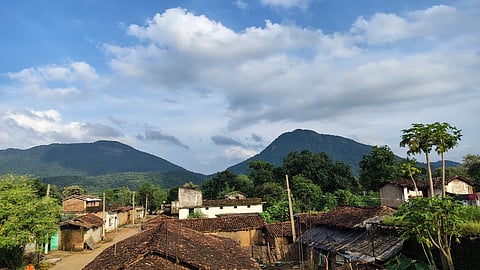

Paikmal block in Odisha’s Bargarh district lies on the fringes of the Gandhamardan hills, a landscape known not only for its rich biodiversity and medicinal plants, but also for the cultural worlds that Adivasi communities have sustained here for generations. I travelled to remote villages as part of a community-led documentation initiative facilitated by WASSAN, aimed at supporting the nomination of the Gandhamardan region as a Globally Important Agricultural Heritage System (GIAHS). My intention was to document traditional food practices. What I did not anticipate was how deeply food here would speak of memory, identity and healing.
Walking through villages tucked between forest patches and fields, spending time in homes and kitchen gardens, I slowly realised that food, in Gandhamardan, is never just about nourishment. It is medicine and a form of everyday resilience. Each leaf, tuber and grain carries stories of care, of how people have learned to live in harmony with nature, without severing their relationship with the forest.
Almost every conversation I had, returned in some way to illness and recovery. When I asked women, what families do when someone has a fever, they did not hesitate. Fingers pointed to the raw papaya trees growing beside their homes. Papaya saag, cooked lightly and eaten with plain rice, is often the first response. No prescriptions, no measurements. Just knowledge honed over generations.
One afternoon, I watched an elderly woman prepare a bitter decoction using giloy (Tinospora cordifolia), gangasiuli (Nyctanthes arbor-tristis) leaves and a wild forest fruit. As the mixture boiled, filling the courtyard with a sharp aroma, she explained that the bitterness was important. “It pulls the heat out,” she said. That moment stayed with me. Here, taste itself carries meaning. Bitterness is not avoided; it is valued for what it does to the body.
Digestive problems, I learned, are treated with equal attentiveness. Keo kanda is a wild tuber. Both its leaf and tuber are cooked into curries to calm the stomach. Bitter gourd, whether fried or eaten as a leaf bhaji, is consumed not for pleasure but for protection, especially against worms. In more severe cases, families swallow freshly ground raw turmeric. The sharpness is endured because it works. Discomfort here is accepted as part of healing.
Summer revealed another layer of indigenous wisdom. Long days of agricultural labour demand foods that cool the body and restore strength. Madia pej, a thin porridge made from ragi, appeared in nearly every home I visited. It is easy to digest, hydrating and filling. Alongside it were madia pitha, small ragi cakes carried to the fields, keeping hunger and exhaustion at bay. Wood apple sherbet was offered frequently, its sour-sweet taste easing thirst and digestion. Even its leaves, people told me, have medicinal uses. Nothing, it seemed, was wasted.
Listening to tribal women speak about post-pregnancy care and menstruation opened another window into how food functions as quiet medicine. Kasa kanda (Discorea pubera) and dudhiari leaves are eaten to reduce cramps, restore strength and warm the body. These recipes are rarely written down. They move from mother to daughter, from elder to younger woman, often beyond the reach of formal healthcare systems. Yet they continue to shape how bodies are cared for.
During outbreaks of chickenpox or measles, diets turn deliberately gentle. Pita kanda (Discorea hispida) replaces heavier foods. Neem paste is applied to the skin. Neem branches are placed around a child’s bed. As these scenes were described to me repeatedly, they felt almost ritualistic, where ancient wisdom and care merge seamlessly. Healing here is as much about the environment as it is about ingestion.
What stayed with me most was the confidence with which elders spoke about their practices. Moringa leaves for eyesight. Kafgajri (Acalypha indica) for cough. Herbal combinations for urinary infections. This was not folklore recalled vaguely or defensively. It was knowledge practiced daily, adjusted with season and circumstance.
My time in Gandhamardan taught me that resilience here is edible. It grows wild, seasonal, bitter and sustaining. It is rooted in forests that continue to feed both body and memory. As conversations around food systems increasingly focus on efficiency and external inputs, these hills quietly remind us that survival can also be cultivated through relationships, with land, plants and collective wisdom passed down over generations.
Abhisek Hota is a Programme Officer with Watershed Support Services and Activities Network (WASSAN) in Nuapada, Odisha
Views expressed are the author’s own and don’t necessarily reflect those of Down To Earth
