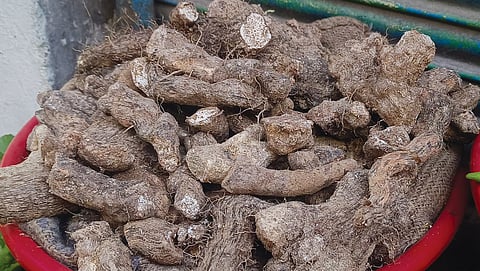

In Himachali folklore, finding an unbroken taradi root is considered a sign of divine luck and favour from forest spirits, a reward for the gatherer’s persistence. The wild tuber can penetrate deep into the ground, making it laborious to extract. Known locally as tardi or tarunkand and scientifically as Dioscorea belophylla, this slender climbing vine grows naturally in the forests of the western Himalayas. According to studies, the species grows in shady forest habitats at elevations of 600-1,000 metres. But that has not deterred its popularity among communities in Himachal Pradesh, Uttarakhand and Jammu and Kashmir, which prize the tuber as a winter delicacy.
It is commonly boiled and prepared as a vegetable. Those wishing to enjoy the seasonal delicacy beyond the harvesting period pickle it and use it in other preserved preparations. Its culinary appeal and limited availability are reflected in its price. Taradi usually sells for Rs 150-200 a kg, but prices can rise to Rs 300-400 during the festival of Shivaratri, when demand increases because of its popularity as a fasting food.
Growing demand, combined with dependence on forest collection, has, however, raised concerns about the sustainability of taradi harvesting. In 2000, researchers at the Regional Horticultural Research and Training Station (RHRTS) in Jachh, Himachal Pradesh, surveyed the plant’s natural habitat in the lower-hill region of Kangra district. They found that almost all taradi entering the state’s markets was collected from forests. The number of naturally occurring vines at several forest sites had declined considerably. Subsequent surveys showed that natural germination was about 10 per cent, while establishment was only 1 per cent.
Interviews with farmers pointed to declining availability as a result of changing land use and growing pressure on natural habitats. Exploitation peaked during the COVID-19 pandemic, when taradi was harvested both for food and as a source of income amid a lack of alternative livelihoods. The conservation challenge is pressing as limited availability of conventional planting material has hindered large-scale multiplication of the plant. Now, after several years of research RHRTS has developed a way to move taradi from the forest floor to farmers’ fields.
Taradi produces two types of reproductive structures on the same vine. The first are small tuberous structures that develop in the leaf axils, known as cormlets or aerial bulbils. But these occur in relatively small numbers and are produced irregularly, often only after the plant has reached maturity. The second source of propagation is the papery, winged fruit, which contains seeds. Even though the winged fruits are produced in large numbers every year, there was no established method for reliably germinating the seeds. To generate enough planting material for large-scale cultivation, RHRTS researchers focused on developing a propagation chain based on the plant’s abundant seeds.
The research involved several years of experimentation with different growing media and propagation conditions. Initial attempts to germinate the papery seeds produced limited results. Even when germination occurred, the young plants survived for only one growing season and did not develop the desired underground tuber. Further experimentation produced encouraging results under controlled conditions. Trials were conducted using cocopeat and a mixture of soil, sand and farmyard manure in a ratio of 2:2:1. Germination was highest in cocopeat, at 80 per cent, followed by 60 per cent in the soil, sand and farmyard manure mixture.
The young plantlets were maintained in propagation trays for several months. An important observation came during the winter dormancy period. After the aerial parts of the plants naturally senesced, small cormlets developed at their base. This provided the missing link in the propagation process. Instead of depending exclusively on the few cormlets available naturally, researchers could now produce new cormlets from plants raised from the more abundant seeds. The newly formed cormlets were then transferred to polybags containing soil, farmyard manure and sand in a 2:2:1 ratio, where they developed into healthy plants suitable for transplantation to the field. In other words, the approach could provide farmers with planting material without requiring them to repeatedly collect mature propagation material from natural forests.
The next challenge was cultivation in the field. If planted directly in unrestricted soil, the tuber can grow deep into the ground, making harvesting difficult and increasing labour requirements. Researchers therefore developed a field system to restrict downward root growth. In one approach, pits about 1-metre deep were prepared and lined at the bottom with a thick plastic barrier before being filled with suitable growing material. In another, trenches about 1-metre deep and 6-8 metres long were prepared, lined at the base with plastic and filled with soil and other growing material. Young taradi plants were then planted in the modified beds at a spacing of 60 cm by 60 cm, with the trenches 1.5 metres apart. Care was taken to minimise root competition. The objective was to ensure that the physical barrier would encourage the root system to remain at a manageable depth, making harvesting easier. Field results suggest that each plant produced 500-800 grams of edible root after one and a half years. On a one-hectare farm, about 11,390 plants could be grown, with average yields estimated at 7,000-9,000 kg and gross returns of up to Rs at 6-8 lakh after 1.5 years.
If the results can be reproduced consistently across different locations, soils and management conditions, they could provide the basis for developing taradi as a specialised high-value crop for suitable hill farmers. The cultivation model also has a wider significance for hill agriculture, where farmers face crop losses from wildlife, particularly wild monkeys. Taradi, which has a strong local market, could reduce dependence on conventional crops and diversify farm income.

Ingredients
Taradi tubers: 500g
Mustard oil: 250 ml
Fenugreek powder: 2-3 tbsp
Cumin seeds: 1 tsp
Turmeric powder: 1-2 tbsp
Red chillies: 5-10, or according to taste
Fresh citrus juice: 200 ml
Salt: to taste
Method
Wash the tubers to remove soil and dirt. Place them in a clean cloth, make a pouch and boil for 10 minutes. Turn the pouch periodically so the tubers cook uniformly. Allow them to cool, remove the outer skin, and cut into small pieces. Spread the pieces in a clean tray and sun-dry for a day. This reduces excess moisture and helps improve pickle keep-ing quality. Heat the mustard oil until it is properly hot. Allow it to cool slightly. Sauté the taradi pieces in the oil; add citrus juice as per taste to make it sour, fenugreek powder, cumin, turmeric, red chilli and mix thoroughly. Finally add mustard seed powder, which provides the characteristic pungency and souring effect. Transfer the mixture to a clean, dry ceramic or glass jar. Ensure that the pieces remain well coated with oil. Keep the jar in sunlight for 10-15 days, mixing it periodically.
This article was originally published in the October 16-31, 2026 print edition of Down To Earth