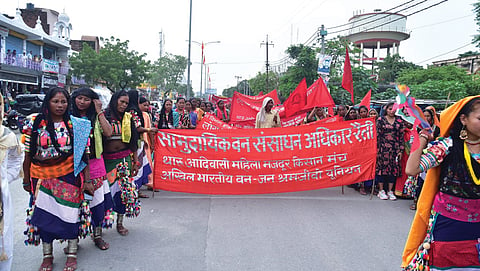


We do not find any plausible reason as to why the Committee ought not to have made an assessment of the forest rights of the forest dwellers, without taking into account the object and scope behind the Act.” With these words, the Lucknow Bench of Allahabad High Court, on April 9, set aside a decision of Uttar Pradesh's Lakhimpur Kheri District Level Committee (DLC). In 2021, the DLC had rejected Tharu tribal community's claims over forest resources of Dudhwa Tiger Reserve.
The Act referred to in the judgement is the Scheduled Tribes and Other Traditional Forest Dwellers (Recognition of Forest Rights) Act, 2006 or FRA, which guarantees forest dwellers rights over forest resources. Under FRA, tribal populations can claim community or individual forest rights with the gram sabha (village council). The gram sabha sends the claim to the Sub Divisional Level Committee (SDLC), which forwards it to DLC, whose decision “shall be final and binding”, states FRA.
In 2013, about 3,000 families from 20 villages in Lakhimpur Kheri filed 20 community rights claims. The gram sabhas sent it to the SDLC, where the matter remained pending for about six years. In 2019, the SDLC forwarded the claims to the Lakhimpur Kheri DLC, where it again remained pending for about two years. Finally, on March 15, 2021, the DLC rejected the claim, basing its decision on a Supreme Court interim order of November 13, 2000 that barred “de-reservation of forests/sanctuaries/national parks”. Consequently, some 107 Tharu community members challenged DLC's decision at the high court, which in its April 9 order directed "the authorities to grant an opportunity of hearing to the petitioners and/or their representatives, and thereafter, pass a reasoned order in accordance with law."
Rajnish Gambhir, founder of Tharu Adiwasi Mahila Mazdoor Kisan Manch, a group fighting for forest rights since 2005, welcomes the order, saying the DLC'S decision was flawed because it ignored FRA's intent, relied on a pre-FRA interim order of the Supreme Court without assessing applicability, and failed to evaluate petitioners' rights. Most experts, however, are not impressed by the high court decision. “The high court order merely reinstates what the law says. The Union Ministry of Tribal Affairs has already clarified that the 2006 Act, being a subsequent statute, overrides all preceding laws and court judgments of prior date,” says Tushar Dash, executive director of Odisha-based non-profit Vasundhara. He also says that the court's order does not seek accountability from the DLC. "If the DLC's decision contravenes FRA provisions affecting has the rights of the tribal people, it is an offence; but the decision has not questioned how DLC has contravened FRA and sought accountability," he says.
C R Bijoy, an independent rese-archer in resource conflicts, based in Tamil Nadu, holds similar views. "The Court should have categorically declared that the DLC rejection of the claims as illegal, and hence a violation of FRA, constituting an offence under Section 7. It should have ordered the gram sabhas...
This article was originally published in the June 16-30, 2026 print edition of Down To Earth
