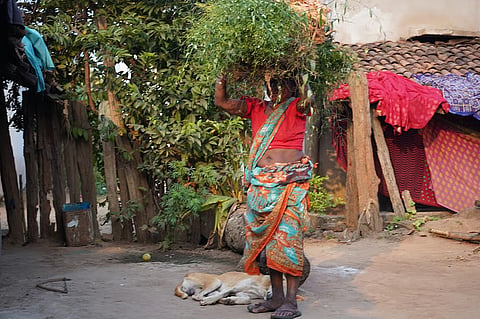


Tribal women in Chhattisgarh’s Nagari block say they are forced to sell minor forest produce to middlemen at low prices because markets are far and procurement centres are unreliable.
Forest produce such as medicinal herbs, tubers, leaves, mahua, tamarind, lac and tendu leaves remains central to tribal livelihoods in the state.
Collectors say they often spend days gathering, cleaning and sorting produce, only to earn a few dozen rupees when selling locally.
Data from Chhattisgarh Minor Forest Produce shows procurement at support price fell from 627,470.50 quintals in 2021 to 35,002.85 quintals in 2024-25.
Seventy-year-old Dhamshila returns home with a heavy load of medicinal herbs on her head after spending the day in the forests of Nagari block in Chhattisgarh’s Dhamtari district.
Outside her one-room house, exhausted and sweating, she unties the bundle and begins sorting the wild herbs she has collected. The work will continue through the night.
“It took me the whole day to collect about five kilos of herbs. Tomorrow, if I give it to the middleman, he will pay me Rs 40 to Rs 50, at Rs 10 a kilo,” she said.
Dhamshila knows the herbs will be sold for much more in the market. But the nearest market is about 40 kilometres away and she cannot afford transport. “What can we do? At least the middleman gives us something. Government procurement agencies do not come to our area,” she said.
Her experience reflects a wider problem faced by tribal forest collectors in Chhattisgarh, where minor forest produce is directly linked to livelihoods. Women do most of the collection, while men often take part in selling the produce.
Down To Earth spoke to forest produce collectors in seven villages of Nagari block, one of the largest forest produce-collecting areas in Dhamtari district. Most said they had been forced for years to sell their produce to middlemen at low prices.
Chhattisgarh has 44 per cent of its land under forests and about 32 per cent of its population belongs to tribal communities.
During the monsoon, from late June to October, medicinal plants, tubers and seeds are abundantly available in the forests. Dhamshila said herbs such as giloy (heart-leaved moonseed), safed musli, shatavari, kalmegh and harra-baheda are commonly collected.
But prices remain a major concern. “Musli sells in the market for more than Rs 600, but the middleman buys it from us at throwaway prices,” she said.
The same months also see lac cultivation on kusum and palash trees, while gum extraction from dhavda, babul and kullu trees begins during and after the rains.
Women also make plates from forest leaves. Kuari Bai of Jabarra village said she spends days collecting and stitching leaves, but earns only Rs 500 to Rs 700 over 10 to 15 days.
“The price is good in the market, but the middleman pays us Rs 100 for 100 plates,” she said.
Madhav Singh Makram, chairman of the Forest Management Committee in Jabarra village, said most tribal families cannot afford to travel to markets for small quantities of produce.
“They often spread the produce on a cloth by the roadside and try to sell it through the day,” he said. “But this is a forested area, not a city. Very few people pass by, and even those who do bargain heavily.”
Pointing to his mother, Kaushalya Bai, who was making leaf plates at home, he said she could make about 150 plates in a day. “If I do not take them by bike to a nearby market, the wages she earns are so low that one wonders what she has earned after a full day’s work,” he said.
In Bendapalani village, on the road from Dhamtari to Nagari, Meena Netam sat in the sun with black and brown tubers laid out on a cloth.
By late afternoon, she had had only one customer, who bought half a kilo of jimi tubers.
“You sit in the sun all day, and if something sells in the evening, you earn only Rs 10 or Rs 20,” she said.
Next to her, Krishna Netam said she had not sold even 100 grams. “How do we support our families? We dig for days, clean the produce and dry it in the sun for a week, only to sell three or four kilos,” she said.
Kamin Nishad, another collector, said sales were uncertain. “Sometimes nothing sells. Sometimes a customer comes and buys everything,” she said.
Most collectors said they do not take unsold produce back home. Instead, middlemen often buy it and later sell it at higher prices in markets such as Dugli, about 40 km away.
When DTE visited the Dugli market, most shops selling forest produce appeared to be run by traders or middlemen. Several vendors said they had bought produce from nearby tribal villages and were selling it in the market.
One shopkeeper sitting beside a pile of tamarind said he had spent the past month and a half visiting tribal villages to collect produce and hoped to sell it by evening.
Winter, from November to February, brings roots, tubers, medicinal fruits and tamarind. Tamarind remains one of the most easily marketable forest products through the year.
In Kamarpara village, 40-year-old Birjha Sori sat outside her house with her children, sorting chironta, a medicinal shrub.
“It took me three days to collect this. But after so much hard work, I have no hope of getting a fair price,” she said.
She said there was a minor forest produce procurement centre in the village, but villagers often did not know when it opened or closed. “In such a situation, we are forced to sell to middlemen,” she said.
Makram said government procurement of minor forest produce had declined sharply in Chhattisgarh over the past five years.
He said there was a time when Chhattisgarh accounted for a large share of the country’s minor forest produce procurement centres. The state had 4,969 centres out of 6,873 centres across India.
But he said the model of government procurement at minimum support price had weakened.
Data from Chhattisgarh Minor Forest Produce supports this decline. In 2021, 627,470.50 quintals of forest produce were purchased at support price. In 2024-25, this fell to 35,002.85 quintals.
March and April are the season for mahua, while May and June are important for tendu leaves. Chironji fruits also ripen during this period and command high market prices. Sal seeds are collected for oil. Some produce, including honey, bamboo and mushrooms, is gathered throughout the year.
For tribal collectors, especially women, the decline in procurement has meant greater dependence on middlemen and lower earnings from labour-intensive work.
