
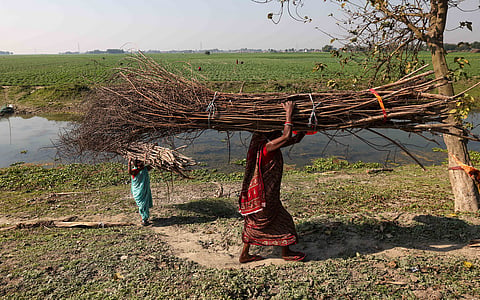

The rural areas of Bihar, India’s second-most populous state, are still very much dependent on firewood as fuel.
While Union government schemes have attempted to help the state transition to Liquefied Petroleum Gas, many of Bihar’s hinterland areas continue to rely on collected fuel—often from forest floors or agricultural waste.

Collecting firewood remains mostly the domain of women and children and traditionally involves significant time and labour.
The collection and use of firewood as fuel has harmful impacts on trees, common lands, and fragile ecosystems, besides human health.
Many do not just collect fallen branches but also cut live trees, which leads to forest degradation. Moreover, such branches are usually used as fuel indoors, leading to severe health problems due to indoor smoke.