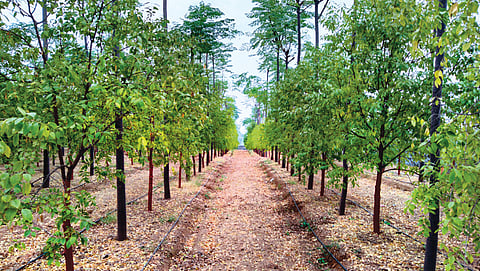


While announcing the Union Budget for 2026-27, Finance Minister Nirmala Sitharaman highlighted sandalwood as an integral part of India’s social and cultural heritage and announced focused efforts to promote its cultivation and processing. The announcement is the latest indication of the attention that sandalwood (Santalum album), is getting in India since the beginning of the decade. For instance, since 2022, states like Karnataka and Maharashtra have relaxed norms for private cultivation and sale of sandalwood trees, promoting its addition in agroforestry plantations. Cultivation has also spread beyond the traditional belts of southern states to Telangana, Gujarat, Madhya Pradesh, Andhra Pradesh and parts of northern India. By 2024, plantations were estimated to cover 23,000-30,000 hectares (ha), expanding by about 600 ha a year. The Union Ministry of AYUSH (Ayurveda, Yoga and Naturopathy, Unani, Siddha, and Homoeopathy) has supported 3,275 ha of plantations.
This is a significant change from the way sandalwood was managed in the past. In the 18th and 19th centuries, the tree was confined largely to the forests of Kerala, Karnataka and Tamil Nadu, with the state strictly controlling its harvest, transport and sale. While India was a major exporter, accounting for 80-90 per cent of premium sandalwood oil exports, its position weakened as sandalwood reserves declined sharply and annual production fell towards the end of the 20th century, with countries like Australia racing ahead in production and trade.
The decline in production has also made India increasingly reliant on imports. The Sandalwood Development Committee, constituted by the Economic Advisory Council to the Prime Minister and Union government think tank NITI Aayog, reports that from 1996-97 to 2023-24, India imported about 505 tonnes of sandalwood oil worth US $196.21 million, compared with exports of 139 tonnes worth $21.44 million.
A reversal of this trend through revival and expansion of sandalwood cultivation can be beneficial for India. Especially so, as the global sandalwood market, valued at $265.8 million in 2023, is projected to reach $502.2 million by 2030, according to Union government data. Similarly, the sandalwood oil market is likely to expand from $182.5 million in 2024 to $388.1 million by 2035.
For farmers, there is an added advantage—sandalwood is a climate-smart, high-value tree that can enhance environmental resilience of plantations. In a chapter of the 2023 book, Salinity and Drought Tolerance in Plants, researchers note that Santalum album is hardy and drought-tolerant, has a light crown, low nutrient requirement and is adaptable to may soil conditions. The tree integrates well in block plantations, boundary plantings and mixed cropping systems. Growing sandalwood in combination with trees like gooseberry, mango, custard apple and legumes like red gram boosts farm incomes.
However, these benefits can only be realised if sandalwood is scientifically managed and cultivated. Poor planting geometry, inadequate nutrition and improper pruning can lead to massive crop failure. Here is a look at the aspects that need the most focus for successful long-term sandalwood cultivation.
Sandalwood is a hemi-root parasitic plant, which means that it depends on other host plants for nutrients and water throughout its life cycle. Poor host selection can result in stunted growth, chlorosis or even mortality. For example, Malabar neem (Melia dubia), widely promoted in high-density systems, creates a heavy shade within two years of growth, suppressing sandalwood. Melia trees are often harvested for plywood, which further reduces the sandalwood’s vigour.
Sandalwood’s parasitic nature can also harm …
This article was originally published in the September 1-15, 2026 print edition of Down To Earth