
The world is not enough

Land is not free—this is the theme running through Michael Grunwald’s counterintuitive book, We Are Eating the Earth, and he breaks down the idea meticulously. That our food systems generate roughly a third of global greenhouse gas emissions is by now a standard line in climate literature. Grunwald actually walks the readers through it and does the accounting—chapter by chapter, acre by acre and one bad policy after another.
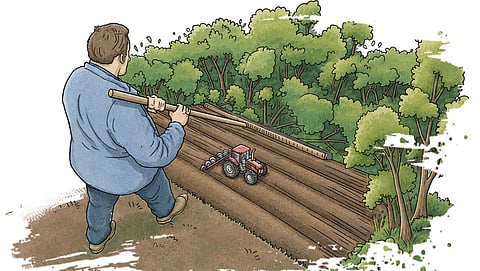
Humanity has cleared a landmass the size of Asia and Europe combined to grow food. By 2050, we will need to feed nearly 10 billion people. However, Grunwald warns that we cannot sustain the world “without frying it” if we continue to clear an acre of rainforest every six seconds (an acre equals 0.4 hectare). The book’s moral and intellectual centre is Tim Searchinger, a senior research scholar at Princeton School of Public and International Affairs, US and senior fellow at World Resources Institute, who showed as far back as 2008 that land-use change makes so-called climate solutions, like crop-based ethanol, dramatically worse for the atmosphere. The logic is simple: shift land to fuel crops like soya bean, corn or sugarcane and you must shift more land elsewhere for the food those acres once grew—mostly forest or native vegetation that was storing carbon.
Even after Searchinger identified this, little has changed except the scale of the problem. For instance, India’s ethanol blending programme has intensified in recent years; estimates suggest producing fuel at scale would require a cropped area the size of an entire state like Bihar. Geopolitical shifts and oil price shocks have accelerated these mandates even as the underlying accounting remains as broken as Searchinger first described it.
This same blind spot reappears across the book. The idea of mak ing biofuels from wood or carbon credits built on agroecology and regenerative agriculture are similarly flawed. These are pseudo-solutions that sound right but ignore what the land could have sequestered if simply left alone. Grunwald is persuasive that the “road not taken”—letting land be—has enormous undervalued climate worth. Grunwald calculates that carbon losses from land-use change can be three times the savings from replacing fossil fuels. Searchinger has spent years pleading this case to policymakers and scientists, largely to no avail. The book’s uncomfortable revelation is that clarity was never enough—decades of advocacy, modelling and evidence could not dislodge a convenient consensus that preferred to count only the benefits.
The book also pushes back against one of the most popular narratives: that industrial agriculture is inherently the villain. But Grunwald writes that producing more food per acre—through technology and intensification—can spare natural land that would otherwise be cleared to meet demand. It is a provocative argument, and one the book makes well, even if it sits uneasily in a world where most farming is still done by smallholders. What would be the impact of industrial agriculture on the hundreds of millions of small and marginal farmers—in India and across sub-Saharan Africa—who make up the majority of agricultural labour in the developing world? That question deserves more space than it gets in the book.
The path forward, he suggests, requires both restraint (leaving land alone) and intensification (making more food from less land, sustainably). Getting both right will demand focus and far more investment than the world is currently willing to commit.
Modern agriculture, Grunwald notes, has split into two camps—the nature-minded prophets of regenerative farming and the efficiency-minded wizards of industrial production, each largely dismissing the other. Neither side alone can solve the problem and the solutions lies in drawing from both. In practice, never the twain shall meet.
This review was originally published in the July 1-15, 2026 print edition of Down To Earth