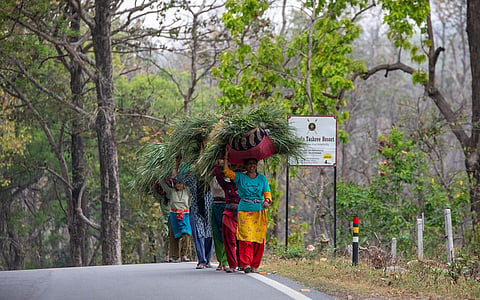


In February 2024, residents of Chokhuta village in Nainital district walked into the forest to prune trees and clear fallen branches — a tradition through which the local van panchayat has maintained its 133-hectare forest for generations. Two months earlier, Uttarakhand’s High Court had criticised the state government for being “in a deep slumber” over illegal tree felling. The van panchayat — the very institution doing the watching, pruning, and guarding — barely appeared in the judgment.
That gap between what van panchayats do and how the state treats them captures the central crisis of forest governance in Uttarakhand today. The institution is functional. The policy architecture around it is being systematically dismantled.
This is not a local matter. Uttarakhand carries 45.5 per cent of its land under forest cover, generating ecosystem services valued at Rs 95,000 crore a year. Its forests regulate rivers, stabilise mountain slopes, and supply water to hundreds of millions of people downstream. What happens to their governance is a question of national ecological consequence — not a state administrative footnote.
Van panchayats did not emerge from a government scheme. They came out of a colonial conflict. When the British systematically tightened their grip on Kumaon’s forests in the 19th century — stripping communities of timber rights they had held for centuries and reserving wood for railways and wartime supply — hill communities refused to comply. The Forest Grievance Committee for Kumaon, formed in 1921, was the colonial state’s first admission that it had overreached. By 1931, van panchayats were formally institutionalised: democratically elected village bodies with the legal right to manage, protect, and equitably distribute the produce of demarcated community forests.
Nearly a century later, 11,217 van panchayats manage 4,526 square kilometres of forest, supporting over a million rural families. Decades of research, including the work that earned Elinor Ostrom the Nobel Prize in Economics, consistently confirms what communities already know: decentralised, locally accountable governance produces better ecological outcomes than top-down departmental control. Van panchayats patrol forests, prevent fires, regulate grazing, and maintain the biodiversity that holds Himalayan ecosystems together. They are one of the largest and oldest experiments in community-based natural resource management anywhere in the world.
The forest department’s encroachment on van panchayat autonomy did not arrive through a single dramatic intervention. It has been a long, patient process of institutional erosion.
The first significant blow came in 1997, when Joint Forest Management Committees (JFMCs) were introduced across Uttarakhand. Van panchayats protested immediately. The forest department — which had no meaningful history of working with these bodies — set up parallel committees over the same forests. Jurisdictions overlapped, boundaries clashed, and decision-making became trapped in bureaucratic ambiguity. The JFMCs were a department-driven creation imposed from above, not a community demand from below. The FAO’s documentation of this period notes plainly that the World Bank-funded project simply assumed the desirability of importing the JFM model into Uttarakhand, without examining whether it was appropriate in a context where autonomous van panchayats had functioned for over six decades.
In 2019, the Central Government’s proposed amendments to the Indian Forest Act attempted something more direct: subsuming van panchayats into a catch-all “village forests” category. If enacted, the forest department would have acquired the discretionary power to take over management rights whenever it judged community governance “unsustainable.” Researchers and forest rights activists pointed out that the word “van panchayat” did not appear in the amendment at all. That was not an oversight. It was a legal strategy.
Between 2020 and 2022, the state government undertook what appeared to be a serious course correction. The revenue department resolved long-standing land record anomalies, revived van panchayat elections — raising compliance from 6 per cent to 69 per cent — and developed modern management frameworks aligned with ecosystem services. Three years of multi-stakeholder consultations produced a comprehensive draft Panchayati Van Niyamawali, 2023, incorporating 58 progressive amendments.
In March 2024, the state cabinet shelved it entirely.
Instead, the government notified token amendments to just 15 rules of the PVN 2005, without a single round of public consultation. The 58-amendment blueprint disappeared. Management plan cycles were extended from five to ten years — directly contradicting the Supreme Court’s directions in the Godavarman case, which mandate five-year plans for village forests. Provisions linking van panchayats to carbon markets, watershed payment mechanisms, and biodiversity finance were deleted. The opportunity to make conservation economically aspirational for a million rural families was deliberately passed over.
This happened while forest fires burned more hectares each year and out-migration steadily hollowed out the communities that these forests depend on for protection. The state chose this moment to weaken the institutions still doing the work.
The reform is neither complicated nor unprecedented. The 2023 draft Panchayati Van Niyamawali — the product of three years of expert and community consultation — must be notified in full. Management plan cycles must revert to five years, consistent with the Supreme Court’s Godavarman directions. The forest department’s JFMC structure must be dissolved wherever autonomous van panchayats already function; parallel governance over the same landscape serves the department’s administrative interests, not the forest’s ecological ones. Van panchayats must receive direct legal access to green economy instruments — forest carbon credits, Payment for Ecosystem Services, and biodiversity finance — so that communities have a material stake in what they protect. And electoral oversight must shift from the revenue department to the Panchayati Raj department, ending the institutional ambiguity that has left van panchayat elections perpetually stalled.
None of this is radical. India’s 73rd Constitutional Amendment envisioned exactly this kind of devolution to elected local bodies. Van panchayats are older than the amendment itself and have been doing what it envisioned for a century.
India has committed, under the Convention on Biological Diversity, to protecting 30 per cent of its land by 2030. Uttarakhand’s van panchayats manage forests that sit directly alongside protected areas and reserve forests. They are structurally indispensable to that target. Weakening them does not just harm Kumaon’s villages — it chips away at India's capacity to honour its own ecological commitments.
Van panchayats survived the British. They survived JFM. What may finally break them is not an external adversary but a state that has perfected the vocabulary of decentralisation while steadily governing communities out of their own forests. Uttarakhand must choose: lead on forest democracy or keep dismantling the only system that has actually worked for nearly a century.
Ankit Mishra is a Research Scholar in Political Science and ICSSR Doctoral Fellow at Govind Ballabh Pant Social Science Institute, Prayagraj. His research examines environmental politics, climate governance, and Indigenous Ecological Knowledge in the Indian Himalayan Region.
Views expressed are the author’s own and don’t necessarily reflect those of Down To Earth