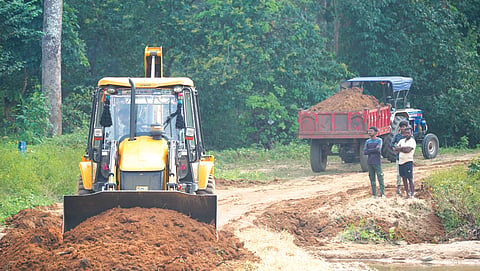


Life in Jabarra is inseparable from the forest that surrounds it. All 102 households of this village in Chhattisgarh’s Dhamtari district, who belong to the Kamar tribal community, have long depended on the woods for their livelihood. In 2019, this bond received a formal recognition when Jabarra was granted community forest resource (CFR) rights under the Scheduled Tribes and Other Traditional Forest Dwellers (Recognition of Forest Rights) Act, 2006. The rights now allow residents to manage 5,352 hectares of forest and to collect and sell non-timber forest produce, such as leaves of maloo (Phanera vahlii), flowers and seeds of mahua (Madhuca longifolia) and safed musli herb (Chlorophytum borivilianum). “Since obtaining these rights our earnings have risen,” says Madhav Singh Makram, a resident.
Yet each year, as soon as the monsoon withdraws, the people of Jabarra volunteer to forego this stream of income for a few days. They walk instead to the Kajal river, which flows along the edge of the village, carrying headloads of wild grass. “We throw bundles of wild grass, sand, cement and other material into the river to build a causeway, a low-raised makeshift crossing across the river,” says Birjha Sori, a 60-year-old resident of Jabarra. They mount this exercise because, although they hold rights over forest resources, access to markets remains difficult.
Around 80 per cent of the forest produce collected by the residents is sold in markets, while the government only procures 20 per cent, explains Rambahu Netam, another resident. Local markets include weekly haats (fairs) in Jabarra and in nearby gram panchayats. But to gain better prices, the residents must travel to either the Dhamtari district market, 61 km away, or to Nagari block and Gariaband district markets, 12-13 km away on the other side of the Kajal. The latter appears the most preferred choice.
Until the turn of the century, there was a bridge across the Kajal. It collapsed due to wear and tear, and since 2001, the residents of Jabarra have been building a temporary crossing every year.
Netam says the technique draws on knowledge pass down through generations, with a clear injunction: the river’s flow must not be obstructed. The causeway is therefore built almost at the river’s water level, allowing it to pass easily over the structure. That design, however, makes the crossing prone to being washed away, especially during the monsoon months. What follows is an incessant cycle: from October to March, Jabarra residents build the causeway; from March to June, they use it to access the markets. Residents of 15 neighbouring gram panchayats also use the crossing at this time. From June to October, when rains return, they revert to the 60-km route as the Kajal reclaims its course and washes away the crossing.
There is an additional spoke in Jabarra’s cycle: the demand for a permanent bridge across the river. Every September since 2001, the residents stage a day-long protest at the district collector’s office to press their demand. “The state has seen three chief ministers since we began our protests, but there has been no progress,” says Netam.
The reason for this demand is the heavy burden the temporary causeway has on Jabarra. Its construction costs about Rs 40,000-Rs 50,000 each year. All households contribute funds and labour. When Down To Earth (DTE) visited Jabarra in October 2025, each household had contributed Rs 500, raising Rs 51,000. The fund was used to pay for construction materials and rent a JCB machine. In years when costs rise, a second round of contributions is collected.
The expense is significant. A household in Jabarra earns around R6,000 a month from the sale of forest produce, which forms their primary income. Some households have farms, while others earn from “ecotourism”. Being close to the forest and seeing an abundant growth of produce, including medicinal plants, Jabarra is promoted by the district administration as a site for ecotourism. From these activities, a household can earn up to Rs 10,000. “However, this income is irregular,” says Makram, who is chairperson of the Gram Van Prabhandan Samiti, a 15-member committee made up of village residents and a representative of the forest department that oversees the construction of the causeway.
The Samiti also assigns two members from each household to work on the causeway each day, ensuring equal participation by men and women. However, for women, this means double labour. “We work day and night in the forests, and then for 15-20 days, do additional labour at the causeway,” says Kaushalya Bai, a resident. “I do not have formal education and do not understand calculations, but I know that a large part of our earnings is spent every year on this temporary bridge.”
Additionally, for the six months when the causeway is not used, transport costs to the distant markets eat up nearly half the earnings from produce sales. The absence of a permanent bridge also affects access to basic services. “The long commute to Dhamtari becomes a serious problem when someone falls ill. Without a bridge, we cannot easily access healthcare, education or other amenities,” adds Sori.
Makram says that the residents have informed the government that they do not seek a concrete structure, only one strong enough to withstand the monsoon. During their latest round of protest in September 2025, district collector Avinash Mishra assured them that their concerns had been conveyed to the state government and that construction would begin once approval was granted, Makram tells DTE. In October, while speaking to DTE Additional Engineer Ranjana Sahu informed that orders to build the bridge have not yet been received.
This article was originally published in the March 1-15, 2026 print edition of Down To Earth
