

Farmer organisations have warned members of the parliament that the proposed Draft Seeds Bill, 2025, together with intellectual property demands emerging in India's trade negotiations with the European Union and the United States, could weaken farmers rights over traditional seeds and increase corporate control over India's seed system.
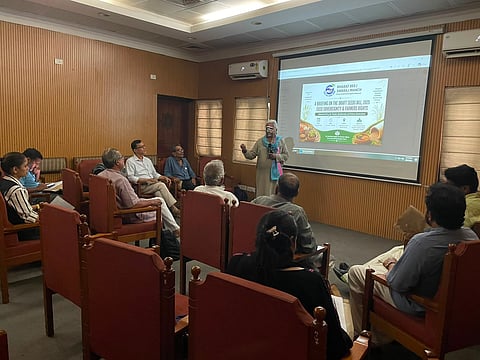
The concerns were raised at a meeting in New Delhi on August 5, organised by the Bharat Beej Swaraj Manch (BBSM), the India Seed Sovereignty Alliance.
The discussion brought together representatives of BBSM and MPs from the CPI(M) and CPI(ML), including John Brittas, Dr V Sivadasan and Amra Ram. Because Parliament's monsoon session was still underway, only a handful of MPs were able to attend.
Farmer representatives urged MPs to oppose provisions they say would burden community seed savers while favouring large seed companies.
The Draft Seed Bill 2025 is meant to replace the Seed Act 1966 and is expected to be introduced in the parliament soon, though it is not yet confirmed for this session. The government has described it as ‘quality and ease of doing business’ reform.
According to the representatives from BBSM the bill would place heavy registration and paperwork requirements on ordinary seed savers and community seed banks, requirements that small farmers would struggle to meet, while large seed companies, with legal and administrative resources would clear easily.
Farmer groups argue this effectively tilts the seed economy toward commercial players, even as the government presents the law as farmer-friendly.
India has so far stayed out of 1991 Act of the International Convention for the Protection of New Varieties of Plants (UPOV 1991), a European-origin patent system for plant varieties. It is a patent system, first developed in Europe, that gives seed companies strong legal rights over new plant varieties. It leaves farmers with very little freedom to save or exchange seed. Under UPOV, only registered commercial breeders count as ‘breeders’ not farmers, even those who have grown and improved a variety for generations.
But BBSM said that could soon change. The EU has pushed for UPOV-style rules in its trade talks with India, and the US has pushed similar demands on several of its own trade partners.
Jacob Nellithanam, BBSM's convenor, said the Bill could make intellectual property rules stronger without protecting farmers' seed diversity or knowledge. He said upcoming changes to the Protection of Plant Varieties and Farmers' Rights Act (PPVFRA) could push India closer to UPOV 1991, partly because of pressure from the US trade deal.
"The major concern is this strengthening of the intellectual property regime without protecting the diversity, the knowledge with farmers, the varieties with farmers," he said.
He said India could use other tools instead like the UN Declaration on the Rights of Indigenous Peoples, and Article 8(j) of the Convention on Biological Diversity. Both already protect traditional knowledge. He said India could use these to write a law that protects farmers first, before any company can claim ownership over a seed.
Farmer representatives warned that India's experience with Bt cotton illustrates how rapidly traditional crop diversity can disappear.
They noted that genetically modified Bt cotton was commercially introduced in 2002 and, within a decade by 2012, indigenous cotton varieties had largely disappeared from cultivation as farmers increasingly adopted commercially marketed hybrids.
According to the groups, a similar trend could affect food crops if genetically modified or gene-edited varieties expand without adequate safeguards for traditional seed systems.
The discussion also highlighted what participants described as a regulatory gap surrounding gene-edited crops. Unlike genetically modified crops, which undergo biosafety assessments before commercial release, several gene-edited crops are currently exempt from comparable biosafety testing requirements in India.
Farmer groups cited recently released gene-edited rice varieties as an example of this emerging concern.
BBSM also pointed to how concentrated the global seed industry already is. Just four corporations control about half of the world's seed market. Ten organisations control around 65 percent of it.
The group said weaker Indian protections, combined with UPOV-style trade pressure, would make this concentration worse, not better.
Bharat Mansata of BBSM said farmer groups want a proper 'varieties of common knowledge' registry.
This would give legal protection to India's traditional seed diversity already recorded in more than 460,000 samples held by the NBPGR as shared heritage, instead of leaving it open for private companies to register and claim.
Asked what the biggest risk would be if the Bill is passed without changes, Mansata said the paperwork it demands could discourage ordinary farmers from saving and exchanging seed.
He said this, combined with the Bill's own stated goal of 'ease of doing business,' shows its priorities lie with companies not with helping farmers stand on their own.
Brittas urged BBSM to broaden their political engagement beyond groups already supportive of their cause.
With only a few days remaining in Parliament's Monsoon Session, he said the campaign would need support from MPs across party lines if it hoped to influence the legislation before its introduction.
Brittas also urged the organisations to simplify their public communication, arguing that technical legal arguments would have limited impact unless they were translated into language that ordinary citizens and legislators could easily understand.
When asked about the next move, farmer organisations said they will now begin meeting MPs individually across political parties to explain their concerns over the proposed legislation.
They also plan to prepare a concise two-page briefing note highlighting the key provisions of the Draft Seeds Bill and their objections.
Participants acknowledged that lengthy legal analyses are unlikely to be read by MPs during the ongoing parliamentary session and said a shorter document would be more effective in building wider political support before the Bill is introduced.