
Subscribe

“It may be dangerous to be America’s enemy, but to be America’s friend is fatal.”
— Henry Kissinger
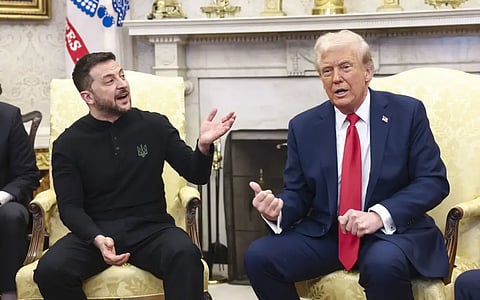
Sitting in the Oval Office in an official meeting with US President Donald Trump and Vice President JD Vance, these words must have rung in Ukrainian President Voldymyr Zelenskyy’s ears on February 28. To put it bluntly, Zelenskyy was caught up with two broad options — an unconditional surrender accompanied by a pro-Russian regime change in Kyiv or letting American companies take over the country’s vast mineral reserves.
For now, Zelenskyy has chosen the latter.
Hence, the quote, attributed to arguably the most remarkable diplomat in American history, seems to explain the surmounting problems for Zelenskyy.
The controversial meeting between the two heads of states was not only bereft of any diplomatic dignity, it also marked the commencement of a new era of American foreign policy in which transactional, short-term gains proved more lucrative than long-term geopolitical interests.
Trump and Vance, visibly desperate in their bid to cut a deal and acquire Ukraine’s minerals repeatedly asserted that war-torn Ukraine simply doesn’t ‘have the cards’ to dictate terms.
While it might not have the cards, Ukraine is the largest country in Europe by area (barring European Russia) and has deposits of 22 out of 34 minerals which the European Union deems as ‘critical’.
It is reported that Trump views the minerals deal with Ukraine as an ‘equalisation’ of approximately 375 billion dollars which the American government has sent Ukraine in war aid over the years.
Ukraine is also home to reserves of rare earth elements — a group of 17 metallic minerals vital for advanced technologies in sectors such as electronics, defence, aerospace, and renewable energy. These include elements like lanthanum, cerium and neodymium.
As reported by the United Nations’ Russian-language news service, Ukraine’s reserves of critical minerals accounted for roughly five per cent of the global supply as of 2022.
These critical minerals encompass precious and non-ferrous metals, ferroalloys, and other minerals such as titanium, zirconium, graphite and lithium. Also, Ukraine contributes around seven per cent of the world’s titanium production.
Additionally, the country’s lithium reserves, estimated at approximately 500,000 tonnes, remain largely untapped and are regarded as one of the largest in Europe.
With the world marching towards electric vehicles which shall involve the utilisation of these minerals, Americans have a viable reason to demand these minerals.
According to the Center for International Relations and Sustainable Development (CIRSD), a public policy think tank based in Belgrade and New York, Ukraine had documented 20,000 mineral deposits before the 2022 Russian invasion.
Of these, 8,700 were confirmed, covering 117 of the 120 most widely used metals and minerals globally.
The country boasts some of the world’s largest recoverable reserves of coal, natural gas, iron, manganese, nickel, ore, titanium and uranium.
Many of these mineral resources are concentrated in regions such as Luhansk, Donetsk, Zaporizhzhia, Dnipropetrovsk, Kirovohrad, Poltava and Kharkiv where Russian troops have either overrun or are trying to cut through Ukrainian defences.
Russia, which currently occupies around 20 per cent of Ukraine— including significant portions of Luhansk, Donetsk, and Zaporizhzhia —is estimated to control approximately 40 per cent of Ukraine’s metal resources, according to analyses by Ukrainian think tanks We Build Ukraine and the National Institute of Strategic Studies.
Notably, the Shevchenko Lithium Ore Field, one of the country’s largest lithium deposits, is situated in a rural area of Donetsk.
Unlike mining minerals like iron, gold, copper and coal, mining critical and rare earth minerals is an expensive pursuit as they are found in extremely low concentrations. Extracting these minerals on a commercial scale also calls for sophisticated technology which only China has been able to muster indigenously.