
.jpg)
The 79th World Health Assembly has adopted the updated Global Action Plan on Antimicrobial Resistance for 2026-2036.
Member States called for stronger financing, surveillance, infection prevention, sanitation and equitable access to effective antimicrobials.
The updated plan places emphasis on a One Health approach, linking human, animal, plant and environmental health.
Experts warn that antimicrobial resistance could cause millions of deaths by 2050 without urgent global action.
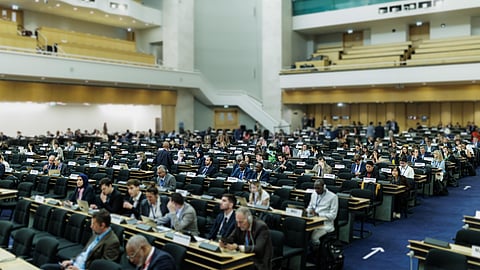
The 79th World Health Assembly, held in Geneva, Switzerland from May 18 to 23, 2026, endorsed and adopted the Draft Updated Global Action Plan on Antimicrobial Resistance, covering the period 2026-2036.
The session was chaired by Timur Sultangaziyev, deputy minister of health of Kazakhstan. Member States discussed and approved the updated global action plan on antimicrobial resistance (AMR).
AMR is one of the world’s most serious public health challenges. It occurs when bacteria, viruses, fungi and parasites change over time and no longer respond to medicines used to treat them. This makes infections harder, and sometimes impossible, to cure.
The growing threat of AMR risks reversing decades of progress in human and animal health, agriculture, food production and environmental sustainability.
According to the World Health Organization’s Global Antimicrobial Resistance and Use Surveillance System (GLASS), one in six common bacterial infections reported in 2023 was resistant to antibiotic treatment. An estimated 4.71 million deaths were associated with bacterial AMR in 2021. Experts have warned that, without urgent action, AMR could cause up to 39 million deaths by 2050, with low- and middle-income countries likely to be the worst affected.
Member states underlined the need to implement the updated Global Action Plan on AMR. The plan aims to preserve the ability to treat diseases in humans, animals and plants by ensuring equitable access to safe and effective antimicrobials for present and future generations. It also seeks to reduce infections through a holistic One Health approach and contribute to the 2030 Agenda for Sustainable Development.
Member states called for stronger global cooperation, increased financing and equitable access to antimicrobials. They also highlighted the heavy burden of AMR on developing countries.
They welcomed the updated Global Action Plan as a means to strengthen surveillance, infection prevention and control, water, sanitation and hygiene, antimicrobial stewardship, innovation and access to affordable medicines. They also emphasised the importance of prevention measures, diagnostics, vaccines and improved sanitation systems to reduce dependence on antimicrobials.
Member states also welcomed Nigeria’s hosting of the 5th Global Ministerial Conference on AMR in Abuja in June 2026, aimed at strengthening global political commitment to tackling AMR.
Earlier, at the 158th session of the WHO Executive Board, members had agreed to continue informal consultations during the intersessional period, with the aim of adopting the updated plan at the 79th World Health Assembly. Board members stressed the need for a One Health approach, stronger surveillance, better regulatory systems and improved laboratory capacity.
The Delhi-based think tank Centre for Science and Environment (CSE), has been working on AMR for more than a decade. As part of its ongoing AMR campaign, CSE conducted an online workshop titled “Global South Perspective to Update the Global AMR Action Plan” from September 8 to 10, 2025.
The workshop focused on the changes needed in the global AMR action plan, particularly from the perspective of countries in the Global South. Based on these discussions, CSE published a report titled Key Recommendations from the Perspective of the Global South to Update the Global Action Plan on Antimicrobial Resistance.
