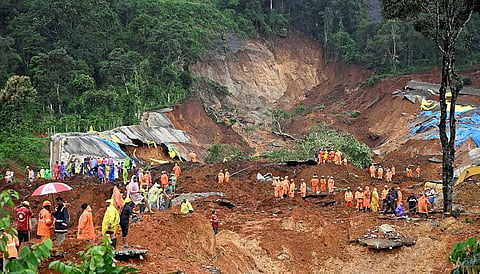


The July 7, 2026, landslide at Kalladi near Meppadi in Kerala’s Wayanad district was a disaster waiting to happen, according to experts.
Their remarks came even as rescue operations are on at the site of the disaster which claimed three lives, with five people being reported missing.
Geo-scientist C P Rajendran, adjunct professor at the National Institute of Advanced Studies, Bengaluru, observed after the disaster that the project had received clearance without detailed geological and hydrological investigations appropriate for such fragile terrain. Tunnelling, he noted, alters stress distribution within hill slopes, creates fractures and can trigger slope failures during episodes of extreme rainfall. He argued that changing rainfall patterns demanded far stricter ecological safeguards for infrastructure in the Western Ghats.
C K Vishnudas, director of the Hume Centre for Ecology and Wildlife Biology in Wayanad, described the Kalladi disaster as an engineering failure imposed upon an inherently fragile mountain. According to him, nearly 200 mm of rainfall in a day was enough to trigger collapse because the landscape had already been significantly altered through excavation, slope cutting and artificial stabilisation.
Even more significant was his observation that such an event occurred during a monsoon season that had otherwise recorded a substantial rainfall deficit. It showed how a single episode of intense rain can overwhelm a disturbed slope.
On July 7 morning, a deafening roar echoed through Kalladi before thousands of tonnes of mud, rock and construction debris crashed down the slope overlooking the exit portal of Kerala’s ambitious Anakkampoyil-Kalladi-Meppadi tunnel road, arguably the largest such project in the country.
Within seconds, vehicles disappeared under the moving earth. A bridge was buried, and workers were trapped. Rescue teams raced against time as terrified residents ran for their lives.
The tragedy occurred just five kilometres from the site of the 2024 Mundakkai-Chooralmala catastrophe, which claimed 298 lives.
Eyewitness accounts from Kalladi underscore how quickly the disaster unfolded. Ariff, a hotel worker near the tunnel entrance, recalled hearing a loud roar before watching an enormous mass of earth begin to move. Within moments, water, mud and rocks engulfed the road. The Meenakshi Bridge was almost buried. He and his colleagues escaped only by running as the debris reached the edge of the hotel.
The victims of July 7’s tragedy were not policymakers, consultants or contractors. They were workers who had travelled hundreds of kilometres from Madhya Pradesh, Bihar and Jharkhand in search of employment. Others injured were local residents whose villages once again found themselves cut off by a mountain disaster. The Meppadi-Chooralmala road was severed, rescue teams struggled to reach affected areas and dozens of families were shifted to relief camps.
People living around Kalladi had repeatedly expressed concern over the massive heaps of excavated earth stored near the portal area. Local elected representatives demanded retaining structures and questioned whether sufficient precautions had been taken before the arrival of the southwest monsoon. Those fears became reality when rainwater mobilised enormous volumes of excavated material into the valley below.
Chief Minister V D Satheesan and Agriculture Minister T Siddique stated that district authorities and the Kerala State Disaster Management Authority had repeatedly directed the contractor to remove the enormous quantities of excavated soil before the monsoon. Those directions, they said, were ignored. The government described the incident as a consequence of unscientific dumping of excavated earth.
If that version is confirmed, it reveals serious failures in site management. Yet it also exposes a larger institutional weakness.
If disaster management authorities had already identified the soil heaps as hazardous weeks before the collapse, why were construction activities not suspended until the risks were eliminated? Why were mandatory safety directions not enforced? Why did regulatory oversight stop at issuing warnings instead of ensuring compliance?
The larger question remains unanswered. Why was a project of this scale permitted through one of Kerala’s most landslide-prone mountain landscapes without the highest possible standards of geological investigation, climate-risk assessment and independent scientific scrutiny?
For Kerala, which has witnessed extreme weather events almost every year since 2018, the Anakkampoyil-Kalladi-Meppadi tunnel road was never an ordinary infrastructure project.
The Rs 2,134-crore twin-tube tunnel, stretching more than eight kilometres through the highly vulnerable Vellarimala mountain ranges, was projected as Kerala’s answer to the treacherous Thamarassery Ghat Road, which connects Kozhikode with Mysuru and Bengaluru through Wayanad.
Successive governments described it as a ‘lifeline’ between Kozhikode and Wayanad, capable of reducing travel time, improving logistics and boosting tourism and trade.
Yet from the day it was proposed, geologists, ecologists and local communities warned that the alignment crossed terrain that had repeatedly demonstrated its instability.
Experts say the Vellarimala-Chembra-Aranamala landscape is among the oldest mountain formations in peninsular India. Millions of years of weathering have converted large portions of the rock mass into highly fractured, deeply weathered slopes that become exceptionally vulnerable under prolonged or intense rainfall.
Climate change has amplified that vulnerability. Rain now falls less predictably but with far greater intensity, overwhelming slopes that may have remained stable for decades before suddenly collapsing.
The same mountain system has repeatedly reminded Kerala of its fragility. Since 2018, devastating landslides have struck locations around the tunnel alignment with alarming frequency: Puthumala and Kavalappara in 2019, Pettimudi in 2020, and Chooralmala and Mundakkai in 2024, where one of India’s deadliest landslides claimed hundreds of lives.
Each event strengthened scientific evidence that these mountains were entering a new era of climate-driven instability. Instead of prompting greater caution, however, development gathered pace.
Scientific studies over the last decade have consistently shown that Kerala is witnessing fewer rainy days but increasingly intense cloudbursts. Short-duration, high-intensity rainfall events are replacing steady monsoon showers. These bursts rapidly saturate hill slopes, increase pore-water pressure and trigger slope failures.
Ajil Kottayil, scientist at the Advanced Centre for Atmospheric Radar Research at CUSAT, has noted that recent extreme rainfall events over Kerala have been influenced by large-scale atmospheric systems such as Kelvin waves, Rossby waves and Mixed Rossby-Gravity waves. These disturbances organise deep convective cloud systems over the Arabian Sea and the Western Ghats, dramatically increasing rainfall intensity over short periods.
Research has linked the catastrophic Kerala floods of 2018 and 2019 to Rossby wave activity, while the deadly Wayanad landslides of 2024 coincided with strong Kelvin wave conditions. Such findings reinforce an uncomfortable reality: mountain infrastructure designed using historical rainfall patterns may no longer be adequate in a warming climate.
The tunnel project also exposed deeper weaknesses in India’s environmental decision-making process. Environmental clearances often evaluate forests, wildlife and pollution in considerable detail but devote relatively limited attention to long-term geological evolution, groundwater dynamics and climate-driven slope instability.
Traditional Environmental Impact Assessments (EIAs) remain poorly equipped to assess how ancient mountain systems behave under rapidly changing rainfall regimes. That gap becomes especially significant in landscapes like Wayanad, where disasters are no longer rare exceptions but recurring events.
Environmentalists have consistently argued that the project was treated largely as a road construction exercise instead of a massive geological intervention. Unlike highways on relatively stable terrain, mountain tunnels disturb rock masses, intercept underground water pathways, change slope geometry and modify drainage patterns that have evolved over millions of years.
The environmental appraisal, critics say, failed to adequately address these cumulative geological risks.
Sridhar Radhakrishnan, one of Kerala’s leading environmental activists who challenged the project, has argued that the environmental clearance itself deserves fresh scrutiny. According to him, conditions attached to the approval, including expectations that blasting would not generate damaging vibrations, reflected unrealistic assumptions rather than the realities of mountain engineering. Following the Kalladi disaster, he renewed his demand that the environmental clearance be withdrawn and that an independent scientific panel reassess the entire project.
Across India’s mountain regions, geological investigations are frequently undertaken from an engineering perspective — whether a tunnel can technically be built — rather than from an ecological perspective asking whether it should be built at all.
Those are fundamentally different questions. The former seeks technical feasibility. The latter evaluates long-term sustainability. In fragile mountain landscapes increasingly shaped by climate change, the distinction can become the difference between resilience and disaster.
The legal challenge against the Wayanad tunnel reflected precisely these concerns. Petitioners argued that the project traversed an ecologically fragile region already experiencing repeated landslides and that environmental safeguards were inadequate. In April 2026, however, the Supreme Court declined to halt the project, describing it as one of significant public importance while leaving regulatory compliance to the statutory authorities.
Legally, the project survived. Scientifically, the debate never ended. July 7’s disaster has now returned that debate to the centre of public discourse.