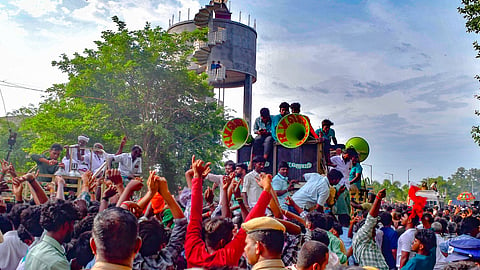


The rise of DJ processions in India underscores the limitations of existing noise pollution regulations, which fail to account for moving sound sources and their health impacts.
Studies show elevated noise levels during festivals, causing stress and hearing issues.
Experts advocate for advanced monitoring techniques, including noise mapping and individual exposure assessments, to safeguard public health.
During the festive season and the wedding months that follow, DJ sound systems blaring devotional and popular music are a common feature of public celebrations across India. These systems are now frequently mounted on vehicles that move through neighbourhoods and streets in processions, exposing residents along their routes to varying levels of noise.
Such moving sources present a challenge for assessing noise pollution. A measurement taken at a single location may capture the sound level at one point in time, but not how exposure changes as a procession moves through different neighbourhoods or how long people remain exposed.
Exposure to excessive noise can cause temporary hearing changes, persistent ringing in the ears and, in severe cases, permanent hearing loss. India's Noise Pollution (Regulation and Control) Rules, 2000, regulate loudspeaker use and prescribe ambient noise limits to protect human health and environmental quality.
The Rules prescribe ambient noise limits based on the energy-equivalent continuous sound level (Leq), which represents the logarithmic average of sound energy over a specified period. However, they do not cover other indicators, such as maximum sound level (Lmax) and statistical sound levels, which can reveal information about short-duration peaks and fluctuations that Leq alone may not capture.
Moreover, if the source is a moving DJ vehicle, sound measurement at one point cannot show how exposure changes across the procession route, leaving gaps in understanding how vulnerable communities may be.
So, can we assess the exposure and its impact on public and environmental health?
Data from festival noise monitoring in Guwahati illustrate the difficulty of distinguishing DJ noise from the broader sound environment. In a 2025 study published in Asian Journal of Science, Kongkon Bordoloi, assistant professor at the department of physics at Majuli College, Assam, analysed data with the Assam Pollution Control Board during the days of the Durga Puja festival between 2019 and 2023, and Diwali in 2023. At Panbazar, a densely populated commercial area, the reported Lmax reached 121.9 A-weighted decibels or dB(A) — a scale for judging loudness that corresponds to the hearing threshold of the human ear — during the 7 pm and 8 pm period on Diwali, indicating an exceptionally high short-duration noise peak.
Leq was 87.9 dB(A) for the same hour. Bordoloi told Down To Earth (DTE) that this is particularly significant because it indicates that the noise environment was not characterised solely by isolated peaks; the overall sound energy during that hour was also considerably elevated.
Bordoloi emphasised that the data captures ambient noise, not individual exposure. The monitoring records cannot distinguish noise from loudspeakers, firecrackers, traffic and other sources, or establish a direct link between festival noise and specific health problems. He said that assessing such effects would require personal exposure monitoring and health assessments of people in the area, including hearing tests, blood pressure measurements and sleep evaluations.
In another study, published in the Integrated Journal for Research in Arts and Humanities in March 2026, researchers from Dr. D. Y. Patil, Arts, Commerce and Science College, Pimpri, Pune, examined DJ and Dolby (an audio system) sound during Ganesh Utsav in 2025 in Pune. The researchers monitored noise at 10 sites on three occasions and reported A-weighted equivalent continuous sound level (LAeq) ranging 95-102 dB and peak sound levels (Lmax) reaching 116 dB. This is much above the Central Pollution Control Board's permissible ambient noise limits, which range from 55 dB(A) during the day to 45 dB(A) at night in residential areas, and from 65 dB(A) to 55 dB(A) in commercial areas.
The study also included a survey of 200 residents and festival participants, as well as pre- and post-festival blood pressure and heart rate measurements among 50 volunteers. The survey recorded reports of sleep disturbance, temporary tinnitus, stress and headaches among respondents. The paper also reported changes in blood pressure and heart rate of people; however, it did not establish that these changes were caused solely by DJ noise alone. It also did not elaborate on the duration of noise measurement and individual exposure to show how much sound each person experienced.
Sharad Gokhale, professor in the department of civil engineering at the Indian Institute of Technology (IIT), Guwahati, told DTE that environmental noise compliance does not necessarily require measuring every individual’s exposure. As noise levels vary with distance from the DJ and time, measurements at multiple locations, with coordination and timestamps, could help create a noise map showing sound levels around the source and the people exposed to it.
Chetan Upadhyay, founder of community empowerment and health non-profit Satya Foundation in Varanasi, who has worked on noise pollution complaints for about two decades, told DTE that people who contact his organisation often ask the police to reduce sound level during the day or stop the sound system at night. Upadhyay said complaints rarely document how long people are exposed to the noise.
Markandeya Tiwari, former faculty, department of civil engineering at IIT-Banaras Hindu University, Varanasi, told DTE that Leq and Lmax are important indicators but not sufficient to provide a complete description of DJ sound. A high Lmax, alongside a considerably lower Leq, indicates a brief peak.
Statistical indicators or percentile sound levels such as L10 (which indicates that noise level exceeded for 10 per cent of the measurement time), L50 (noise level exceeded for 50 per cent of the measurement time) and L90 (noise level exceeded for 90 per cent of the measurement time) can provide additional information about fluctuations in sound levels and the background noise, he said.
Tiwari said assessing people’s exposure also requires considering their location, how long they remain exposed, their activities, and how noise changes spatially and over time as the DJ moves.
Assessing potential health risks also requires knowing how long the peak lasts, how frequently it occurs, and how long individuals are exposed. Noise mapping combined with time-spent data, or individual noise dosimeters, could help estimate exposure.
ENT (ear, nose and throat) specialists say that assessing hearing problems after exposure to loud noise requires more than looking at symptoms alone. Rajat Jain, senior otorhinolaryngologist and ENT at King George’s Medical University in Lucknow, tells DTE that the risk of hearing damage depends on both sound level and exposure duration. He cautions that a normal hearing test does not rule out every auditory problem.
Durgesh Kumar Shukla, advocate at the Lucknow bench of the Allahabad High Court, told DTE that moving DJ processions are not exempt from applicable noise limits for religious, cultural, or festival events. Under the 2000 Rules, the use of loudspeakers requires written permission, while noise levels at public places must comply with the applicable limits.
Shukla said repeated violations should be treated as an enforcement issue rather than isolated incidents. Citing the Allahabad High Court’s directions in the case, Sushil Chadra Srivastava v. State of U.P, he said the police are required to respond to complaints, measure the noise levels, record details of complaints with what action has been taken, and inform the competent authority.