

I began writing this piece not at a desk, but in the afterglow of a conversation that refused to end.
It was close to four in the morning in Varanasi. The city had fallen into a deceptive quiet. A few stray sounds lingered. Distant footsteps. A passing vehicle. The occasional bark of a dog. Inside, however, time had loosened its grip. Words continued to move, unhurried, circling back, opening into other thoughts. There are conversations one does not conclude. One only carries them across cities.
This essay emerges from that condition of carrying.
I write this not merely as a recollection of a visit, nor as a festival note, but as an attempt to understand how cities endure in language. In an age where literature festivals risk becoming spectacle, and cities risk becoming surfaces, it feels necessary to return to the slower, more attentive act of reading a place. Banaras offers that possibility. It resists easy consumption. It demands time, memory, and listening.
I arrived in Banaras at the end of January 2026, when winter had begun to loosen its hold but still lingered in the early hours. The air carried a faint softness, touched with smoke and river mist. I had come for the Banaras Lit Fest, but the city, as always, had its own designs.
Banaras does not allow you to remain within the boundaries of your purpose. It draws you outward into its lanes, its conversations, its silences.
My first encounter with the city dates to 2002, when I arrived as a young student at Banaras Hindu University to study the humanities. That Banaras was overwhelming, almost excessive in its presence. Nothing seemed to align with the neat structures I had been taught to expect. Over time, I came to understand that Banaras is not meant to be grasped at once. It unfolds slowly, often contradicting itself, and in that contradiction lies its truth.
This return, therefore, was not a beginning. It was a continuation. A revisiting of something unfinished.
Cities like Banaras do not belong to a single time in one’s life. They return, altered yet familiar, asking to be read again. Each reading reveals not only the city, but the reader as well.
The days during the festival were full. Panels, conversations, hurried exchanges, familiar faces, new encounters. Literature was being spoken, debated, performed. Yet it was in the interstices, in the time between events, that the city revealed itself.
At moments, the festival also revealed another layer. Branded backdrops, curated sessions, the quiet choreography of visibility. Conversations that sought depth occasionally brushed against the demands of performance. It was not a contradiction so much as a coexistence. Literature, here, was both lived and displayed. One could move from a serious discussion to a carefully staged moment within minutes. The city, however, seemed to remain just outside these frames, waiting to be encountered elsewhere.
Almost every evening, after the formalities of the day, I would make my way to the Lahotia residence of Vyomesh Shukla. A major poet, prose writer, thespian, and cultural theorist, he remains, in many ways, a keeper of Banaras’s conscience. He is also, not incidentally, a generous and attentive host.
Those visits became a quiet rhythm. We spoke of literature, of institutions, of the strange afterlives of texts. But our conversations rarely stayed confined to the literary. They moved, almost organically, across art, music, spirituality, society, politics, environment, and the many layered worlds through which a city thinks and feels.
Over the years, a certain intimacy has come to shape my association with him. A shared attention to language, certainly, but also a deeper engagement with the life that surrounds it. With Vyomesh ji, conversation is never hurried. It unfolds, returns, deepens. What stays are rarely conclusions, but fragments. Observations that open into larger questions.
From there, I would return to my hotel late into the night, carrying these fragments, preparing again for the next day. Sleep felt secondary, almost incidental.
On the night of February 1, that rhythm stretched. Our common friend Kanishka Gupta and I reached Vyomesh ji’s home close to midnight. What followed was not a discussion in any formal sense. It was a slow unfolding. Of the literary and intellectual life of Banaras, of Hindi literature, of the city’s intimate relationship with language.
Time receded. It was close to four in the morning when we finally stepped out.
The next day, I had to return to Bengaluru.
There are conversations one does not finish. One only carries them forward.
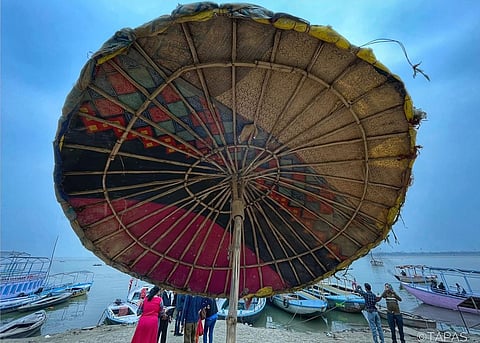
Mornings in Banaras belong to the river. Before the day gathers its noise, the ghats hold a different kind of stillness.
One morning, I sat beside an old boatman preparing his vessel. His hands moved with practised ease, repeating a gesture learned long ago and never forgotten. I asked him how long he had been on the river.
“As long as I can remember,” he said, smiling.
He spoke of the river as one speaks of a relative. Without ceremony. Without distance. “The Ganga keeps changing, but remains the same,” he added.
I asked him if the city had changed.
He paused, then said, “The city changes, but its rhythm does not.”
There was a clarity in that statement that resisted interpretation. Change without rupture. Continuity without sameness.
Not far from where I sat, the river carried another, quieter image. Along the edges, plastic bottles had gathered in small clusters. A thin film moved slowly across a still patch of water. The same river that holds centuries of faith also bears the marks of neglect. Devotion and disregard seemed to exist side by side, without cancelling each other. The continuity one speaks of is not untouched. It persists, sometimes, in spite of what erodes it.
A little further down, a group of men sat wrapped in shawls, their conversation moving effortlessly between politics, local gossip, and philosophy. Banaras does not separate these domains. The sacred and the everyday exist together, without hierarchy.
I was reminded of something Vyomesh Shukla had once said in passing. A city is not where you live. It is what continues to live in you.
At the ghats, that felt particularly true.
In the afternoon, when the festival briefly loosened its pace, I found myself drawn to a familiar refuge: Harmony The Bookshop at Assi Ghat.
It is a space I have returned to over the years, though each visit feels like a rediscovery. The shop is less an organised establishment and more an accumulation of time. Books are stacked without visible order. Some carry a fine layer of dust, as if waiting patiently. Others seem recently handled, still warm with attention.
The shopkeeper, Rakesh Singh, himself a well-read and quietly perceptive presence, looked up and asked what I was searching for.
“Anything,” I said.
He smiled, as if recognising the answer. “You do not find anything here. What you find is what you needed.”
When I asked him if the readers had changed, he paused for a moment. “People come,” he said, “they look, they ask, sometimes they take photographs. Fewer sit with the books.” There was no complaint in his voice, only a quiet acknowledgment. The space still held its density, but the rhythm around it had shifted. What was once a habit now felt, at times, like a choice that fewer people made.
He began pulling out books. Old Hindi journals, out-of-print essays, slender volumes of poetry. Each came with a story. Who had written it. Who had once asked for it. Who might return for it. His memory of books was not merely precise. It was relational.
We spoke of Hindi literature, of shifting readerships, of writers who now survive only in such intimate, almost hidden spaces. When I mentioned Vyomesh Shukla, he nodded and said, “He reads the city.” Then, after a brief pause, he added, “Before him, Kashinath Singh. Before him, Shivprasad Singh.”
It felt less like a hierarchy and more like a lineage.
Harmony is not just a bookshop. It is a quiet archive of intellectual life. Over the years, it has drawn writers, thinkers, artists, and journalists who pass through Banaras, not always as customers, but as participants in an ongoing conversation.
For me, this place carries an added intimacy. My association with it goes back to 2002, when I first arrived in Banaras as a student. My brother, Atul K Thakur, and I would often find our way here, lingering without urgency, discovering books we had not known we needed.
Returning now, I realised that while much around the city had shifted, this space had retained its essential character. Not unchanged, but continuous.
Like Banaras itself.
Evenings in Banaras often resolve into smaller, unannounced rituals. A cup of tea at a roadside stall. A plate of samosas eaten standing, without ceremony. These are not interruptions to the day. They are its most complete expressions.
At one such stall, the tea vendor poured tea with practised ease, the kettle moving in small, assured arcs.
“Is this your first visit?” he asked.
“No,” I replied.
“Still, you seem new,” he said, laughing.
A samosa vendor nearby joined in. He spoke of how the city had changed. More visitors, more noise, more movement. “But the essence is the same,” he added.
There was no complaint in his voice. Only recognition.
It was in such moments that I recalled an observation by Vyomesh Shukla. Banaras does not organise itself around the formalities of lunch and dinner. The city lives on snacks.
At first hearing, it sounds playful. But it carries a deeper truth. In Banaras, snacks are not simply food. They are a way of inhabiting time. Flexible, recurring, social.
From early morning kachoris to late evening samosas, from the first tea at dawn to another cup late into the night, the rhythm of the city is sustained through these intervals. People stop, gather, exchange a few words, disperse, and return again.
In that sense, eating becomes a form of conversation.
It is here that language finds its most natural expression. At the tea stall, words are not arranged or performed. They arise directly from lived experience. They carry humour, irony, and insight without effort.
To sit with tea in Banaras is not merely to drink. It is to enter a living field of language.
Banaras does not remember in straight lines. It accumulates.
Walking through its lanes, one encounters layers that do not resolve into a single narrative. A temple beside a shop. A modern signboard resting on an old façade. Nothing cancels the other.
In one of our conversations, Vyomesh Shukla observed that the city does not forget. It postpones. What seems lost returns, altered, reframed, spoken in another voice.
Coming from Mithila, where memory often travels through song and oral tradition, I felt a quiet resonance. In both places, the past is not archived. It circulates.
Now, as I live in Bengaluru, the capital of Karnataka, I find that this movement of memory does not remain confined to geography. It travels with you.
Kashi has long shared a deep relationship with Karnataka. From traditions of learning and pilgrimage to the movement of scholars and seekers between the south and the north, the connection is both historical and lived.
Banaras continues in Bengaluru, just as Mithila continues in both.
Banaras exists in many languages at once. Bhojpuri, Hindi, Sanskrit, Urdu. Each carries its own rhythm, its own way of seeing.
At the festival, this multiplicity became visible in subtle ways. English conversations on stage. Hindi debates in corridors. Bhojpuri exchanges in the background.
Yet the city’s linguistic life extends further. For centuries, it has been home to speakers of Bangla, Maithili, Marathi, and several South Indian languages. Scholars, pilgrims, teachers, and seekers have come here and stayed.
In certain neighbourhoods, one still hears traces of these journeys. A Bengali cadence. A Maithili phrase. A Tamil or Marathi inflection carried across generations.
These are not residues. They are signs of accommodation.
As Vyomesh Shukla once noted, a city remains open as long as it can sustain many languages. The moment it is reduced to one, it begins to close.
To write about Banaras in a single language, then, is to risk losing something essential.
Yet, there are also silences.
Not every story finds expression. Not every voice is heard.
In the changing landscape of the city, there are absences that remain unmarked. People move. Spaces disappear. Practices fade.
The visible city is only one layer.
To attend to the city is also to listen for what is no longer there.
For a writer, the city presents a challenge. It resists being contained.
At Banaras Hindu University, I was trained to seek clarity, coherence, argument. Banaras offers something else. Complexity without resolution.
One does not write the city. One responds to it.
Writing becomes an act of attention.
The morning of my departure was quiet. The city seemed unchanged, yet something had shifted.
Perhaps it was only my perception.
Or perhaps Banaras had altered its shape once again.
As I left, I carried with me not conclusions, but fragments. A boatman’s remark. A bookseller’s insight. A late-night conversation. The taste of tea. The sound of the river.
“The city changes, but its rhythm does not.”
The sentence returned, almost unbidden.
Cities do not remain in their buildings. They remain in the words we carry.
Banaras, in that sense, continues. Not as a place left behind, but as a presence that returns, unexpectedly, in language.
And perhaps that is what a city ultimately is.
Not a fixed geography.
But an afterlife in words.
(Ashutosh Kumar Thakur is a Bangalore-based writer, literary critic, and curator of the Banaras Lit Fest. He can be reached at ashutoshbthakur@gmail.com )
Views expressed are the author’s own and don’t necessarily reflect those of Down To Earth