
Book Excerpt: Conserving the dolphins of a mighty river

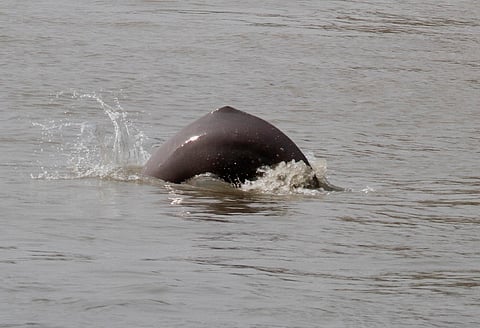
The presence of dolphins in the Brahmaputra has long been documented. As a child, I would look forward to our visits to Guwahati so we could go to the river bank and watch river dolphins leap, play and dance. Over the years, this has become a far rarer sight with the phenomenal surge of Guwahati’s growth, the building of public infrastructure and private buildings along the riverside, and the consequent pollution of the river and its smaller tributaries such as the Bharali. Indeed, the Bharali has suffered the indignity of being virtually turned into a gutter, spewing household muck and plastic bags and wrappers into the Brahmaputra. All this has played a major role in driving the dolphin population to less crowded and less polluted waters.
One of the key figures working in the area of dolphin protection is the zoologist R.K. Sinha of Patna University. We met fortuitously, first over email. At that time, I was working on a research project on conserving the dolphins in the Brahmaputra. These are the same species as the ones in the Ganga and the Indus, all called by the same generic name—Gangetic dolphins. By then, I had learnt of the Binns, the impoverished community which had migrated from Bihar and who were known to be poachers or dolphin hunters. The rationale for hunting the animals, Binns told me, was its precious fat or blubber. It had magical qualities, one of them said; a few drops of it mixed with a foul-smelling concoction of goat fat and wheat would attract a rush of fish which would surge to the surface to be captured in nets or by cane fishing rods. About 80 per cent of a dolphin’s body weight consists of blubber.

A majority of the Binns live in lower Assam, especially in the western district of Dhubri. Why kill such a beautiful precious creature just for its oil?
‘Sir, it has healing properties, it helps ease body pain, especially rheumatism and other ailments; we also use it for lighting lamps,’ said Sudama Binn, an older man with a bristling untrimmed beard. ‘We do not know any other livelihood, this has come down for generations and we have to feed our families.’
I was not convinced. Surely there had to be a better way of catching fish than killing dolphins.
Research took us to the email address of Prof Sinha at Patna University. In early 2007, he came to a conference in Guwahati. Sinha spoke of what I call the real magic potion, born of science and experimentation, which could replace dolphin oil and end the cruel killings of an international river beauty.
We emailed each other several times after that conversation as my team, and I had found that some of the Binns in the Dhubri area were keen to be freed of the social stigma of being poachers. They wanted to see if there were ways to reform and yet manage a livelihood from fishing. Some of the Binns from Dhubri travelled to Patna to learn from their fellow fisherfolk. Prof Sinha’s formula was simple: after years of testing, he had found the key ingredient of his magic in fish gut or offal. This was often thrown away by fishmongers since few customers had use for it. But when heated on a simple dish, it produced an oil which was similar in its chemical composition to that of dolphin blubber.
Within a month of their training, the four Binns from Dhubri had conducted a demonstration for hundreds of fishermen at the district headquarters about the efficacy of the alternative oil prepared from fish viscera, used as bait to catch a variety of fish known as the neria (Clupisoma garua).
We announced in a press statement on the eve of World Environment Day: ‘The fishermen from Dhubri, who previously used dolphin oil to catch fish, say that “the alternative oil is as effective as the dolphin oil and there is no need to use dolphin oil for fishing.”’
Things moved rapidly after that.
I did realize, however, that such efforts, though significant in themselves, needed a legal framework that would enable government departments to act, including the law enforcement agencies such as the police. I drafted a potential law and handed it over to a senior officer of the forest and wildlife department. They used it as a basis for the final law.
On World Environment Day the following year, Chief Minister Tarun Gogoi, a cheerful, lean politician who was widely respected for his common sense and good humour, was the main speaker at the state’s premier event. I had spoken to him a couple of times about notifying the dolphin as the state river animal.
Flanked by his cabinet ministers, including Environment and Forests Minister Rockybul Hussain188, the chief minister spoke to a packed hall. He was reading from a prepared text when he broke into a smile, looked for me in the audience and said, ‘Now, Hazarika will be happy to hear this,’ and announced the notification of the xihu as the state aquatic animal. The entire hall burst into spontaneous applause.
Another major goal had been achieved for the protection of the species. Yet, well after the dolphin was named the state aquatic animal, the challenges remain. It has been long hunted in India and other parts of South Asia for its fat and oil, as we have seen. Its numbers, once plentiful in the Ganga, Brahmaputra, Indus and their tributaries, have shrunk over the years. These days, there is a gradual revival of the population, thanks to efforts by researchers and scientists, environmentalists, state wildlife and forest departments as well as the government and international groups such as the World Wildlife Fund.
Although poaching in Assam has dropped after the dolphin was declared the state aquatic animal and the mammal’s numbers have grown, they still remain low. The results of the first ever national dolphin census were released by Prime Minister Narendra Modi in March 2025 and reported a total of 6,327 river dolphins across the country. Assam, specifically, recorded 635 dolphins in five rivers. The highest concentration of dolphins was found in Uttar Pradesh with 2,397 individuals.
Excerpted with permission from RIVER TRAVELLER - JOURNEYS ON THE TSANGPO-BRAHMAPUTRA FROM TIBET TO THE BAY OF BENGAL@2025SpeakingTigerBooks