
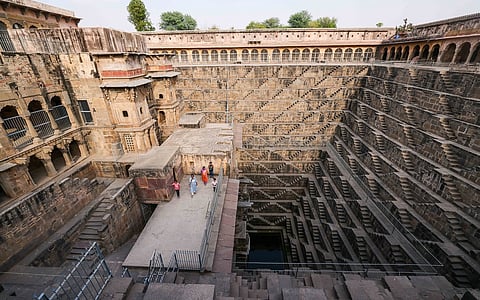

These photographs show the Chand Baori, built during the 8th and 9th centuries by an eponymously named king of the Gurjara-Pratihara dynasty in today’s Dausa district of eastern Rajasthan.
The Baori or stepwell is one of the largest of its kind in the world, plunging 13 stories or 64 feet deep.

Stepwells were a regular feature in the landscape of ancient northwestern and western India. Known variously as baolis, baoris, or vavs, these magnificent structures were primarily subterranean.
While they were primarily designed to harvest rainwater and provide year-round access to groundwater in arid regions, they evolved into something else: vibrant communal gathering spaces, temples, and cool sanctuaries for weary travelers.
In today’s climate change era when the value of water and cooling cannot be stressed enough, stepwells hold the promise of the Indian Subcontinent’s ancient wisdom once again coming to its rescue, as its climate stretches the endurance of its inhabitants to the limits.