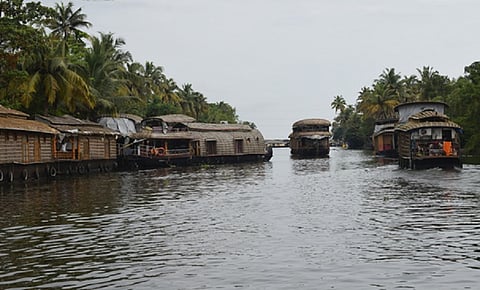

The recent actions by the Kerala government on the houseboats following the Kerala High Court’s order on houseboat pollution has once again stirred conversations on the pollution load in the Vembanad ecosystem. The court observed that the increasing number of tourist vessels has exceeded the carrying capacity of the lake, contributing to sewage discharge, oil leaks and solid waste accumulation. It also called for stricter monitoring and mandatory pollution compliance measures for vessels operating on the lake. But pollution crisis in Vembanad did not begin with houseboat tourism alone.
The transition in Vembanad Lake began after the commissioning of the Thanneermukkom Bund in 1976. Constructed to prevent saline intrusion into the Kuttanad region and support paddy cultivation, the bund altered the lake’s natural tidal flow and created a hydrological divide affecting both biodiversity and livelihoods. Although the bund was intended to remain closed only during the punja cultivation season, its operation has prolonged beyond the decided timeline.
Elders around the lake often recall a time before the bund when water moved continuously between the lake and the Arabian Sea. A common phrase among elders in the region- “Ozhukunna vellam eppozhum sudhamaanu” (flowing water is always clean) reflects a period before the bund’s existence. Communities believe that the prolonged operation of the bund has reduced the lake’s ability to naturally flush pollutants and recover from ecological disturbances.
Pollution in Vembanad is shaped not only by houseboats, but also by agricultural runoff from Kuttanad, untreated waste from nearby settlements and upstream pollutants entering the ecosystem through connected rivers. At the same time, the unregulated expansion of houseboat tourism has created challenges in waste management.
Houseboat tourism in Vembanad expanded in the early 2000s, particularly around Alappuzha and Kumarakom, establishing a niche region for houseboats and making it a top destination for tourism. According to government estimates, these regions host around 700 registered and 750 unregistered houseboats operating across the lake.
This concentration of houseboat operations has raised concerns over the carrying capacity of the ecosystem. The lack of adequate sewage treatment facilities and poor waste segregation systems at anchoring points have further deepened the crisis. Also the siltation of canals is a major constraint, limiting navigation to a few routes and increasing congestion. Houseboat operators have therefore called for canal de-siltation and restoration to improve navigation and reduce pressure on heavily used routes.
The aesthetics of Kuttanad’s below-sea-level paddy landscapes also contributes to this concentration. Tourists often prefer routes where agriculture, waterways and everyday life remain closely interconnected, making these regions central to Kerala’s backwater tourism economy.
The growth of houseboat tourism occurred alongside the increasing use of single-use plastics across Kerala. Fishers often associate plastic waste in the lake with houseboat operations, particularly because discarded plastic bags frequently contain food waste that attracts and traps fish. Clam collectors similarly report increasing plastic accumulation on the lakebed, affecting habitats and resource collection areas.
Communities argue that stagnation caused by the operation of the bund has intensified the accumulation of waste in the southern regions of the lake. As a fluid ecosystem connected to rivers, canals and settlements, waste entering the lake may also originate from upstream towns, agricultural runoff and households located along the banks.
While houseboats often become the most visible targets in discussions on pollution, the absence of coordinated waste collection, segregation and disposal systems across the wetland landscape remains a major concern. In recent years, state initiatives such as Kudumbashree and Haritha Kerala Mission have introduced measures to improve waste management, though implementation gaps continue to persist.
The rapid expansion of houseboat tourism has also exposed the fragmented nature of governance in the sector. The Port Department, functioning under the Inland Vessels Act, is responsible for vessel registration, while pollution certificates are issued by the State Pollution Control Board. In addition, the District Tourism Promotion Council under the Tourism Department oversees Sewage Treatment Plants (STPs) for houseboats. This fragmented institutional structure has limited coordinated planning and monitoring.
Under existing regulations, houseboats are expected to use STPs and comply with pollution control requirements. However, treatment infrastructure remains limited. Currently, only one of the two STPs are operational, and several operators report that these facilities are difficult to access or remain non-functional for extended periods. Attempts to establish additional STPs in parts of Kuttanad have also faced resistance from local communities concerned about odour, poor maintenance and waste accumulation.
Oil leakage from houseboat engines is another persistent concern. Many vessels continue to rely on modified lorry engines adapted for marine use, increasing the risk of oil discharge into the water. Although experiments with electric engines and cleaner technologies have begun in Kerala’s inland water transport sector, adoption within the houseboat industry remains limited due to high transition costs and limited institutional support.
Despite ecological concerns, tourism has become an important source of livelihood for many communities around Vembanad. Houseboats generate employment for fishers and local residents as boat captains, helpers, cooks and guides. Younger generations increasingly view tourism as an alternative livelihood amid the uncertainties around fisheries.
The challenge facing Vembanad is therefore not whether houseboat tourism should exist, but how tourism can coexist within a fragile social-ecological system. Addressing pollution in the lake requires coordinated action that goes beyond periodic crackdowns on houseboats. This includes defining ecological carrying capacities, improving sewage treatment infrastructure, restoring waterways and strengthening coordination between state agencies, tourism operators and local communities.
Without addressing the broader ecological and governance failures shaping the lake, periodic regulatory interventions alone are unlikely to restore the long-term health of Vembanad Lake
Ashish Mathew George is Senior Manager at the BhuSampada Centre, National Institute of Advanced Studies (NIAS), Bengaluru
Views expressed are the authors’ own and don’t necessarily reflect those of Down To Earth
