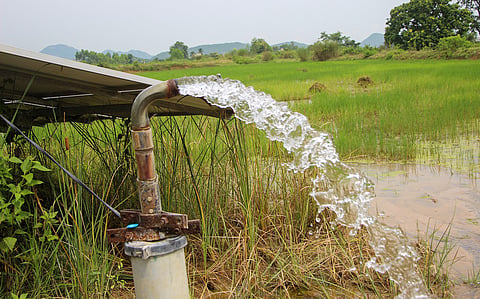


How strange — and alarming — to think that an invisible employer is vanishing beneath our feet. Groundwater, long treated as a private convenience, has quietly underpinned millions of days of casual farm work across India. As water tables fall, that “employer” is showing up less at the village gate: fewer transplanting seasons, shorter harvests, and less demand for daily wage labour. The result is not only ecological stress but a mounting labour-market shock for the most precarious rural workers.
Start with the scale. The Central Ground Water Board (CGWB)’s Dynamic Ground Water Resources assessment (2024) reports India’s annual groundwater recharge at roughly 448.5 billion cubic metres (BCM), with an annual extractable resource of about 407.8 BCM and estimated annual extraction near 247.2 BCM. Those national aggregates can lull policymakers into complacency. The truth is local and sharp: in the CGWB’s block-level accounting (2023), 736 out of about 6,553 assessment units (≈11 per cent) were classified as “over-exploited” — extracting more water than recharges — with many more labelled “critical” or “semi-critical.”
Why does that matter for labour? Two linked facts do the damage. First, casual agricultural labour is a major source of rural work: recent labour surveys (PLFS 2022–23, MOSPI) show that roughly one in four rural workers are casuals — the people hired day-to-day during peak cropping operations. Second, groundwater-fed irrigation historically expanded cropping intensity and the seasonal calendar that generates those jobs. When wells go dry or pumping costs spike, farmers cut irrigation, shift to less labour-intensive crops, or reduce cropped area. That immediately reduces hiring days for casuals and prompts out-migration or prolonged underemployment.
Field and academic evidence confirm the mechanism. Local case studies (for example, recent assessments in parts of Purulia and other drought-prone districts) show sharp falls in casual agricultural employment where groundwater access declined, while broader analyses emphasise that groundwater depletion increases fragility even as it previously reduced poverty by enabling irrigation. In short: groundwater irrigation lifted incomes — and created jobs — but its depletion reverses some of those gains
The human arithmetic is simple and brutal. A farmer who once hired 10 local labourers for transplanting and weeding now hires five; casual wages either decline, or those workers find zero paid work for weeks. Women — who supply a large share of informal farm labour — are disproportionately affected because their non-farm employment options are limited and water-fetching burdens rise as the resource shrinks. The decline in workdays cascades into food insecurity, debt, and distress migration — the very problems we imagine only droughts bring, but here happening quietly, thanks to a receding aquifer.
There is good news: India already has programs and pilots that point to solutions. Community-driven groundwater management under Atal Bhujal Yojana (program guidelines, Ministry of Jal Shakti) and state recharge drives have produced demonstrable local gains. Recent pilot reports and press accounts document measurable rises in water levels and restored irrigation capacity where recharge structures, community monitoring and IoT-enabled piezometers were deployed. These interventions do two things at once: they raise aquifers and create local employment — precisely the job-rich public works rural households badly need.
But pilots must be scaled and reframed as a labour-positive policy. Three priorities would make that possible.
First, target the hidden subsidy. Replace blanket, untargeted pump-power subsidies with metered electricity and targeted direct transfers for smallholders. Metering removes the perverse incentive to over-pump while transfers protect the poorest farmers’ incomes.
Second, use public works for recharge and jobs. Ask the state rural works to prioritise watershed and artificial recharge works in over-exploited blocks. This maps job creation to aquifer recovery — and creates immediate paid work for casual labourers who need it most.
Third, make groundwater labour-aware. Integrate block-level aquifer status into district employment planning and social-protection triggers. When a block shifts to “critical,” local administrations should scale up work guarantees, grain transfers and skill programs that ease the seasonal employment loss.
Thinking of groundwater only as a hydrological statistic is a policy blind spot. It is also a labour and development variable. If India wants resilient rural livelihoods, it must stop treating subsurface water as someone’s private tap and start treating it as a shared capital stock — one whose management can both restore aquifers and sustain the millions of informal jobs that depend on them. The choice is obvious: act now to revive an invisible employer or watch rural precarity deepen as wells run dry.
Sushanta Kumar Mahapatra teaches economics at ICFAI Foundation for Higher Education, Hyderabad
Purna Chandra Padhan teaches at the Xavier Labour Relations Institute (XLRI) in Jamshedpur, Jharkhand, India
Madan Meher is a former Senior Research Fellow (UGC) at the School of Economics, Gangadhar Meher University, Sambalpur, Odisha
The views expressed are those of the authors alone and do not necessarily represent those of their affiliated organisations or Down To Earth