

The proposed sale of a 49 per cent stake in Adani Vizhinjam Port Private Limited to Terminal Investment Limited (TiL), the port-operating arm of Mediterranean Shipping Company (MSC), has triggered one of Kerala’s biggest debates on infrastructure, environment and public interest.
Valued at about Rs 13,000 crore, the transaction would bring the world’s largest container shipping company into the ownership of India’s first deep-water transshipment port, located close to Vizhinjam near Thiruvananthapuram, at a time when another MSC vessel continues to cast a long shadow over the state’s coastline.
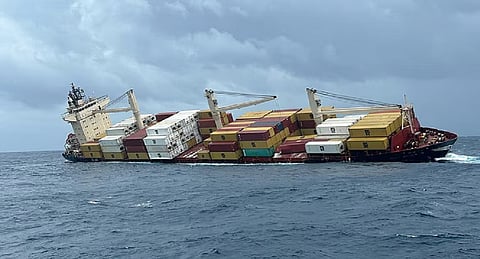
Barely a year has passed since MSC Elsa 3 sank off Kochi, releasing fuel, containers, and billions of plastic pellets into the Arabian Sea. The tiny nurdles continue to wash ashore along the Kerala and Tamil Nadu coasts after every spell of rough weather, keeping alive questions about environmental accountability even as MSC seeks a larger commercial presence in the state. The coincidence has transformed what might otherwise have been a routine corporate investment into a wider public interest issue. It is no longer merely about a change in shareholding. It is about who controls a strategically important public asset, whether competition can be preserved, how public investments are protected and whether ecological concerns can coexist with one of India’s largest maritime infrastructure projects.
Adani Ports and Special Economic Zone announced on June 30 that TiL would acquire a 49 per cent stake in Adani Vizhinjam Port Private Limited, valuing the company at nearly Rs 27,000 crore. The company said the partnership would strengthen Vizhinjam’s position as a major transshipment hub and deepen its long-standing relationship with MSC.
Kerala, however, has adopted a cautious approach. Chief Minister V D Satheesan told the Kerala Assembly that the state government had not been consulted before the announcement and had learnt about the proposal through media reports. He said any transfer of shares requires prior approval under the concession agreement with Adani and assured the House that Kerala’s interests would not be compromised. Satheesan said the proposal would be examined against five principles: national security, protection of Vizhinjam as a common-user port, fair competition, equal opportunity for all operators and the state’s long-term interests. Leader of the Opposition Pinarayi Vijayan also demanded scrutiny. He questioned whether allowing the world’s largest shipping company to become a major shareholder could gradually concentrate cargo movement and terminal operations in the hands of a single global player. He also sought clarity on whether the proposed transaction complies with the concession agreement.
MSC is far more than a financial investor. It is the world’s largest container shipping company and one of the biggest terminal operators through its subsidiary TiL. Maritime analysts believe its investment could guarantee cargo volumes and strengthen Vizhinjam’s challenge to Colombo, Singapore and Dubai. But critics fear the growing integration of shipping and terminal ownership could reduce competition over time. If one company becomes both the dominant customer and a major shareholder, rival shipping lines may perceive the port as favouring one commercial network. Similar concerns have attracted regulatory attention in Europe, where competition authorities have examined the implications of vertical integration in container shipping. The proposed transaction has therefore become a governance issue as much as a commercial one.
The controversy has also revived questions about the concession agreement itself. The Comptroller and Auditor General (CAG) had earlier observed that several provisions of the agreement disproportionately favoured the concessionaire despite substantial public investment. Kerala invested thousands of crores in land acquisition, breakwaters and connectivity, yet the audit questioned whether the state’s financial returns were commensurate with that investment. The proposed stake sale has renewed calls for greater transparency over how a publicly supported infrastructure project is monetised and whether the public receives a fair share of the value it helped create.
The questions surrounding the Adani-MSC partnership become sharper in the light of the MSC Elsa 3 disaster. On May 24, 2025, the Liberia-flagged container vessel sank about 38 nautical miles off Kochi, carrying containers, fuel and industrial plastic pellets. Oil spread across the sea, containers drifted ashore, and billions of nurdles entered the marine environment. More than a year later, plastic pellets continue to wash ashore along Kerala and Tamil Nadu after rough seas and monsoon currents. Scientists warn that the tiny polyethylene pellets are almost impossible to recover completely because they become buried beneath beach sand, move with tides, and are consumed by marine organisms. For fishing communities, the pollution remains a continuing economic burden. Fishers have reported finding nurdles trapped in their nets, while concerns over seafood safety and damaged fishing grounds continue to affect livelihoods.
Greenpeace has described the shipwreck as a wake-up call for India’s marine governance after conducting large-scale research in the affected areas. It called for long-term monitoring of plastic pellet pollution, stronger liability mechanisms, and greater accountability from shipping companies. Greenpeace has also questioned the continued operation of ageing cargo vessels and argued that multinational shipping firms should bear greater responsibility for environmental damage. The MSC Elsa disaster exposed the institutional challenges of regulating global shipping, where complex ownership structures and flags of convenience often complicate accountability after maritime accidents.
The debate over Vizhinjam cannot be separated from the ecological changes already unfolding along Kerala’s southern coast. Coastal geomorphologist A J Vijayan has consistently argued that ports should not be assessed in isolation. Breakwaters alter the natural movement of sand, trapping sediment in some places while accelerating erosion elsewhere. He has repeatedly called for cumulative environmental impact assessments that consider ports, seawalls, dredging and climate change together.
Several fishing villages north of Vizhinjam have experienced shrinking beaches, damaged fishing infrastructure and repeated displacement. Civil society studies have documented the loss of houses, degradation of rocky reef ecosystems and declining access to traditional fishing grounds. Marine ecologists warn that the rocky reefs around Vizhinjam support rich biodiversity and function as breeding grounds for commercially valuable fish species while also protecting the coast from wave energy.
Few dispute Vizhinjam’s strategic importance. Its natural depth and proximity to one of the world’s busiest shipping lanes give India a rare opportunity to reduce dependence on foreign transshipment hubs. The challenge is ensuring that commercial success does not come at the expense of environmental sustainability, public accountability and coastal livelihoods. Chief Minister V D Satheesan’s insistence that the proposal be tested against public interest, competition and national security, and Pinarayi Vijayan’s demand for scrutiny of its long-term implications, reflect the broader questions now confronting Kerala.