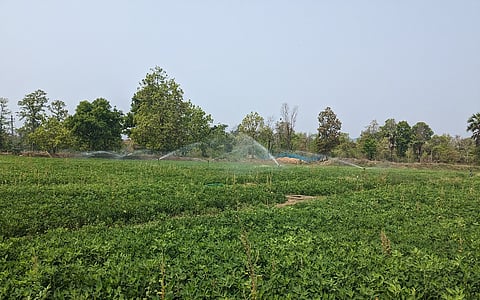


By late summer, the hills around Chitapari village in Chitrokonda block of southern Odisha’s Malkangiri lose much of their green. Streams that cut through the slopes after the monsoon shrink into narrow trickles, wells turn shallow, and farmers begin reading the soil more carefully than the sky. In this remote rainfed landscape, where irrigation barely reaches upland farms, the farming year depends almost entirely on how long rainwater can be held in the land.
A few years ago, that water rarely stayed long enough.
“Whenever there was heavy rain, the water would rush down the slope and carry the topsoil with it,” said Ghasi Kirsani, a farmer standing beside his upland field. “Before we felt the land had absorbed enough, it had already dried again.”
Chitapari lies across undulating terrain where lowlands support paddy, but uplands remain exposed to runoff and moisture stress. For generations, farmers here adapted by cultivating mixed crops such as millets, pulses and oilseeds on higher ground, relying on crop diversity. But increasingly erratic monsoons and repeated soil erosion have made even these resilient systems fragile.
Watershed Support Services and Activities Network (WASSAN) has been working with local communities and NGOs to promote community-led watershed intervention. The process did not begin with construction, but with walking with the farmers.
Field teams of WASSAN moved across slopes with farmers, identifying drainage lines, eroded field edges, moisture-retaining patches and runoff channels. The planning relied less on technical maps and more on farmers’ intimate reading of land behaviour.
“Farmers here know exactly where water first starts cutting through a slope,” said Jyoti Ranjan Samal, Project Engineer, Malkangiri, WASSAN. “They can point out which patch dries first after rain and where moisture remains longest. Watershed planning starts from that local knowledge.”
Based on this, carefully placed interventions followed: contour bunds across upper slopes, trenches along runoff paths, farm ponds near cultivated plots and check dams across seasonal streams. Together they slowed runoff and allowed water to infiltrate.
The results became visible only after a few seasons.
“Earlier, after the paddy harvest, the upland dried so quickly that we left much of it unused,” says Deba Kirsani, another farmer in the village. “Now moisture remains longer. We grow pulses and vegetables for more months.”
The first gains were subtle: damp soil deeper into winter, shallow depressions holding water longer, and a seasonal stream near the village flowing for several extra weeks after the monsoon.
For households dependent entirely on rainfed farming, even that small extension mattered. “A few additional weeks of moisture meant fodder for livestock, pulses after paddy, and vegetables that reduced dependence on weekly markets,” said Trinath Taraputia, Associate State Coordinator, Koraput, WASSAN.
But in villages like Chitapari, water conservation is rarely about structures alone.
The slopes are hydrologically connected: runoff from one field directly affects another below. If upper slopes remain untreated, lower plots continue losing both water and topsoil. That made village-level planning essential.
A series of community meetings helped decide which fields needed treatment first, how common lands should be protected and who would repair structures damaged after heavy rains.
“A bund survives only when farmers rebuild it every year,” says Pratidendu Pritibhushan, Project Engineer, Koraput, WASSAN. “If people see it only as a project asset, one heavy rain can undo the work.”
That principle of local ownership is increasingly shaping watershed initiatives across rainfed India. Physical structures can slow water, but only institutions sustain them.
In Jamuguda village in Khairput block, water conservation has taken a different form.
Here, 21 farming families now manage a shared solar irrigation system that has become a collective water lifeline. Established during 2023-24 under Odisha’s Special Programme for Promotion of Integrated Farming, the initiative covers 35 acres and uses a 10 HP solar pump to lift river water through underground pipelines reaching farms at different elevations.
The project cost Rs 14.4 lakh, with major support from the Department of Agriculture and Farmers’ Empowerment, Government of Odisha. But what distinguishes it is the contribution from farmers themselves: labour worth Rs 1.77 lakh was invested in laying pipelines and filling trenches.
Implementation was led by Swabhiman Farmer Producer Company with technical support from WASSAN. A local Water User Association now manages distribution, maintenance and crop scheduling.
“We worked together because this water belongs to all of us,” says Mukunda Gurteli, one of the farmers in Jamuguda. “When irrigation comes at the right time during dry spells, it saves both paddy and millet. Now we are able to grow a second crop.”
The impact is visible in farm incomes. With rainfall becoming increasingly erratic despite stable annual totals, farmers have been able to protect kharif crops and expand rabi cultivation of groundnut, green gram and vegetables.
Farmers now report additional annual earnings between Rs 30,000 and Rs 80,000, depending on landholding.
Hari Gurteli, a model farmer harvested 18 quintals of groundnut last season, earning over Rs 1 lakh, along with three quintals of green gram worth another Rs 30,000. “Earlier, water was uncertain,” he says. “Now, we can plan our crops with confidence.”
WASSAN’s field experience across Odisha has also shaped a larger policy argument: watershed success should not be measured only by the number of structures created. Water retention alone cannot secure livelihoods unless cropping systems also align with local ecology.
In Chitapari, that understanding remains embedded in traditional farming systems. Millets and pulses require less water, tolerate dry spells and restore soil health compared to water-intensive monocrops.
“If rain stops early, millet still gives grain,” said Deba Kirsani, who has recently expanded finger millet cultivation on upland land. “Paddy needs standing water. Millet survives with whatever moisture remains.”
This practical ecological logic later informed broader state efforts such as Shree Anna Abhiyan (formerly Odisha Millets Mission), where WASSAN contributed to strengthening rainfed farming strategies.
Across Odisha, rainfall is increasingly arriving in shorter, more intense bursts, followed by longer dry spells. In districts like Malkangiri, where irrigation coverage remains limited, this makes every contour trench, farm bund and community-managed water system more significant.
Yet the lesson from Chitapari and Jamuguda is larger than infrastructure.
Future water policy in rainfed regions cannot remain confined to engineering targets or isolated schemes. It must invest in village institutions, support local crop diversity, strengthen common water governance and recognise that farmers already possess hydrological knowledge of their landscapes.
On World Water Day, these tribal villages show that climate resilience is not about bringing more water from elsewhere, but by learning how to hold rain where it first falls.
Abhijit Mohanty works as a Programme Manager - Knowledge Building for Watershed Support Services and Activities Network (WASSAN), Bhubaneswar.
Soumya Ranjan Majhi works as a Regional Coordinator for Watershed Support Services and Activities Network (WASSAN), Koraput.
Views expressed are the authors’ own and don’t necessarily reflect those of Down To Earth