

This is the first of a 2-part series. Read the second part here
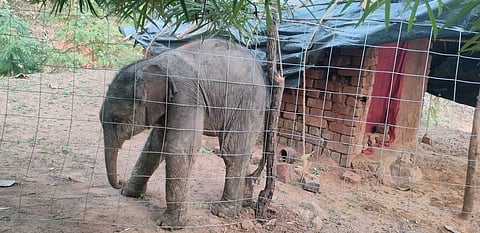
It was the coldest morning of the year in Kalahandi, Odisha. Mist clung to the paddy fields like a shroud, and frost crunched under the feet of a farmer walking toward his harvest. The silence was broken only by his own breath, until he heard a weak whimper from a dilapidated hut at the forest’s edge. Inside, shivering violently, was a baby elephant, perhaps three or four months old. Its skin was pale from cold, its eyes barely open. Curiosity turned to pity, but before the farmer could step closer, a deafening trumpet erupted from the treeline. A massive tusker and a visibly distressed mother elephant stood guard. As villagers gathered, the elephant family retreated up a steep hill slope into the forest—but the newborn was too weak to follow. It lay there, abandoned not by choice, but by circumstance, as the herd waited anxiously in the wooded shadows.
This poignant scene is not an isolated tragedy but a symptom of a deeper, escalating crisis at the intersection of human and elephant lives in India. As forests shrink and resources dwindle, elephants increasingly venture into farmlands, leading to fatal conflicts. The incident in Kalahandi—where forest officials were slow to respond—highlights systemic gaps in both emergency response and long-term conflict mitigation.
As traditional forest habitats degrade, elephants are pushed to the brink of starvation. Deforestation and dwindling water sources have depleted the natural fodder—grasses, bamboo, leaves, and bark—that a mega-herbivore herd requires daily. An adult elephant needs over 150 kilograms of food and 100 litres of water each day, a demand fragmented forests can no longer meet.
Driven by hunger, herds venture beyond the forest boundary. Here, they discover vast, nutrient-rich alternatives: cultivated paddy fields and sugarcane plantations. Unlike scattered forest vegetation, these crops are concentrated and palatable, turning farmlands into irresistible buffets.
This desperate migration for survival, however, sets the stage for tragic conflict. What is survival for the elephant translates into catastrophic economic loss for a farmer whose annual livelihood can be wiped out in a single night. This cycle underscores that the core of human-elephant conflict is not aggression, but a profound ecological crisis.
While a health team has arrived, the reported injury to the calf deepens the crisis. The promise of a press statement feels like a bureaucratic ritual, prioritising public relations over a fragile life. The mention of Nandankanan Sanctuary highlights a terrifying gap: the dangerous journey itself.
Transporting a critically injured elephant over long distances is high-risk. Stress, shock, and a lack of specialised mobile veterinary care could prove fatal. Who bears responsibility if the calf succumbs en route? The delayed response points to systemic failure—a lack of emergency protocol, equipment, and urgent accountability.
The forest department’s duty is one of care. Every moment of delay questions their commitment to the Wildlife (Protection) Act. The herd’s silent vigil is a reminder that this is about honouring the bond between mother and young.
Elephant corridors—ancient pathways allowing herds to migrate—are facing unprecedented disruption. These vital highways are being severed at an alarming rate.
Rampant infrastructure development is the primary culprit. National highways, railway lines, and mining projects carve through these passages, creating fatal barriers. Elephants are forced to navigate dangerous crossings, leading to tragic accidents.
Simultaneously, large-scale deforestation for agriculture and encroachment shrinks the very forests these corridors connect. What remains are isolated “forest islands”, trapping elephant populations and escalating raids on farms.
Furthermore, expanding human settlements and commercial plantations permanently block traditional routes. Even when corridors are identified on paper, poor enforcement allows incursions to continue unchecked.
The result is a devastating cycle: obstructed corridors force elephants into human spaces, leading to crop raids, property damage, and casualties on both sides.
Elephants, being mega-herbivores, require vast stretches of forest and abundant fodder and water. However, habitat fragmentation due to mining, infrastructure projects, and agriculture has pushed them into human-dominated landscapes. In regions like Odisha, Jharkhand, West Bengal, Assam, and Kerala, elephants raid crops—especially nutrient-rich paddy—causing devastating economic losses for farmers. For marginal farmers, a single night’s raid can wipe out a year’s livelihood.
But the conflict is deadlier still. According to data from the Union Ministry of Environment, Forest and Climate Change (Mo), elephant attacks claim around 400-500 human lives annually across India. In Odisha alone, over the past decade, more than 700 people have died in such encounters. Village residents, often poor and with limited options, risk their lives guarding fields at night with fire-torches, crackers, and crude weapons—a dangerous standoff that frequently turns fatal.
The emotional and economic toll is immense. When a farmer like loses his crop, or a family loses its sole breadwinner, resentment toward elephants—and the government—grows. This animosity undermines conservation efforts and sometimes leads to retaliatory killings, poisoning, or electrocution of elephants.
To address this, both central and state governments have rolled out several schemes:
Project Elephant (1992): A centrally sponsored scheme focusing on elephant protection, habitat restoration, and conflict mitigation. It supports states in creating elephant reserves, deploying anti-depredation squads, and using early warning systems like SMS alerts and drone surveillance.
Compensation for losses: Most states offer ex gratia payments for human deaths (usually Rs 4-10 lakh for small to high risks), injuries, and crop damage (varies per acre). However, the process is notoriously slow, entangled in bureaucratic red tape. Families often wait months or years, and the compensation rarely matches the lifelong loss.
Mitigation measures: These include:
Solar-powered fences and trench barriers to keep elephants out of villages.
Beehive fences (elephants fear bees).
Creation of water holes and fodder plots inside forests to reduce venturing out.
Rapid Response Teams (RRTs) to drive elephants back safely.
Despite these measures, implementation is inconsistent. In the Kalahandi incident, the absence of a veterinary doctor and the divisional forest officer’s unavailability reveal a crippling lack of emergency preparedness. The forest department is often understaffed, underfunded, and ill-equipped to handle crisis situations in remote areas.
The Wildlife (Protection) Act, 1972, provides the bedrock for elephant conservation. Elephants are listed under Schedule I, affording them the highest level of protection. Key provisions relevant to human-elephant conflict include:
Section 9: Prohibits hunting, with strict penalties for violation.
Section 29-31: Regulates trade in elephant parts and captivity.
Section 3A of the 1991 Amendment (Chapter IV): Empowers the Central Government to declare Elephant Reserves—not legally binding as “protected areas” but critical for focused conservation.
The concept of elephant corridors—narrow strips of land that allow elephants to move between habitats—is central to reducing conflict. India has identified over 100 such corridors, but only a handful is legally secured. While the National Green Tribunal (NGT) and courts have often directed states to protect corridors, ground realities differ. Encroachment, mining, and infrastructure projects (roads, railways) continue to fragment these passages.
At the central level, the MoEFCC guides policy and funding. At the state level, forest departments are responsible for corridor demarcation, land acquisition, and community engagement. However, inter-state corridors face coordination challenges, and economic interests often trump ecological needs.
The recent death of an elephant crossing the Mahanadi river, and the tragic demise of journalist Arindam Das while covering it, underscore this grim irony. The incident sparked public outrage, with politicians and officials making emotional statements and promising swift action. Yet, such “hue and cry” rarely translates into sustained policy change. Media coverage fades, and the cycle of neglect continues.
In the Kalahandi case, the baby elephant’s fate hangs in the balance. The herd’s instinct to protect its young is at odds with human curiosity and bureaucratic apathy. Without immediate medical intervention, the calf may not survive, and the herd—lingering nearby—could grow agitated, increasing the risk of conflict.
A path forward that saves elephants while safeguarding human lives demands a holistic and compassionate strategy, built on several pillars. First, rapid response systems must be strengthened through 24/7 veterinary and rescue teams, dedicated emergency helplines, and GPS-based monitoring to address crises immediately. Second, elephant corridors must be legally secured by notifying them under environmental laws and enforcing strict bans on disruptive activities like mining and construction within these vital passageways. Third, conservation must become community-led, engaging villagers as custodians by providing crop insurance, ensuring prompt compensation for losses, and training local “elephant guardians.” Fourth, long-term investment in habitat restoration is essential to replenish degraded forests, create elephant-friendly buffer zones with alternative crops, and promote sustainable livelihoods for forest-adjacent communities. Finally, accountability and transparency must be ensured by holding officials responsible for lapses and establishing clear public grievance redressal mechanisms. Only through such an integrated approach can we hope to balance ecological integrity with human well-being.
The shivering baby elephant in Kalahandi stands as a powerful metaphor for India’s urgent conservation challenge. These gentle giants are not intruders but victims of a relentlessly shrinking wilderness. Their survival—and our shared future—depend on our collective will to balance development with empathy, and to replace conflict with genuine compassion.
The calf’s survival hinges on compassion and competent care. It requires immediate on-site stabilisation—warmth, hydration, and treatment for its injury. Only when it is stable, should a carefully planned, minimally stressful transport be attempted.
At the sanctuary, the goal must be rehabilitation, not permanent captivity. The ultimate objective should be a soft release back into its native forest and, if possible, its original herd.
This calf’s fate is a microcosm of the larger conflict. Its survival would be a testament to what is possible when bureaucracy is bypassed by decisive, life-affirming action—a victory for coexistence. The herd’s silent vigil is a plea; our response must be a promise kept.
Chitta Ranjan Pani is an independent researcher of livelihood and natural resource governance
Views expressed are the author’s own and don’t necessarily reflect those of Down To Earth