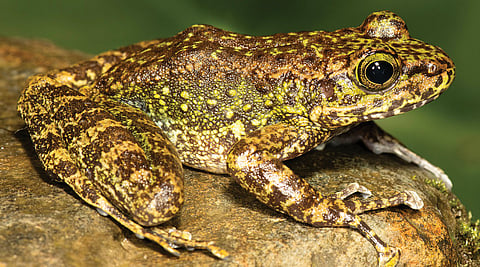


A newly discovered frog in the forests of Tripura has given an unexpected afterlife to the memory of a Kerala woman who spent much of her own life caring for people.
The frog, Amolops ammachi, has been named after Padmini Varkey, affectionately known as Ammachi, by a team of scientists led by S D Biju of the University of Delhi, widely known as the ‘Frogman of India’.
The name is more than a formal scientific tribute. Biju had known Ammachi decades before he became one of India’s leading amphibian scientists.
As a young student and activist in Thiruvananthapuram, he was a friend and fellow activist of her son Ashokan and was among the young people who found a welcoming space in the Varkey household.
Years later, while exploring the forests of Northeast India in search of frogs, he found a species that science had never formally recognised and chose to give it the name of the woman whose home had once welcomed him.
The story of Amolops ammachi begins in a very different landscape, in a house in Thiruvananthapuram during the politically charged years of the late 1970s and early 1980s.
Padmini Varkey and her husband, P M Varkey, lived there with their six children. But their home was rarely occupied only by the family.
Students, political activists and friends of their children came and went freely. Young people associated with the student movement often gathered there, discussed politics, ate together and sometimes stayed the night.
Ammachi never treated them as outsiders. She cooked for them, listened to them and cared for them with the natural ease of a mother.
The name by which she was known eventually came to mean much more than a family relationship. For many of the young people who passed through her home, she was indeed a mother figure.
Biju was one of them. At the time, nobody could have predicted that the young activist who entered the Varkey home would eventually spend decades travelling through some of India’s most remote forests, studying amphibians and discovering species unknown to science.
His career would take him deep into the biological wealth of the Northeast, where mountains, forests and innumerable streams have created habitats for an extraordinary variety of life.
Yet the memory of Ammachi remained. When his team encountered the distinctive frog in Tripura and established through scientific investigation that it was a species new to science, Biju chose to connect it with a woman he had known long before his scientific career had taken shape.
Padmini Varkey’s political and social commitments were closely intertwined. She worked in the Kerala Health Department and was associated with progressive and Left movements, but her politics was expressed as much through her conduct as through organisational activity.
For her, solidarity was not an abstract political idea. It meant feeding a hungry student, helping someone in distress, offering shelter or standing beside a person who had been pushed to the margins.
She was associated with women’s organisations and social initiatives and later devoted considerable energy to palliative care and the welfare of vulnerable people.
Her work included associations with the Devaki Warrier Memorial Women’s Studies and Empowerment Centre, the Kerala Working Women’s Association and Ashraya. Even after retirement, the instinct that had shaped her life remained unchanged: people who needed help should not be turned away.
That background makes the name given to the frog particularly meaningful. The formal scientific description records that Amolops ammachi was named in honour of Padmini Varkey, who was fondly called Ammachi, meaning ‘mother’ in Malayalam, and notes her unconditional love and readiness to help people in need.
Such acknowledgements are not unusual in taxonomy, where new species are frequently named after people who have contributed to science or inspired researchers. What makes this case unusual is the personal history connecting the scientist and the person being honoured. Biju was not simply commemorating a distant public figure. He was remembering someone whose home and affection had been part of his own formative years.
The frog was discovered in the Jampui Hills of Tripura, one of the biologically rich mountainous regions of Northeast India.
It belongs to the genus Amolops, a group of Cascade Frogs comprising around 100 species distributed across Asia. Their name reflects their preferred habitat: fast-flowing forest streams, rocky waterfalls and cascades.
The newly identified species is medium-sized, measuring about 80 millimetres, with a light-brown body marked by striking olive-green reticulations. Its existence had remained hidden within a group of frogs whose members can look remarkably similar, making identification difficult without detailed examination.
The discovery was the result of more than 15 years of systematic exploration. Biju and his colleagues surveyed mountainous areas across all seven northeastern states and documented more than 300 geographic populations of Cascade Frogs.
The researchers combined field observations with detailed morphological studies of adults and tadpoles and DNA analysis to determine their evolutionary relationships. Their work resulted in the identification of three species new to science from Tripura, Nagaland and West Bengal, as well as five Cascade Frog species recorded in India for the first time.
The other two newly described species are Amolops sendenyu, the Sendenyu Cascade Frog, named after Sendenyu village in Nagaland where it was discovered, and Amolops bella, the Beautiful Cascade Frog, from West Bengal, named for its striking appearance. Together, the discoveries demonstrate how much biological diversity remains undocumented even in regions that have been studied for decades.
The study, titled Systematics, molecular phylogeny, diversification, and biogeography of Cascade Frogs (Ranidae: Amolops) from India: an integrative assessment with description of three new species, was published in the Bulletin of the Museum of Comparative Zoology, a prestigious scientific journal published by Harvard University since 1863. It goes beyond the description of three new species to examine how Cascade Frogs evolved and spread across Asia. DNA-based dating indicates that the group underwent extensive diversification around 32 million years ago, around the Eocene-Oligocene transition, a period of major geological and climatic change. The study points to several waves of east-to-west colonisation across Asia and highlights the role of the early uplift of the Himalayas in shaping the distribution and diversification of these frogs.
“This study is a work of over 15 years to comprehensively study India’s Cascade Frogs. It is a taxonomically challenging group, but we have now clarified several confusing aspects of its biology, which will help in proper identification and conservation of species. Our study reaffirms that many Indian faunal groups remain poorly studied and contain undiscovered biodiversity, especially in the lesser explored northeastern states that are part of two internationally recognised biodiversity hotspots,” Biju says.
That warning is as important as the discovery. Northeast India forms part of the Himalaya and Indo-Burma biodiversity hotspots, regions recognised for their extraordinary biological richness and large numbers of species found nowhere else. Many of these species depend on highly specialised habitats that are increasingly vulnerable to disturbance. Cascade Frogs, living in fast-flowing streams and forested mountain landscapes, are closely tied to the health of their habitats. Discovering a species is therefore only the first step. Understanding its distribution, protecting its habitat and ensuring its survival are equally important.
The story of Amolops ammachi brings together two kinds of discovery. Biju’s scientific work revealed a frog that had existed unnoticed by formal science, while his memory revealed something about a woman whose influence was preserved primarily through the people she touched. Padmini Varkey died in 2015, but her memory survived in the lives of the activists she encouraged, the people she helped and the family she raised. Now it has entered a completely different realm.
Every time Amolops ammachi appears in a scientific paper, a field guide or a conservation study, the name Padmini Varkey will travel with it. Somewhere in the forests of the Jampui Hills, the frog lives among rocks and rushing water, part of an evolutionary story that began millions of years before the woman whose name it now bears was born.