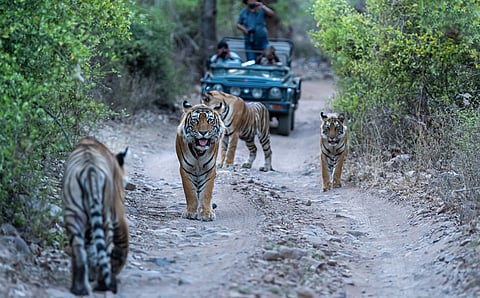


Since the first wildlife safari in India decades ago, every part of the experience has changed dramatically.
Photography and social media now decisively shape perceptions, frame conservation ideology, foster anthropocentric views, and influence diverse engagement with wildlife. As human-wildlife interactions rise amid calls to expand tiger reserves, narratives within tiger reserves and buffer zones and their impacts on locals and wildlife are critical, as public perceptions and support can drive or hinder meaningful change on the ground.
The growing tiger population is widely celebrated in India. However, life in the buffer areas tells a different story. This fall-out from some tiger reserves reaching their tiger-carrying capacity, along with the stress from overtourism impact locals and animals.
Local communities around Parks are increasingly holding overtourism responsible for worsening human-wildlife interactions. In some areas, it has impacted the social fabric of villages outside the reserves. In February 2026, farmers in Karnataka protested against safaris and illegal resorts after fatal human-tiger encounters. Parks remained shut for nearly two months. Similarly, in one such study, a local from buffer areas of the Tadoba Andhari Tiger Reserve explained to the interviewee, “Tourism is not for us. Maybe five or six families in each village get work in resorts or as guides. What do the rest of us get? Just tourists passing by our damaged fields.”
As threats to displace tribal communities from tiger reserves persist, protests are growing across states. In a May 2026 meeting, Adivasi groups from Karnataka, Tamil Nadu, and Kerala condemned wildlife tourism and forest expansion. They described how these activities erase their ties to the land, displace burials, and transform these landscapes into commercial safari destinations that admit thousands but exclude them.
Overtourism in Protected Areas has also negatively affected some forest habitats and, recently, tiger breeding behaviour. Similar changes are observed outside India too. Unfortunately, the state and institutions repeatedly ignore the ecological knowledge of indigenous communities, despite their valuable insights. For instance, locals in Maharashtra and Karnataka have observed changes in tiger behaviour, such as reduced fear of people due to repeated safari encounters.
Every kind of wildlife tourism involves consumption, commodification, and objectification. A safari remains a privileged activity because of its high cost, which also establishes social status and economic hierarchies. If you can afford a jeep over a canter, you have better chances of wildlife sightings.
Tracing its origins to European colonialism, safari was designed as a leisure activity shaped by European aristocrats. Today, nothing much has changed in India either. It still re-establishes an age-old human construct, presenting the wilderness as separate from human presence. A majority of tourists might not be aware that these forests once shared space with tribals whose ancestral lands still remain within the Park. In fact, Project Tiger, initially comprising nine tiger reserves, has now expanded to 58 across 18 states. In 2021, over 110,000 people were identified for eviction. Since then, these numbers have only grown.
One animal driving this demand in India in particular is the tiger. It influences how people view tiger conservation socially, emotionally, culturally and scientifically, even outside reserves. We now see this obsession playing out differently inside and outside National Parks. It reflects state control, exclusion, unequal profit-sharing, and contradictory stories about wildlife and conservation.
Watching wild animals in “pristine” protected areas, often influenced by popular nature documentaries that depict National Parks as empty wild spaces, free of politics, has its impacts. They often tend to oversimplify conservation issues as stemming solely from human greed, distorting perceptions of nature by both creating and concealing important contradictions.
One such example is when a cheetah was recently found in the same safari zone as tigers and leopards in Ranathambore, the news was widely celebrated. Better photo ops aside, this scenario is not sustainable and can negatively impact the big cats.
These contraindications also lead us to the question: Do urban perceptions shaped by tourism allow for engagement with alternative ways of understanding animals and wildlife? Environmental anthropologist Annu Jalais highlights this issue when she speaks of the global ‘cosmopolitan’ tiger and the local ‘Sundarbans’ tiger. The propagated idea of the tiger constructed by a majority who witness the animal on safaris, she states, stands opposed to those experienced by locals facing interactions (Sundarbans’ man-eating tigers).
Part of this influence can be seen on social media platforms. On several dozen dedicated tiger fan pages across digital platforms, tigers are celebrated individuals - like the King, Big Boy, Queen, Scarface, Handsome Bali, Brute Jamhol, Star Rana, etc. Over the years, tourism has given rise to wildlife warriors who develop favourites within these forests. However, this obsession sometimes has negative consequences: when notable tigers are implicated in local attacks, protests against their capture can delay necessary action, resulting in further threat to local communities.
There is also a stark contrast between the attention given to wildlife fatalities and human casualties in regions affected by tourism-driven conservation. When a tiger dies or is involved in an interaction with locals, it is publicly debated for days. However, the deaths of local people, like the recent loss of four women in one day in Chandrapur, Maharashtra, receive little acknowledgement.
The reel and selfie craze, overcrowding, catcalls to attract animals, and the enjoyment of mock charges during safaris are common. Instagram is flooded with images of jeeps venturing too close, blocking wildlife movement within safaris. Yet this “misbehaviour,” persistent for decades, is often judged more leniently than when locals chase wild animals from farms or photograph them. Locals are often labelled inhumane, encroachers, accused of provoking wildlife, and seen as deserving retaliation.
As safari tourism grows, strict regulations increasingly target local commons and tribal communities, while calls to expand tiger reserves persist. The resulting social disruption is neglected. Less discussed is how such tourism commodifies tigers and lions as non-human labour, fueling capital and power for the state, institutions, and individuals.
In forests dominated by a frenzy for tiger sightings, paparazzi-like celeb hunting, loud cheering, and golden-hour shots, tigers grow stressed. Meanwhile, buffer zones echo with roars of fear, loss, and anxiety over lives and livelihoods. Balancing conservation and economic growth through wildlife tourism amid increasing human-wildlife interactions, disenfranchisement of tribal communities, and the threat of climate change requires considering whether protecting existing forests is more beneficial than opening new forests to tourism.
We must also question how our fascination with the ‘wild’ affects locals and wild animals, for whom ‘wild’ is a daily reality. If we truly respect wildlife and seek to experience their world, we must recognise that humans and animals are interconnected and mutually beneficial, not separate.
Time to ask ourselves:
Been on a cheetah safari yet? A majority of these cats, in just two years since their release, were tranquilised 110 times and brought back to Kuno, also for our gaze.
We can’t celebrate the Tadoba tigers without being empathetic and supportive of locals, who are the very reasons for their recovery.
We can’t upload images of a tiger cornered by 50 jeeps and celebrate its legacy.
We cannot claim to be “an ethical explorer of the natural world” in the Great Nicobar forests, after displacing thousands of locals.
We can’t honour the forest if we overlook the mongoose, Arjuna tree, or serpent eagle. A forest is richer than a single predator.
Gana Kedlaya is an independent journalist based in Bengaluru
Views expressed are the author’s own and don’t necessarily reflect those of Down To Earth
