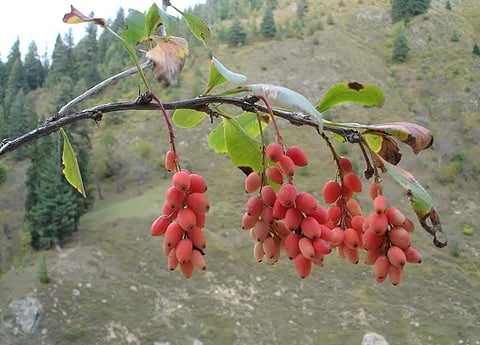


In the hills of Kashmir, summer once meant waiting for wild berries to ripen, and growing up in a forest-fringe village, many of our days were spent wandering through orchards, fields and hillsides with cousins and friends, searching for signs of ripening fruits. Among the most eagerly awaited were the berries of Berberis (Barberry) — a thorny shrub we knew as Kawdach or Sumbal.
Once the fruits turned deep purple, we would gather around the shrubs carefully reaching past their sharp thorns to pluck the tangy berries and eat them by the handful. Girls would even squeeze the juice onto their lips, delighted by the natural purple tint it left behind. For us, the shrub was simply a part of summer — something that grew quietly along slopes and pathways, always ready to offer its sour-sweet fruits.
Years passed but the habit remained. During my field trips across the forests of Kashmir, whenever I came across the patch of barberry, I would still stop to taste its berries — an instinct carried over from childhood. Over time, my casual encounters with the shrub evolved into professional curiosity, and I started observing the various species of barberry growing quietly in forests and along village edges and understanding their ecological role.
Across the Himalayan region, the genus Berberis (family Berberidaceae) is represented by numerous shrubs adapted to dry slopes and disturbed landscapes. Several species occur in Jammu & Kashmir, including Berberis lycium, B. kashmirana, B. huegeliana, B. pachycantha and B. aristata among others. These shrubs are well suited to harsh mountain conditions, thriving in soils where few other plants manage to establish.
In spring, barberry shrubs bear clusters of yellow flowers that later develop into berries turning red or purple as they ripen. The fruits are relished by birds and small mammals, which disperse the seeds across the hillsides, thus quietly supporting the ecological web of mountain landscapes. In this way, shrubs like barberry support wildlife, particularly in disturbed areas where few other species can survive.
The shrub performs another less visible function as well. Its dense and spreading root system helps bind loose soil on slopes and road cuttings. In fragile mountain terrain prone to erosion and landslides, shrubs like barberry act as natural stabilisers. The shrub is also known for its resilience to grazing and disturbance, allowing it to persist in degraded habitats where many other plants fail to survive.
For generations, barberry has also been valued as a medicinal plant. The roots and bark contain berberine, a yellow alkaloid widely used in traditional medicine and as a natural dye in textiles. Scientific studies have shown that berberine possesses antimicrobial and anti-inflammatory properties and may help regulate blood sugar levels.
This makes barberry an important ingredient in several herbal formulations used for treating infections, digestive disorders and metabolic conditions such as diabetes. In traditional medicine, the roots and bark are also used to prepare a medicinal extract known as rasaut (also called rasanjan or rasaunt), widely used in Ayurvedic preparations in India. The extract is traditionally prescribed for skin ailments, liver disorders, jaundice, eye infections and as a blood tonic.
Beyond medicinal uses, the shrub has traditionally served several everyday purposes in Himalayan villages, including fuelwood, live fencing and occasionally fodder for browsing livestock.
Until recently, its use remained largely local. Villagers would occasionally dig out a root or two, leaving most of the shrubs undisturbed. Over the past few years, however, the scale of extraction appears to have changed. Across several parts of Kashmir, barberry has quietly entered the informal trade in medicinal plants. Local collectors now uproot entire shrubs to obtain the roots, which are sold to contractors and middlemen supplying herbal markets beyond the region. The material often fetches modest prices at the collection stage — sometimes only Rs 30 to Rs 50 per kilogram — but its value increases significantly as it moves through the supply chain.
Across the Himalaya, several medicinal plants have followed a similar trajectory — once locally used and largely unnoticed but later drawn into commercial trade as demand for herbal products grows. A recent similar example is Yarrow (Achillea millefolium), which also witnessed wanton extraction from agricultural fields in Kashmir before the trade was eventually brought under regulation by the forest department. Without clear harvesting guidelines, such plants often face intense extraction from the wild before their ecological importance is fully understood.
Similar patterns of extraction have also been reported from parts of Himachal Pradesh and Uttarakhand, where barberry species are collected for the medicinal plant trade. Conversations with locals suggest that the demand for its roots has increased steadily, encouraging more collectors to gather the plant wherever it occurs.
The problem lies not merely in the harvesting but in the method. Since the commercially valuable part lies underground, collectors often uproot the entire plant rather than removing only portions of the root. The result is complete loss of the shrub, leaving behind bare patches of soil. In landscapes where vegetation already struggles to hold fragile slopes together, such extraction can have ecological consequences that are easy to overlook but difficult to reverse.
What was once familiar wild shrub of the hills is gradually becoming a target of extraction.
In some instances, the forest department has intercepted vehicles carrying uprooted barberry collected from forest areas, highlighting the growing concern around its removal. Yet regulating the harvest of the plant remains challenging. Barberry grows not only within forests but also along village commons and agricultural fringes, making enforcement alone difficult.
In India, the harvest and transport of forest produce are regulated under the provisions of the Indian Forest Act, 1927 and associated transit rules. Historically, non-timber forest produce (NTFP) was managed by the forest department through official auctions, with royalties collected for harvested forest produce. In J&K, NTFP trade is now regulated under the J&K Non-Timber Forest Produce Policy 2022, which also oversees its transportation through National Transit Permit System (NTPS) under the J&K Forest (Transit) Rules 2020.
From a regulatory perspective, most Himalayan Berberis species are not currently listed under the appendices of the Convention on International Trade in Endangered Species (CITES), and several species such as Berberis aristata and Berberis lycium are assessed as “Least Concern” on the IUCN Red List due to their relatively wide distribution.
However, unsustainable local extraction can still lead to regional depletion of wild populations. Another challenge is the absence of reliable data. Despite its ecological and medicinal significance, there are currently few baseline studies on the abundance or regeneration status of Berberis in Jammu & Kashmir or the Himalayan region. Its presence outside forests is already declining in several places due to land-use changes, road construction and agricultural expansion. Without such information, it becomes difficult to determine how much harvesting is sustainable or whether restrictions may be required.
The solution lies not only in enforcement but also understanding the plant itself. Sustainable harvesting protocols, better monitoring and community participation through Biodiversity Management Committees (BMCs) could help reduce pressure on wild populations. Propagation in forest nurseries may offer a practical solution. Raising barberry in forest nurseries could support restoration efforts and provide a regulated source of planting stock. During my previous posting in Kupwara, I experimented with raising a small nursery bed of barberry through cuttings, and the results were encouraging.
For many people in Kashmir, barberry still evokes memories of childhood summers. Today, however, the same plant is increasingly exploited for its roots rather than appreciated for the berries it once offered so freely.
If the growing demand for its roots continues unchecked, the quiet shrub that once fed children and birds alike may gradually disappear from many of the slopes where it has grown for generations.
Mir Faizan Anwar is a Range Officer with the J&K Forest Department and a wildlife enthusiast
Views expressed are the author’s own and don’t necessarily reflect those of Down To Earth
