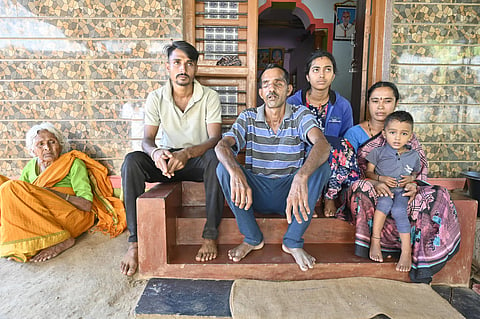


Madhava Gowda no longer greets the day by its first light. He now senses its arrival through sound. His life changed irreversibly on the morning of October 16, 2025, when he entered his field on the forested edge of Saragur taluk in Karnataka’s Mysuru district.
In his village, Badagalapura, fields give way to scrub, and scrub to bamboo thickets and dense woodland. The boundary between cultivation and wilderness is narrow and often indistinct. Gowda and other village residents have long farmed this landscape and learned to navigate its hazards. But on that day, residents say, Gowda was working in his field when a tiger lunged at his face. By the time neighbours arrived, drawn by his screams, he had suffered catastrophic injuries. Both eyes were beyond saving, leaving him permanently blind.
At home, Gowda’s wife, Indrani, became a full-time caregiver overnight. “We never imagined that stepping into our own land would cost him his eyes,” she tells Down To Earth (DTE). “There is no income now. I cannot leave him alone even for an hour. Children who once watched their father plough now guide him by the hand.”
Badagalapura was already living in fear before Gowda was attacked. His mauling came amid repeated tiger movements in Saragur taluk, which borders large tracts of the Bandipur Tiger Reserve. Farmers had begun avoiding work at dawn. Women stopped children from walking to school alone. Dusk came to feel more threatening. After the attack, fear changed to anger. Residents blocked roads and confronted forest officials. Why, they asked, had warnings not been issued earlier? Why had known wildlife corridors gone unmonitored? Why were they repeatedly being told to “coexist” while risking their lives?
The Karnataka government announced compensation for Gowda, recognising his injury as permanent disability, and promised lifelong medical support. But compensation alone cannot address the deeper problems confronting Saragur.
Ten days later, on October 26, 2025, Rajashekarappa, a marginal farmer and cattle herder from Bennegere village which comes under Mullur gram panchayat, walked into an open grazing patch near his home one afternoon when a tiger emerged from the scrub and went straight for his neck, dragging him into cover. By the time village residents reached the spot, Rajashekarappa was dead.
In his mid-50s, Rajashekarappa was the sole breadwinner for his family. What angered relatives as much as the attack itself was the apparent absence of any official response. Holding up his phone as proof, his son, B R Sivanand, tells DTE: “We kept calling. The forest office, the helpline—everyone whose number we had. No one answered. My father was alive when the attack happened. If help had come on time, maybe he would still be here.”
Sivanand wants criminal action against the forest officials who, he says, failed to respond. “They talk about protocols after people die. What about accountability before that? If a farmer breaks a rule, he is punished. When officials ignore distress calls, who answers for that?”
Protests followed. Roads were blocked. Farmers’ organisations filed police complaints against senior officials, including the forest minister, alleging negligence. The anger reflected a growing belief that rural communities were bearing the costs of a conservation system that intervenes only after tragedy strikes.
On November 7, 2025, Dhana Naika, known locally as Swamy, a small farmer from Eggudu, also known as Hale Heggudilu, near the Nugu Wildlife Sanctuary, left home to plough his field with a pair of oxen. Only the animals returned, still tethered. Later that day, Naika’s body was found near the forest edge, partially consumed. Forest officials confirmed that a tiger was responsible. He was survived by his wife, Rukmini, three daughters and his elderly mother.
“He left home like every other day,” Rukmini tells DTE, sitting beside her children. “Now I have to be both father and mother to my girls and look after my mother-in-law. We are poor farmers. We have nothing saved. If the fields are dangerous, how do we live? If we do not go, we starve. If we go, we die.”
In less than a month, Saragur taluk had witnessed permanent blindness, multiple deaths and repeated near-misses. Fields were left unattended. Village residents moved in groups. Agricultural work slowed sharply.
Saragur is not an exception. It is a warning, human–animal conflict in Karnataka has moved far beyond forest fringes. It is now a state-wide rural economy crisis. Forest Department records show more than 35,500 wildlife conflict incidents in 2024-25, with elephants accounting for over 22,000 of them. These numbers record what is reported, not what is endured. They do not capture fear, sleepless nights, abandoned harvests, labour shortages, or the slow accumulation of trauma.
The geography of conflict now spans the Nilgiri Biosphere spillover districts of Mysuru and Chamarajanagar, the tract of Bandipur-Nagarahole-Biligiri Ranganatha Swamy Temple (BRT) wildlife sanctuary, the coffee and areca nut slopes of Chikkamagaluru and Kodagu, the Kudremukh-Sringeri landscape, and parts of Hassan, Ramanagara and Tumakuru.
Across these regions, farmers describe a reordered agricultural life. Crops are chosen based on animals. Work timings follow wildlife movement. Labourers refuse to enter fields at dawn or dusk. Guarding has become a night economy with torches, crackers, watchtowers, and sleepless shifts.
In Chikkamagaluru district, repeated elephant incursions have triggered shutdowns. In July 2025, a farmer’s death led to a voluntary bandh across Balehonnur, Khandya, Huyigere, and Devadana. Later that year, on October 31, two men, Umesh and Harish Shetty, were killed in the Kerekatte range of the Kudremukh Wildlife Division. The elephant involved was later captured.
Such captures bring temporary calm. They are done after the damage
Forest officials point to over 400 kilometres of rail barricades, solar fencing, trenches, drones, radio collars, AI cameras, and digital alert boards. Conservationists argue that these measures falter when highways, rail lines, plantations and settlements squeeze wildlife corridors beyond repair.
“Tigers and elephants are adapting faster than governance,” says Joseph Hoover, a senior conservation biologist working in the Bandipur–Nagarahole landscape. “This is no longer about animals straying. It is about fragmented habitats and pressure building silently.”
Environmentalists warn that conservation built on continuous rural sacrifice will not endure. “Wildlife recovery is a success story,” says Y Ramesh, an environmentalist based in Mysuru. “But success without justice breeds resentment. You cannot protect forests by making farmers feel disposable.”
Ramesh argues that Karnataka’s response has become excessively reactive. “Every conflict is treated as a law-and-order problem or a wildlife control issue. Capture, translocation, compensation. None of these addresses why animals are entering fields in the first place,” he said. “We have fragmented habitats, degraded corridors, shrinking water sources inside forests, and aggressive land-use change around reserves. Unless these ecological stresses are repaired, conflict will only intensify.”
Several conservation scientists echo this view, stressing that long-term solutions lie not in isolating animals but in restoring landscapes. This includes reviving forest, water bodies, protecting and widening wildlife corridors, regulating linear infrastructure such as highways and railways, and rethinking plantation expansion along forest edges. In many conflict-prone zones, invasive species have choked native forage, pushing animals outward in search of food.
Beyond elephants and tigers, farmers face relentless damage from deer, gaur, monkeys, peacocks, parrots, and rodents. Ginger uprooted, tubers grazed, fruits stripped bare. These rarely make headlines, but their cumulative impact is devastating.
Studies using Karnataka’s e-Parihara compensation data show wildlife conflict now spans thousands of villages. In coffee and areca nut belts, annual losses of Rs 50,000 to Rs 1.5 lakh per household are common, damaged infrastructure, and labour refusal are accounted for.
Mahesh Bargi, a Chamarajanagar-based farm leader, says symbolic action has replaced structural response. “Every death brings compensation, protests, and one captured animal. Then everything returns to the same unsafe routine,” he says.
While crop insurance now covers losses due to wild animal attacks, Bargi says, “What farmers need are scientific, long-term solutions. Permanent monitoring in conflict zones. Real-time alerts that reach workers before dawn. You cannot talk of coexistence without safety and dignity.”
Equally critical, experts say, is rebuilding trust with farming communities. What farmers resist is not conservation, but uncertainty. The absence of timely warnings. The silence after distress calls. The normalisation of loss.
In Saragur, people say the danger is not only the tiger. It is the unanswered phones, delayed response, and the erosion of confidence in institutions meant to protect both people and wildlife. Karnataka stands at a crossroad. Coexistence already exists, but it is fragile and unequal. If conservation continues to rely on compensation after death and capture after damage, it will deepen fear and resistance. If it is rebuilt around ecological restoration, corridor protection, early warning systems, and human dignity, there is still a chance. The forest has entered the field. The question now is whether governance will enter with foresight or will continue to arrive only after tragedy.
This article is part of the series Conflict in the Backyard. A version of it was published in the cover story, Conflict in the Backyard, in the May 16-31, 2026 print issue of Down To Earth