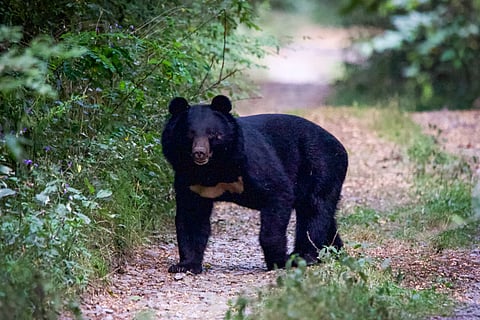


In Kashmir, encounters between Asiatic black bears and people are rising as habitats shrink and apple orchards expand closer to forest areas.
Farmers, shepherds and orchard workers say bear attacks are leaving survivors injured, traumatised and unable to return to work.
Conservationists link the conflict to land-use change, poor waste management, warmer winters and disrupted hibernation patterns.
Wildlife officials say control rooms, compensation and awareness programmes are in place, but communities living near forests continue to face daily risk.
In the summer of 2024, Bashir Ahmed Chopan, 26, was working in his apple orchard in Watshan Manigam, a rural area in Ganderbal district of central Kashmir, when a black bear attacked him.
The bear’s claws tore through his face, slashing his cheeks and forehead. His lips were split and bleeding. Chopan collapsed and was taken to the emergency ward of Sher-i-Kashmir Institute of Medical Sciences in Srinagar.
He underwent multiple surgeries, including plastic surgery to repair injuries to his face, left eye and right thigh.
Shabir Ahmed Choudhary, 50, a shepherd from Anderwan village in Ganderbal, survived a similar attack. He needed more than 20 stitches in his right foot after trying to save his herd from a bear near a forest. “It is no longer about whether we wander near forests or not,” Choudhary says.
“Bears have made our lives a nightmare. They killed five of my goats, leaving me with nothing.”
He says bears lurk in apple orchards in the mornings and evenings and attack livestock at night outside homes. “We live in fear, unable to sleep or work in our fields. Even the women in my family are too terrified to fetch firewood for cooking,” he tells Down To Earth.
Researchers and conservationists say human-bear encounters are increasing across Kashmir as habitats shrink and land use changes.
Farhan Nazir, a local researcher who has documented the intensifying human-bear conflict in Ganderbal district, says the rising frequency of attacks is linked to habitat loss and disruption of the region’s ecological balance.
“When we push into the wild, we break the boundaries that keep both animals and humans safe. Unfortunately, those lines have all but vanished in places where human-bear conflict is rampant,” says Nazir.
He says the expansion of horticulture, along with homes built in traditional wildlife corridors, has turned once-stable landscapes into conflict hotspots.
“Every encounter we see in our fields is a sign of a habitat in distress, turning a shared landscape into a place of growing fear for both local families and wildlife,” he adds.
The impact on survivors is long-lasting. Kalas Irshad Ahmad, 38, from Wangat village in central Kashmir, was mauled by a bear. The attack left him with a twisted nose, damaged lips and scars that have made it difficult for him to speak normally. He is now fully disabled and unable to return to the farm labour that supported his family.
“I am crippled for life with the shame of not being able to do anything for my family due to my physical disability,” he says.
Ahmad received Rs 5 lakh in compensation from the Wildlife Protection Department of Jammu and Kashmir. But he says the amount is not enough to rebuild a livelihood.
There is also a gendered pattern to the attacks. Most victims are men because they are more likely to enter forests and orchards for work.
“The attacks are male-centric as more men enter forests and apple orchards for heavy tasks like spraying pesticides,” says Mehreen Khaleel, a researcher based in Srinagar who studied human-wildlife conflict while at the Centre for Cellular and Molecular Biology in 2021-22.
“Women focus more on vegetables or apple-picking. The risk is even higher for elderly men,” says Khaleel, who also runs the non-profit Wildlife Research and Conservation Foundation.
The Asiatic black bear usually hibernates from November, when temperatures fall, snow becomes heavy and forest food such as rosehip seeds becomes scarce. The animals usually emerge in spring.
But conservationists say that pattern is changing. In recent winters, some bears have remained active, and the hibernation period has reduced from about six months to two or three in some areas.
Wildlife conservationist Kashif Bhat, based in Srinagar, says he has seen signs of bear activity in December in Dachigam National Park, including scat, pugmarks and direct sightings.
According to Bhat, bears are coming down even in peak winter and entering human settlements, increasing the risk of conflict.
Land-use change is also playing a role. Bhat says many farmers in Kashmir have shifted from traditional crops such as paddy and maize to apple cultivation. Land close to protected areas, including Dachigam National Park, is now dominated by apple orchards.
“This attracts the bears. The nearest village is only half a kilometre away from Dachigam,” he says.
Waste from apple orchards is another problem. Dumped apples, thrown away after sorting, attract black bears towards settlements.
Shabir Hussain Bhatt, a naturalist hired by the Jammu and Kashmir Wildlife Department, has worked in Dachigam for nearly 17 years. “The hibernation of bears depends on snowfall. It should ideally start in December, but lately it is either late or lighter. Without it, bears raid villages, even distant ones, for easy food,” he says.
There are about 100 black bears in Dachigam, according to Bhatt.
Jammu and Kashmir’s Department of Wildlife Protection reported 67 deaths and 940 injuries from bear attacks over five years, according to 2023 records analysed in the Journal of Threatened Taxa and cited in a 2025 media feature, Life in the Shadow of the Kashmir Human-Bear Conflict.
The wildlife department says 25 control rooms have been set up at strategic points. These are equipped with tranquiliser guns, medicines, capture nets and cages. The department also runs awareness and sensitisation programmes.
Departmental data from the office of Tawheed Ahmad Deva, regional wildlife warden for the Kashmir division, shows that four people died in bear attacks in 2024-25 and three in 2025-26. During the same period, 134 bear attacks on humans were recorded.
In 2024-25, Rs 20 lakh was paid as compensation for deaths and Rs 72 lakh for injuries. In 2025-26, compensation for injuries stood at Rs 97 lakh.
The compensation amount is Rs 5 lakh in cases of death or permanent incapacitation and Rs 2 lakh for grievous injury.
Aaliya Mir, programme manager at Wildlife SOS in Kashmir, says while human-bear interactions have increased due to changing land use, expanding horticulture, and poor waste management that attracts bears into human-dominated landscapes, the severity of conflict ( human deaths or injuries or animal deaths or injuries) has declined.
“Through multidisciplinary interventions, habitat management, public outreach, and rapid response efforts, we have been able to significantly reduce human injuries and fatalities associated with these encounters,” she adds.
She says distress calls to Wildlife SOS have increased because of better communication and greater public trust, which has helped prevent vigilante action. But the conflicts themselves have also risen.
Crop losses are a major concern. “Bears destroy entire apple trees, wiping out five years’ fruit yields all at once. Human deaths and injuries spark anger in people. Garbage mismanagement, like dumped apples, worsens the issue,” Mir says.
She says most conflicts occur in Kashmir’s southern division, where orchards dominate.
Government officials say apple cultivation is central to Kashmir’s rural economy. Syed Muddassir Hussain Shah, a subject matter specialist and district officer in the horticulture department in Poonch, says 90% of apple cultivation is in the Kashmir division, compared with the Jammu division.
He says government schemes subsidise horticulture across the region, not only apples but also citrus fruits, grapes, almonds, walnuts, kiwis, dragon fruit and cherries. But farmers mostly prefer apples because it is an established industry.
Mohammad Amin Bhat, technical officer in the directorate of horticulture in Kashmir, says apples bring higher profits than other crops.
He says the government is also promoting high-density apple orchards, which offer greater resilience to climate change, along with training, technical guidance and irrigation facilities.
“The bear attacks are mostly in the higher regions of Kashmir where traditional apple orchards dominate. High-density orchards are mostly established in lower altitudes due to better water availability,” he says.
Bhat adds that government incentives are not driving the conflict, as most farmers in Kashmir have been growing apples for the past four to five decades.
For families living close to forests and orchards, however, the risk is now part of daily life.
As bear encounters continue in this ecologically sensitive Himalayan region, experts say conservation and rural planning must take account of changing climate, shrinking habitats, waste management and the spread of orchards near forests.
For survivors like Ahmad, the damage is both physical and psychological.
“When the bear left, it took more than just my face,” he says. “It took away the man I used to be, who could look at the sunrise without trembling.”
This article is part of the series Conflict in the Backyard. A version of it was published in the cover story, Conflict in the Backyard, in the May 16-31, 2026 print issue of Down To Earth.
