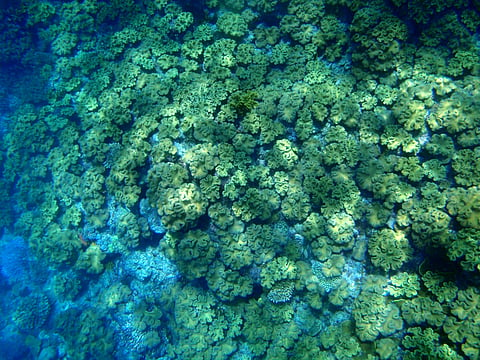


Coral reefs are facing bleaching events more frequently, leaving them less time to recover between periods of severe heat stress.
Global hard coral cover has declined by an estimated 9.5% compared with the 1980–2009 reference period, the GCRMN report said.
More than 40% of reefs experienced heat stress severe enough to risk bleaching and mortality in 2024.
The report warned that marine heatwaves, driven by climate change and compounded by local pressures, could push reefs towards sustained decline.
Coral reefs around the world experienced increasingly frequent bleaching events, leaving them little time to recover before another episode of severe heat stress struck, according to the latest global assessment of coral reefs.
The seventh Status of Coral Reefs of the World report by the Global Coral Reef Monitoring Network (GCRMN) said recovery periods had shortened dramatically, with major disturbances occurring every four to six years in many regions after 2010, compared with roughly once a decade in the past.
Global hard coral cover had fallen significantly and reefs faced the risk of sustained and potentially irreversible decline, the report warned.
Released on August 31, the report was the most comprehensive global assessment of coral reefs undertaken to date. It drew on 21.1 million observations from 87,299 surveys at 36,886 reef sites between 1980 and 2024. GCRMN is the world's premier coral reef data network.
The report examined long-term changes in hard coral and macroalgal cover across the world’s shallow, warm-water coral reefs and included detailed assessments of all 10 regions covered by the GCRMN.
“Coral cover has decreased substantially, with an estimated average loss of ~9.5 per cent (ranging from 4 to 14.5 per cent) relative to the reference period (1980–2009), and a pronounced stepwise decline since 2010,” the report said.
It said the pattern closely followed the increasing frequency, intensity and geographical extent of marine heatwaves driven by human-caused climate change, which had contributed to four global coral bleaching events since 1998.
The report warned that without significant reductions in greenhouse gas emissions, global warming would exceed 2 degrees Celsius and marine heatwaves would persist and intensify, causing further declines in coral reefs.
Marine heatwaves, compounded by local human and environmental pressures, had pushed coral reefs towards sustained global decline, it said. As the time available for reefs to recover became shorter, degradation was likely to continue unless there was urgent action to reduce emissions and manage local pressures.
The report noted that 2023 and 2024 were the two warmest years on record at the time, with 2024 becoming the first calendar year in which the global average temperature exceeded 1.5°C above pre-industrial levels.
Coral reefs were particularly vulnerable to heat stress during summer marine heatwaves. Sea-surface temperatures over coral reefs worldwide rose by 0.81°C between 1985 and 2025, the report said. Marine heatwaves had become the single strongest driver of coral-cover decline worldwide, with their frequency and severity amplified by global climate change, it underlined.
In 2024, 87 per cent of reefs experienced unprecedented heat stress and more than 40 per cent experienced levels of heat stress associated with a risk of coral mortality, the report said. It measured accumulated heat stress using degree heating weeks (DHW). A value of 4°C-weeks or more is associated with significant bleaching, while 8°C-weeks or more can cause widespread bleaching and mortality.
More than a quarter of the world’s reef areas experienced heat stress of at least 4°C-weeks on four or more occasions between 2019 and 2025, meaning near-annual bleaching stress had become a reality across a substantial proportion of the world’s coral reefs, the researchers found.
The authors said estimates of the effects of the fourth global mass bleaching event were likely to be conservative because the report’s coral-cover data extended only to 2024 and therefore did not capture its full impact through 2025.
Even so, global hard coral cover was estimated to have fallen by 8.9 per cent between 2023 and 2024, the largest single-year relative decline recorded to date.
“With 42.6 per cent of the world’s coral reefs exposed to heat stress severe enough to risk reef-wide bleaching and mortality (DHW ≥ 8 °C-weeks) in 2024, and 27.4 per cent in 2025, global average hard coral cover is likely to continue declining from 2025 onwards, suggesting the fourth global bleaching event is on track to be the most severe event recorded to date,” the authors warned.
The fourth global mass bleaching event began in 2023, reached unprecedented levels of heat stress in 2024 and was thought likely to have ended in 2025. It was described as the fastest and most widespread global bleaching event on record.
Since 1998, the world had experienced four major global bleaching events. Each was associated with an estimated 6.5 per cent to 9.9 per cent relative loss in average global hard coral cover. The periods when the largest proportions of reefs experienced severe heat stress were 1998-99, 2010-11, 2016-17 and 2023-24.
The effects varied significantly between regions and individual reefs. In the US Virgin Islands, about 53 per cent of corals bleached across 33 surveyed reefs and coral cover declined by 47 per cent, the report said. In the Dominican Republic, about 70 per cent of reefs were left with less than 5 per cent coral cover.
“In Belize, heat stress caused catastrophic impacts where >90 per cent of wild and restored acroporids died and long monitored sites collapsed to <5 per cent coral,” the report said. “Across the Mesoamerican Region, ~30 per cent of colonies died.”
Research at Puerto Morelos in Mexico found that the 2023 marine heatwave eventually resulted in 100 per cent mortality of Acropora palmata, an important reef-building coral, in the area studied. “Acropora were most affected, with wild and restored populations suffering rapid tissue loss and near complete collapse in several countries,” it said.
In the ROPME Sea Area — formerly known as the Kuwait Action Plan Region and covering parts of the Gulf and surrounding waters — reefs lost about half of their hard coral cover between 2020 and 2024 compared with the 1980-2009 reference period, the report said.
Hard coral cover in the Caribbean had begun declining in the 1980s, and the impaired functioning of reefs in the region had been extensively documented, it added.
The report said average hard coral cover in 2024 stood at about 15 per cent in the ROPME Sea Area and 7.1 per cent in the Caribbean. Such low levels indicated that reef functioning could already have been compromised and that future recovery could be constrained by smaller and increasingly isolated coral populations.
Australia and the Pacific also recorded moderate declines over the reporting period, particularly after the third and fourth global bleaching events, though the losses were not as severe as those recorded in the Caribbean and ROPME Sea Area.
The authors warned that simulations of future coral-cover trends showed that shorter recovery periods between major disturbances would lead to continued declines in global coral cover.
“When the frequency of major disturbances exceeds historical patterns, the decline in coral cover is expected to be more severe than currently documented in this report,” the report said.
